
Technologies · Composite
Terrazzo
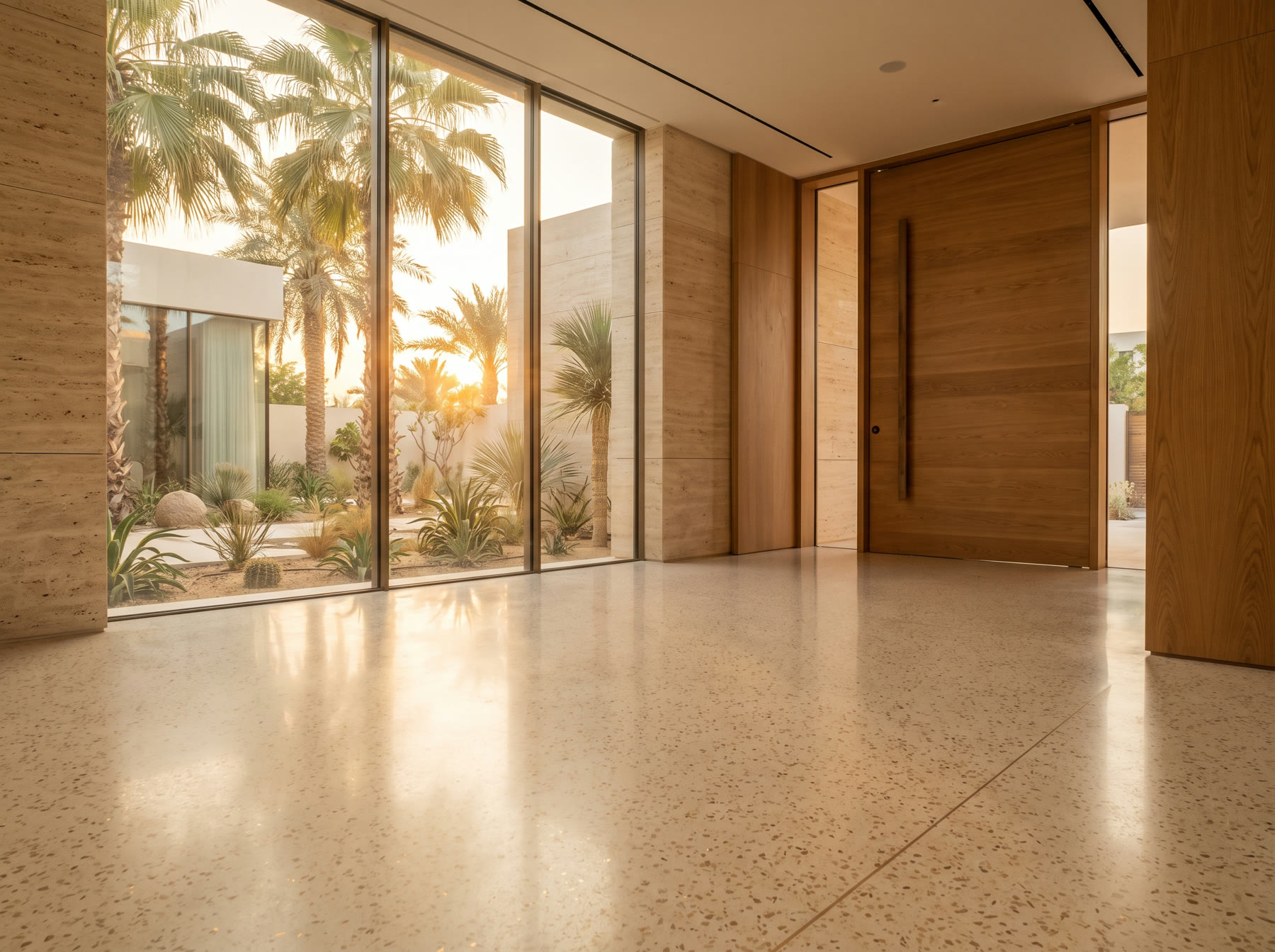
Marble and stone chips scattered through a binder, then ground and polished to a soft, speckled sheen — a floor with centuries of Venetian craft in every fleck.
What it is
Terrazzo is a floor made of fragments. Chips of marble, granite and stone are folded into a binder — traditionally cement or lime — poured in place, then ground back and polished until the surface turns smooth as glass. What was once a scatter of loose pieces becomes one continuous, speckled plane — cool underfoot, quietly luminous, and unlike any other floor in the world.
Its charm lies in the freedom. The chips can be fine and subtle or bold and generous, the colours soft and pale or deep and dramatic. Chosen well, terrazzo carries light beautifully, giving a room a sense of depth and calm. And because it is ground and polished as one piece, it flows seamlessly through a space, with no lines to interrupt the eye.
Where it comes from
Terrazzo was born in the villas and workshops of Venice, where marble-cutters set the offcuts too small to sell into the floors of their own homes. In time this thrift became an art. The Venetians perfected the seminato, the fine speckled floor, and the grander palladiana, with its bold shards of marble laid like a mosaic. Centuries on, that same patient craft still gives terrazzo its unmistakable, timeless character.
How thick is a terrazzo floor?
Traditional cement terrazzo is a real screed layer, typically laid around 20–25mm thick over its base — thick enough to hold a full depth of chips and survive repeated grinding and re-polishing over decades. That thickness is also why it is heavy, and why an upper floor or a renovation with no room to raise the finished level often calls for epoxy terrazzo instead, a resin-bound version laid a few millimetres thick with none of the structural load.
Cement terrazzo, epoxy terrazzo or terrazzo tiles?
The word “terrazzo” covers three different ways of getting the same speckled look, and the right one depends far more on the building than on taste.
| Cement terrazzo (poured) | Epoxy terrazzo (poured) | Terrazzo tiles | |
|---|---|---|---|
| How it is laid | Poured on site, cured, then ground and polished in place | Poured on site as a thin resin layer, then ground and polished | Made in a factory, laid and grouted like any tile |
| Joints | None — divider strips only where you want them as design | None — divider strips only as design | Grout joints between every tile |
| Thickness and weight | A real screed, around 20–25 mm, and heavy | Roughly a centimetre or less, and light | Depends on the tile; cement tiles are heavy |
| Upper floors and renovations | Often too thick and heavy | The usual answer | Possible, at the tile’s own thickness |
| Indoors or outdoors | Both — outdoors with a textured finish | Interiors only — epoxy ambers in direct sun | Cement or outdoor-rated tiles outside; resin tiles indoors only |
| Time on site | About 10–15 days, including the cure before grinding | Faster-curing than cement | The quickest for a small room |
| Best for | Ground floors, villas, terraces, the traditional look | Lobbies, retail, upper floors, brighter colours | One small room, a tight budget, a bathroom in look-alike porcelain |
Poured terrazzo of either kind is priced per project after a site visit. The full comparison of the binders is in cement, epoxy or polyester terrazzo, and the tile question — real cement tiles, resin tiles or terrazzo-look porcelain — is answered in terrazzo tiles in Dubai. For the resin version see epoxy terrazzo.
Where terrazzo suits — and where it doesn’t
Terrazzo is one of the few floors that is genuinely at home in a UAE villa: cool underfoot through the summer, forgiving of the fine sand that comes in on shoes, and able to run unbroken from the entrance hall through the living room. Its limits are just as real, and we would rather you heard them before the pour than after it.
- Living rooms, halls and staircases: the natural home of a polished terrazzo floor. Matching treads and risers look excellent; ask for a honed tread or a non-slip nosing on stairs.
- Kitchens: a good floor, with one caution — marble chips etch on contact with lemon, vinegar and harsh cleaners. A seal slows that; wiping spills promptly matters more.
- Bathrooms and anywhere wet: honed, not polished. A polished terrazzo floor is slippery when wet, in the same way polished marble is.
- Upper floors and renovations: a cement pour is often too thick and too heavy, so the answer is epoxy terrazzo, laid thin, rather than forcing a screed the structure was never designed to carry.
- Terraces and pool surrounds: cement terrazzo with a textured finish — never polished, and never epoxy, because epoxy ambers under direct sun.
- One small room on a tight budget: a poured floor prices high per square metre in a small room, and tiles can be the sensible spend. Is terrazzo worth it runs through that honestly.
If the speckle is not essential and what you really want is a calm, seamless floor in a home, microcement may suit better — it looks like smooth stone or concrete, not terrazzo, and it is for homes and normal-use rooms only.
How a poured terrazzo floor is laid
A poured terrazzo floor is built in place, and most of the time on site is spent waiting and grinding rather than pouring:
- The base is checked and prepared. The slab has to be sound and level enough for the build-up; this is decided on the site visit.
- Divider strips are set out, where the design wants them — to separate colours, mark a pattern or follow the room. In a poured floor they are a design choice, not a necessity.
- The terrazzo mix is poured — the chips in their binder — and levelled across the floor.
- It cures. A cement pour has to cure before it can be ground; that wait is part of why a poured floor typically takes 10 to 15 days, including the cure before grinding and polishing.
- Grinding passes with progressively finer tooling open up the chips and flatten the surface, until the floor reads as one continuous, speckled plane.
- Polish and seal to the sheen you chose — polished for living areas, honed where the floor gets wet.
Once it is down, the care is simple: dry-mop the sand first, then a pH-neutral cleaner, never acid, bleach or vinegar. The full routine is in how to clean and maintain a terrazzo floor, and chips, cracks and dull patches are covered in terrazzo repair. RBS is responsible for every job, from the site visit to the final polish.
Terrazzo: the short answers
Is terrazzo still made? Yes — poured on site in cement or epoxy, and as factory-made tiles. The two get confused; is terrazzo still made explains the difference.
Can terrazzo go on stairs? Yes. Treads and risers in matching terrazzo are one of its classic uses; choose a honed tread or a non-slip nosing so the stair grips.
Is terrazzo good in a bathroom? It can be, in a honed finish and sealed. Polished terrazzo is slippery when wet, so it does not belong on a bathroom or shower floor.
Can terrazzo go outdoors in the UAE? Cement terrazzo can, with a textured finish. Epoxy terrazzo cannot — it is an interior floor, because epoxy ambers in direct sun.
How long does terrazzo last? It is one of the longest-lived floors there is. Because the chips run through its full depth, a worn or etched floor can be ground and re-polished as one surface decades later instead of being replaced.
Do you make terrazzo countertops or vanities? No. We pour terrazzo floors. Precast terrazzo worktops, vanity tops and furniture are made in a workshop by a fabricator, and a fabricator is the right person to ask.
Is terrazzo better than tiles? It depends on what you want underfoot. Poured terrazzo has no grout lines, so there is nothing for dirt to sit in, and a worn floor can be ground and polished again instead of being pulled up. Tiles are quicker to lay, can be replaced one piece at a time, and suit a budget or a floor that must be lifted later. RBS pours terrazzo; it does not lay tiles, and when tiles are the better choice for your space we will say so. The side-by-side is in the table above and in terrazzo tiles in Dubai.
What decides the price of a terrazzo floor? The area, the chips and their size, the binder (cement or epoxy), the state of the base and how much grinding it needs. None of these can be judged from a photo alone, so a terrazzo floor is priced per project after a site visit.
How do I look after a terrazzo floor? Dry-mop first, then use a pH-neutral cleaner and a damp mop; never acid, bleach or vinegar, which etch the polish. Wipe spills quickly. The full routine is in terrazzo care and cleaning.
How much does terrazzo cost? Poured terrazzo is priced per project after a site visit — the area, the chips, the binder and the base all move the figure. What drives it is explained in the terrazzo cost guide.
Planning a terrazzo floor? Send a photo of the space and its rough size on WhatsApp, or call +971 4 587 7086 — we will tell you honestly whether cement terrazzo, epoxy terrazzo, tiles or another floor suits it.
Start a project
Considering Terrazzo for your space?
Tell us about your project on WhatsApp and we'll take it from there.