
Technologies · Composite
Microcement
A thin, jointless mineral coating that flows seamlessly across floors, walls and even wet areas — contemporary, continuous, calm.
What is microcement?
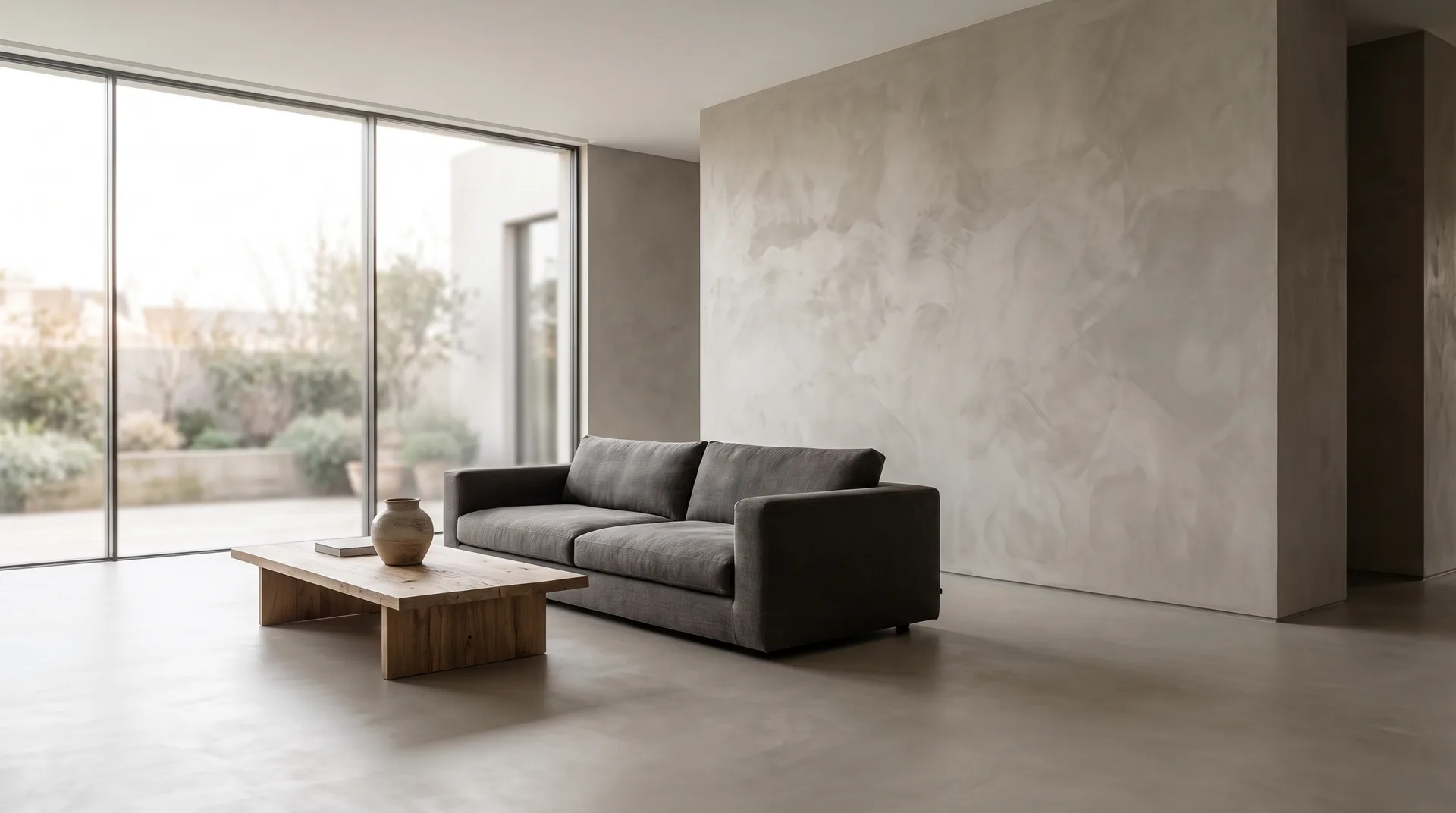
Microcement is a thin, polymer-modified cement coating — about two to three millimetres thick — trowelled by hand into a smooth, seamless surface and sealed, used on floors, walls, stairs and bathrooms in homes and normal-use rooms. Because it is so thin, it can wrap floors, walls, stairs and even bathrooms in one continuous mineral skin, often laid straight over what is already there. No grout lines, no joints: just a calm, contemporary finish with a soft, cloudy movement all its own.
Microcement in short: what it is, where it goes, where it does not
Microcement is a thin cement-based coating, a few millimetres thick, applied by hand over an existing floor or wall to leave one seamless surface with no grout lines. In the UAE it suits homes and normal-use rooms: living areas, bathrooms, kitchens, staircases and feature walls. It is not for heavy-use floors, and outdoors only in the outdoor-rated colours of the range (terraces, balconies and outside walls, never driveways). Pricing is on the city pages: microcement in Dubai and microcement in Abu Dhabi.
Where it comes from
Born from béton ciré — “waxed concrete” — microcement took the raw beauty of polished concrete and made it light, thin and liveable. RBS applies its own Micro-C, a professional Italian microcement system finished by our crews — mostly indoors, and outdoors in the colours of the range rated for outside use.
Planning a project? See our practical guides to microcement in Dubai, microcement in Abu Dhabi and microcement bathrooms — with real starting prices and how we build the surface.
Micro concrete, microtopping vs microcement: the same material?
Yes. Micro concrete, microtopping, micro topping, micro cement and microcemento are all names for the same material described above — a polymer-modified cement coating applied at two to three millimetres and sealed. “Microcemento” is simply the Spanish word, from the market that popularised the finish; “microtopping” is the name several international product lines use; “micro concrete” is a looser UAE label that describes the look rather than the chemistry. None of them is a thicker, stronger or cheaper version. What does differ between one supplier’s system and another’s is the binder quality, the sealer and, above all, the hands applying it.
One name that sounds the same is a different product: flowable micro concrete (also sold as free-flow micro concrete) is a structural repair grout, poured into formwork to rebuild or jacket damaged concrete columns, beams and slabs. It is engineering work for a structural contractor, not a decorative finish, and RBS does not do it. If a column or slab is cracked or spalling, have it assessed and repaired first; microcement can then go over the sound, repaired surface.
Micro concrete specifications: thickness, layers and the material
A microcement system is specified as a build-up, not a single product. Total thickness is typically 2–3 mm across four coats: two base coats of a coarser, fibre- or mesh-reinforced cement mix for strength and adhesion, then two fine finish coats that carry the colour and the trowel movement. On floors the base coats are the higher-strength grade; on walls a lighter grade is enough. Over that sits a sealer — a wear-grade sealer for dry areas, an immersion-grade one for showers and pools — which takes the wear and the water so the mineral coat never has to. The material bonds to concrete, screed, sound tiles, plasterboard and blockwork once primed; it does not bridge cracks or movement joints, and it is not a levelling compound.
The application procedure: how microcement (micro concrete or microtopping) application works
The procedure is the same under every name, and it runs on cure times rather than effort:
- Substrate check and preparation — sound, dry, flat; loose tiles re-fixed, cracks treated, movement joints respected, everything primed.
- Tanking in wet zones — a waterproofing membrane before any cement goes on.
- Mesh embedded in the first base coat where the substrate could move.
- Two base coats, each cured and sanded before the next.
- Two finish coats of the coloured microcement, hand-trowelled; this is where the cloudy movement is made and where skill shows.
- Sealing — two or more coats of the correct sealer, cured before use.
A room takes four to seven days because most of that time is curing, not trowelling.
How to do micro cement — and can you do it yourself?
The steps above read simply; the results do not. Every coat has a working window measured in minutes in UAE heat, the trowel pressure decides the pattern, and the sealer is unforgiving of dust, humidity and haste. We do not sell kits and we do not recommend the ones sold online — the honest reasons are in can you DIY microcement?
Micro concrete uses: where microcement belongs, room by room
Floors — also called micro topping floor or micro concrete flooring
The main use. Living rooms, corridors, bedrooms and whole villa floors, laid over tiles or screed with about 3 mm of added height and no joints. It is a floor for homes and normal-use rooms, not for heavy use: busy commercial floors, garages and workshops need a different floor, and we will say so.
Walls and feature walls — also sold as micro topping wall systems
Feature walls, whole rooms, fireplace surrounds and the walls of kitchens and bathrooms. For a wall that only needs colour, paint is the cheaper answer and we say so. What a microcement wall looks like up close, its texture options and the rooms where it earns its rate are in our guide to the microcement wall finish.
Bathrooms, showers and pools — the micro topping bathroom use case
Excellent when tanked and sealed for immersion — the seamless wet room is one of the best things the material does. Skipped tanking is the source of nearly every bathroom failure story.
Kitchens — micro concrete kitchen and microcemento kitchen surfaces
Floors, walls and splashbacks without reservation, with prompt wiping and pH-neutral cleaning. We apply microcement to floors, walls and ceilings only — not to worktops, islands, vanities or furniture; for a worktop, a stone, quartz or porcelain slab from a fabricator is the right choice.
Stairs
Treads, risers and the floors they connect as one surface, provided the nosing and the grip are detailed rather than improvised.
Outdoor use: microcement (microtopping) on exterior surfaces
Yes, in the right colour. Part of our microcement range is rated for outdoor as well as indoor use; the rest is indoor-only, and we say which is which when you choose the colour. Outdoors we use the outdoor-rated colours on terraces, balconies and outside walls with normal foot traffic. It is never for a driveway or anything that takes cars, and in the UAE sun the sealer works harder outside than indoors, so an outdoor surface needs its care more often. For driveways we point clients to resin bound stone carpet instead.
What is microcement made of?
Cement, very fine mineral aggregate, polymers that give it grip and flexibility, and pigment for the colour — applied as reinforced base coats and fine finish coats, then sealed. The sealer is part of the system, not an extra: it is what takes the wear, the stains and the water. Microcement contains no tiles, no grout and no coarse gravel, which is why it can be so thin. Microtopping and micro concrete are the same material under other names — the microtopping guide explains where each name comes from.
What is microcement flooring?
Microcement flooring is a seamless floor made of the same 2–3 mm cement coating, laid over an existing floor and sealed. In detail, it is the same coating laid on a floor: the floor-grade base coats and a wear-grade sealer over an existing screed or sound tiles, giving one jointless floor that can run into the walls and stairs. It suits homes and normal-use rooms; it is not for heavy-use floors such as busy commercial floors, garages or anything with trolleys. Floors start from AED 250 per square metre (walls from AED 220).
What is a microcement bathroom?
A bathroom where floor, walls and shower are finished in microcement instead of tiles — often straight over sound existing tiles, with a waterproofing membrane in the shower and an immersion-grade sealer, so there is no grout to clean. Wet zones start from AED 350 per square metre.
Is microcement the same as concrete or polished concrete?
No. Concrete and polished concrete are poured slabs, centimetres thick, ground and polished in place. Microcement only borrows the look: it is a few millimetres of hand-trowelled coating over a surface that already exists, so it goes where a new slab cannot — onto walls, over tiles, into showers and up stairs.
Microcement: the short answers
Is microcement waterproof? The coating itself is not what keeps water out. In a shower or wet room a waterproofing membrane goes under it and an immersion-grade sealer on top, and that system is what makes a wet zone work. Skipped tanking is the source of nearly every bathroom failure, and the pros and cons of microcement are honest about its limits.
How long does microcement last? Longer than the sealer on top of it. The mineral coat is hard, and the sealer takes the wear, so how long a floor looks good depends on the room and the care. The detail is in how long microcement lasts.
Microcement or tiles? Tiles are the better choice where grout lines do not bother you, where the room is heavy-use, or where you want the lowest cost. Microcement wins where you want one seamless surface without breaking out sound tiles: microcement vs tiles sets them side by side.
What does microcement cost in the UAE? Walls start from AED 220 per square metre, floors from AED 250 and wet zones from AED 350, supplied and installed. What moves a quote is explained in the microcement cost guide.
Want to know whether microcement suits your room? Send a photo and the size on WhatsApp and we will tell you honestly — including when tiles or another finish would serve you better.
Start a project
Considering Microcement for your space?
Tell us about your project on WhatsApp and we'll take it from there.