
Technologies · Mineral
Marmorino
A hand-worked lime plaster from Venice that carries the soft, cloudy depth of stone. Matte to gentle satin, with a quiet drift of marble movement rather than a mirror shine.
What it is
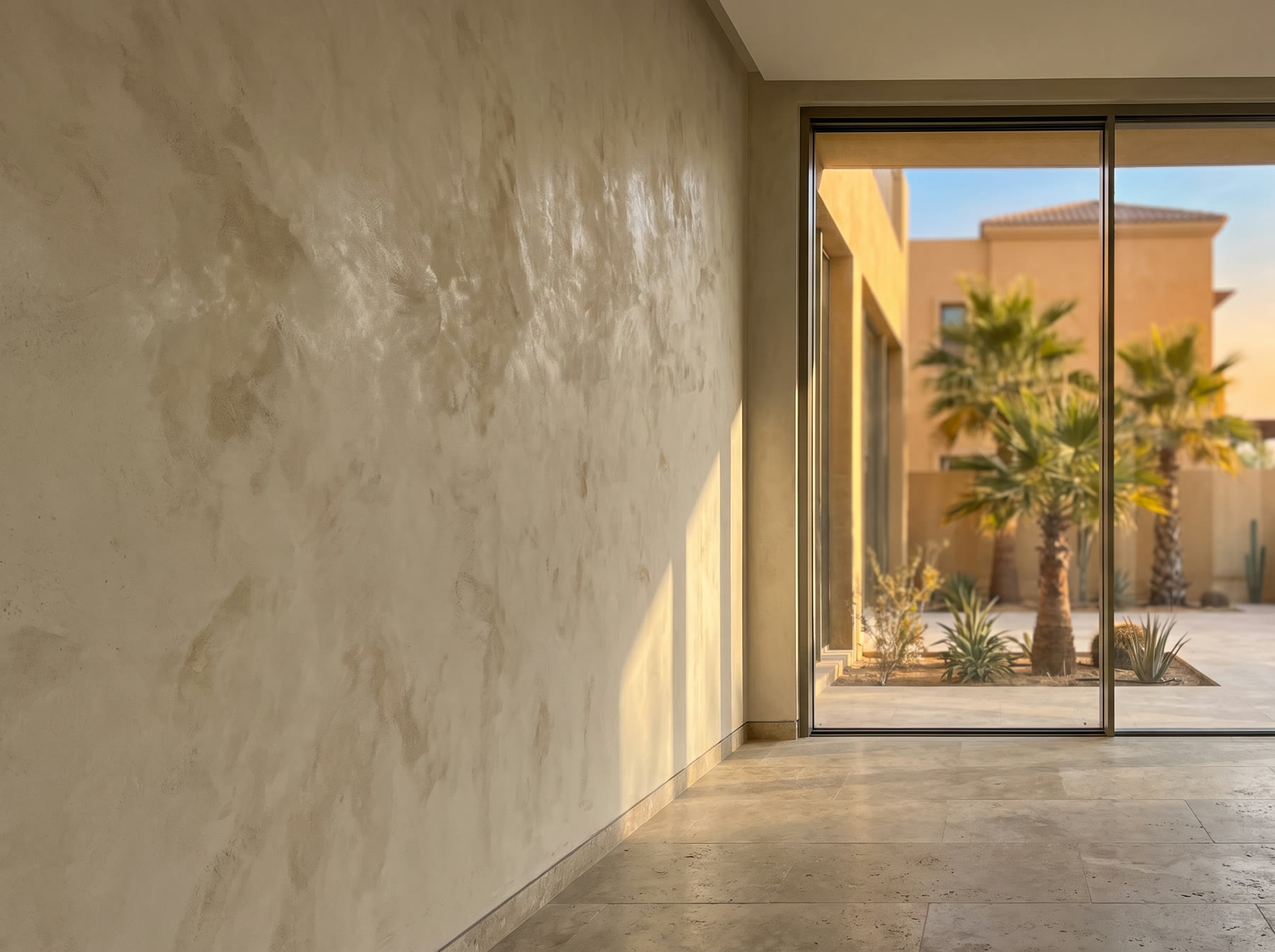
Marmorino is a lime plaster with the soul of stone. Fuller-bodied than the glossy Venetian finishes, it holds a soft, cloudy depth you can almost feel — a slow drift of marble movement that shifts as the light travels across the day. The surface sits matte to gentle satin, sometimes lightly burnished, never a mirror. Run your hand along it and there is real substance there, the faint tooth of crushed marble settled into lime.
It belongs where a room wants weight without noise. On a living-room wall it reads as pale, breathing stone; in a bedroom or hallway it wraps the space in something calm and enveloping. Choose a finer grade and the surface grows smooth and serene; ask for a more open one and it turns earthier, more hand-touched. Either way it feels grown rather than applied, at home beside timber, linen and warm brass. In Dubai and across the UAE it is the quieter side of the polished plaster family — the one clients choose when they want the calm of stone without its shine.
Have a wall in mind? Send a photo on WhatsApp and we will tell you honestly whether marmorino suits it — priced per project after a site visit.
Where it comes from
The recipe belongs to the Venetian lagoon. In the palazzi of Venice and the wider Veneto, builders ground marble dust into slaked lime and spread it across their walls — a way to dress a room with the composure of stone without carving and hauling whole slabs. Over centuries it earned its own name: marmorino, the little marble.
That craft has changed remarkably little. It is still laid by hand, pass over patient pass, each layer pressed and tightened until the wall takes on its stony calm. Lime is a slow, living binder; it cures gently and only grows more handsome with the years, which is why a marmorino wall tends to look better a decade on than the day it was finished.
Marmorino paint in Dubai: what people mean
“Marmorino paint” is not a paint. Marmorino is a lime plaster with crushed marble in it, laid by trowel in several passes and pressed tight; it has body, and a real one is a few millimetres thick. What is sold as marmorino paint in Dubai is usually an acrylic effect paint that copies the cloudy look with a brush. That can be the honest choice for a ceiling or a fast fit-out, and we apply those effect paints too — but they are a film on the wall, not a mineral surface that breathes and ages. If you want the real thing, ask for marmorino plaster and expect a trowel, not a roller.
Stucco marmorino: is it the same as marmorino?
Yes. Stucco is simply the Italian word for plaster, so stucco marmorino, marmorino stucco and marmorino plaster are one material: slaked lime and marble dust, trowelled and pressed to a matte, stone-like wall. Its glossier sister is stucco veneziano, burnished to a shine; the question of how it differs from a paint is answered in what is Venetian plaster, often searched as “venetian paint”. The confusion comes from English, where “stucco” usually means the hard cement-and-sand render on villa and boundary walls; that is a different product, and our guide to what stucco is untangles the two.
What does a marmorino finish look like?
A marmorino finish is soft, cloudy and matte to gentle satin, with a slow drift of tone like pale stone rather than a flat painted colour. Up close you see trowel movement and fine marble-dust depth; from across the room it reads as calm, breathing stone. It can be left matte or lightly burnished for a quiet sheen — and for a true mirror shine the finish to ask for is Stucco Veneziano, not marmorino.
Marmorino finish and marmorino lime plaster are the same thing. The plaster is the material, slaked lime with crushed marble; the finish is how the wall looks once it is trowelled and pressed. Ask for “marmorino” and you get that lime plaster, not a paint.
Marmorino plaster in a bathroom or kitchen
Marmorino plaster works in a bathroom on the dry walls — the vanity wall, the WC, the wall behind a tub — sealed for humidity and with an extractor that actually runs. Inside the shower it should be tadelakt, the lime made for water. In a kitchen it suits the walls and a range hood; behind the hob we would rather specify microcement in the kitchen, because lime is etched by lemon, vinegar and tomato and a busy splashback will not always be wiped in time. The zoning logic is the same one we use for polished plaster: see Venetian plaster in bathrooms.
Can marmorino plaster go on a floor?
No. A marmorino floor is not something we apply: the finish is thin coats of relatively soft lime, and feet, grit and furniture would scratch through it in months. For a seamless floor with the same calm, mineral look the right system is microcement, which is made for home floors and starts from AED 250/m². Marmorino walls with a microcement floor is a pairing we build often, and it is the honest one. For walls, the side-by-side is microcement vs Venetian plaster.
Are there marmorino plaster suppliers near me?
We supply and install marmorino as one job across the UAE, and we do not sell the plaster on its own for DIY or for another contractor. The reason is not commercial: marmorino lives in the hands that lay it — the timing between passes, the pressure, the moment to burnish — and a bag of lime without those hands is not a product we would put our name to. It is priced per project, supply and install, after a site visit; see Venetian plaster in Dubai for the full picture.
Start a project
Considering Marmorino for your space?
Tell us about your project on WhatsApp and we'll take it from there.