
Technologies · Mineral
Encausto
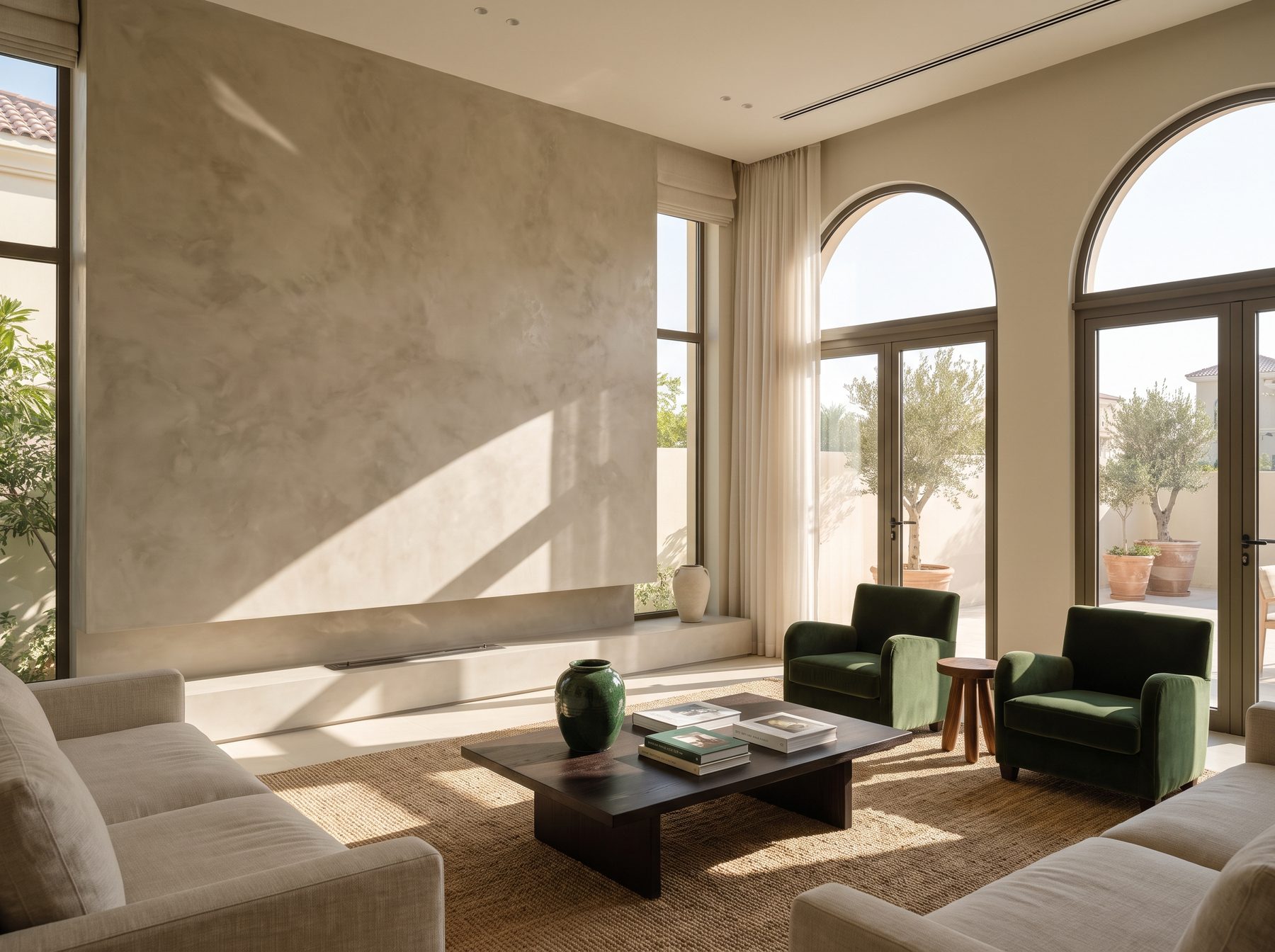
Venetian lime plaster sealed and burnished with wax — a warm, fed satin glow rather than a cold mineral mirror. The most tactile of the polished lime walls, and the one you can actually wipe.
What it is
Encausto is Venetian lime plaster finished the old way — sealed and burnished with wax until the wall takes on a warm, fed glow. The lime body underneath is the same honest thing as the rest of our lime family: slaked lime with marble or stone flour in it, trowelled on in thin coats and worked flat. What sets encausto apart is the last step. Instead of polishing the lime alone, the artisan works a wax into the still-firm surface and burnishes it in, so the sheen you see is the wax and the lime together — a soft, buttery satin that seems lit from just under the skin.
That single change is the whole character of the finish. Where Stucco Veneziano earns its glassy, mirror-bright shine from the burnished lime itself — a cool, hard, almost glacial gloss — encausto is warmer and quieter, a low satin lustre with a tactile, waxen hand rather than a mirror. And where Marmorino settles into a bare, matte-to-satin lime that prefers to be dressed rather than scrubbed, encausto’s wax layer gives the wall a working skin: it sheds a splash, takes a wipe, and shrugs off the daily marks that bare lime quietly absorbs. If marmorino is the calm cloudy stone and stucco veneziano is the polished marble, encausto is the one you can actually live against — the most tactile of the three, and the only one you can clean without a second thought.
It is worth being precise about the name, because encausto — from the Greek for “burned in”, the same root as encaustic — describes the wax method, not a stone it imitates. The wax is what you are paying for: the warmth, the depth, the resilience. The cost of that warmth is breath. A bare lime wall keeps exhaling moisture; the wax seals that off, which is exactly why encausto belongs on interior feature walls rather than anywhere a substrate needs to keep breathing. It is also why we place it beside the waxed lime floor rather than calling it one: for that surface underfoot, the wax-finished Venetian lime floor is Pastellone — same idea of lime fed with wax, but built and burnished to take footfall. Encausto is its wall counterpart.
Where it comes from
Wax and lime are one of the oldest partnerships in decoration. The Romans sealed and polished their finest lime and marble-dust walls with wax to deepen the colour and protect the surface — the technique the Greeks called enkaustikón, “burned in”, because the wax was worked and warmed into the plaster rather than merely brushed over it. The same instinct ran through the Venetian trade centuries later: having coaxed humble lime into the look of marble, the plasterers of the palazzi fed the finished wall with wax to give it depth, a soft sheen and a measure of protection the bare lime could not offer on its own.
Little about it has changed. It is still lime laid by hand over patient passes, and it is still the wax — worked into the firm surface and burnished until it glows — that turns a good plaster wall into encausto. Modern waxes have made the finish more durable and easier to renew than the beeswax of the old palazzi, but the principle is identical: the sheen is fed into the surface, not sprayed onto it.
The honest case for it in the UAE is a specific one. Most villa walls here are painted, flat and faintly lifeless; the polished lime finishes answer that with real depth, but bare marmorino and even stucco veneziano ask to be treated gently, and not every wall in a busy home gets treated gently. Encausto is the polished lime finish for the wall that has to earn its keep — a dining-room elevation, a hallway that gets brushed past, a powder room, a headboard wall you lean on — because the wax skin takes the daily contact that would slowly dull a bare lime surface. It is not a miracle coating: acids still etch the lime beneath, so vinegar and descalers are still off the table, and it will still want re-waxing every so often to keep both its glow and its water resistance. And it stops at the wet zone. Where a wall or floor is genuinely, constantly wet — a shower, a pool surround — Tadelakt or microcement wet zones are the surfaces built for it, and we would rather point you there than sell encausto past the edge of what its wax can honestly do.
Start a project
Considering Encausto for your space?
Tell us about your project on WhatsApp and we'll take it from there.