
Technologies · Mineral
Marmo Antico
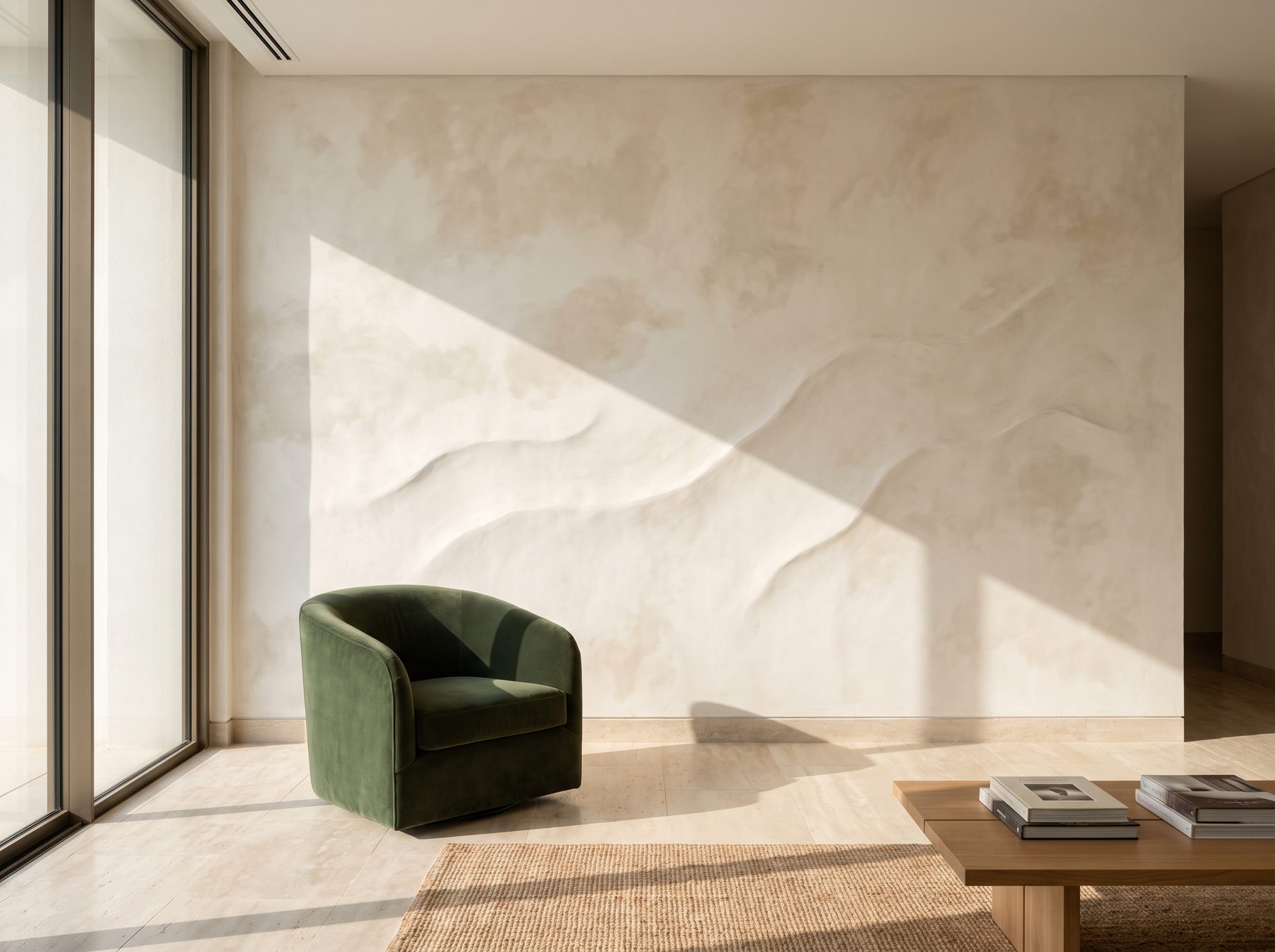
A textured lime plaster built to look already old — an irregular, hand-raised relief with worn edges and drifting tone, so a new wall arrives with the quiet of a weathered palazzo.
What it is
Marmo Antico is lime plaster laid so that a new wall looks as though it has been standing for a hundred years. Where most fine plasters chase flatness, this one chases the opposite: an irregular relief raised by hand, ridges softened and rounded as if a century of shoulders had brushed past, tone drifting pale and deep across the surface the way old lime weathers unevenly. Light does the rest. Grazing across the wall in the late afternoon it finds every ridge and pocket, and the wall gains a depth that a flat surface simply has no way to produce.
The material underneath is the same honest thing as the rest of our lime family — slaked lime with marble or stone flour in it, several millimetres thick, carbonating slowly back toward the rock it came from. What changes is the hand. The plaster is built up, cut back, worked and burnished selectively so that some passages sit polished and others stay open and matte. That contrast within a single wall is what sells the age; a uniformly textured wall reads as a product, while an unevenly worn one reads as history.
It is worth being precise about how this differs from its siblings, because the whole lime family gets bundled together and the differences are what make the choice. Marmorino is the same lime on a flat plane — a calm, cloudy stone-look surface with movement inside the material but essentially no relief on top of it. Travertino imitates one specific stone, with the pores and directional bedding that travertine actually has. Marmo Antico imitates no stone at all: it imitates age. Its texture is not a quarry’s grain, it is wear. And where our Texture Paints reach for a share of this look in two coats from a brush, they land a fraction of a millimetre thick — enough grain to warm a bedroom wall, nowhere near enough body to throw the deep, raking shadows this finish lives on. If the wall is the reason you walk into the room, that difference is visible from across it.
Where it comes from
The look is older than any recipe for it. Lime rendering has been the default skin of Mediterranean buildings for millennia, and what people now pay for is what those walls did to themselves for free: patched over generations, worn at the corners, faded unevenly where the sun and the rain got to them, burnished smooth where hands and furniture touched them most. Walk any old quarter of Italy, Greece or the Levant and the walls tell you where people passed.
What the Italian decorative trade did, roughly from the mid-twentieth century onward, was work out how to arrive at that condition deliberately instead of waiting for it — building the relief in the laying rather than letting time cut it, and shading the tone in the material rather than letting the weather bleach it. Trade names came and went; the technique settled. It is unashamedly an effect, and we would rather say so plainly than pretend otherwise.
The honest case for it in the UAE is that most villa interiors here are new, flat and hard, and nothing in them has any age at all. A room can be beautifully finished and still feel like it was switched on yesterday. This is one of the few surfaces that puts time into a space on the day it is handed over — and being real lime, it then genuinely does start ageing, so the effect grows into truth rather than away from it. But it earns that on the right wall. On a hallway, a stair, an arched niche, a long living-room elevation, it is the whole atmosphere of the room. On every wall in the house it becomes a theme park. We would rather lay it on one wall you’ll never tire of than five you will.
Start a project
Considering Marmo Antico for your space?
Tell us about your project on WhatsApp and we'll take it from there.