
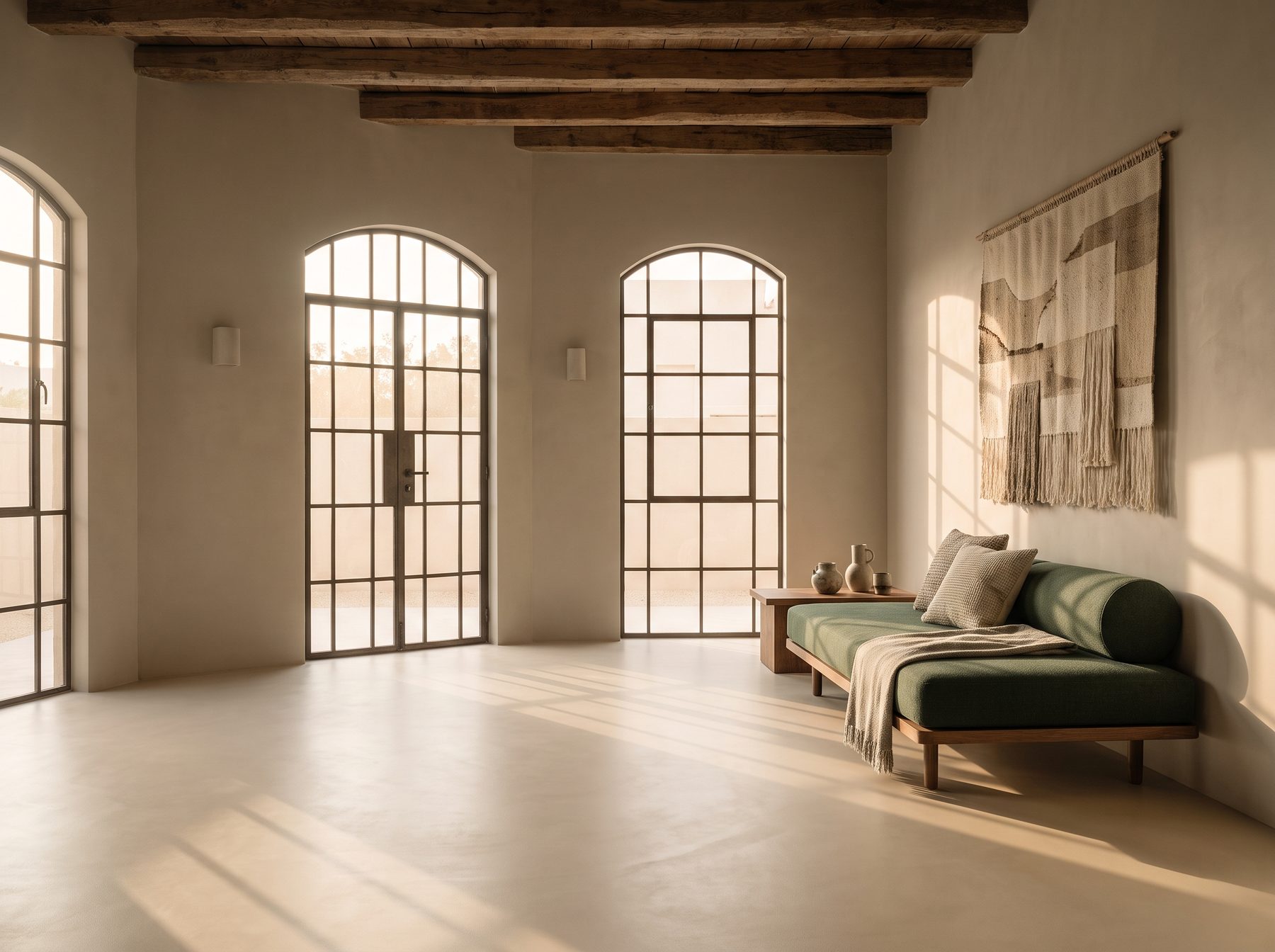
Technologies · Mineral
Magnesite Flooring
The historic seamless floor — magnesium oxychloride (Sorel cement) poured jointless, warm and quiet underfoot. A heritage craft we keep alive for restoration and for the rare dry interior that truly wants it.
What it is
Magnesite flooring is the original seamless floor. Calcined magnesium oxide is mixed with a magnesium chloride solution — the combination known as Sorel cement — and filled with fine wood flour, sawdust, cork or sand, plus pigment. Poured and trowelled in place, it sets fast into one continuous, jointless plane. The organic-filled body is what gives it its charm: a magnesite floor is warm underfoot where concrete is cold, quiet where terrazzo is hard, with a slight give that makes long hours of standing and walking kinder than any other mineral floor we lay.
And now the honesty this page exists for: magnesite hates water. The binder is a salt-bound cement; soak it repeatedly and it leaches, softens and breaks up. It is a floor for strictly dry, conditioned interiors — never a bathroom, never a wet-mopped commercial kitchen, never anywhere near a hose. Laid carelessly against steel, the chloride in its body corrodes pipes, conduits and reinforcement, which is exactly how many historic magnesite floors were ruined. Laid properly — isolated, dry, respected — it lasts generations.
So who is it actually for? Mostly, people restoring it: period buildings where a magnesite floor survives and deserves like-for-like repair rather than demolition. Beyond restoration, it suits the rare client who wants a warm, quiet, genuinely historic seamless plane in a dry room and accepts its temperament. Most clients who start this conversation actually want something else, and we would rather name it: for wet areas and bathrooms, Microcement or Tadelakt; for heavy-duty and commercial traffic, Polished Concrete; for a warm seamless floor with a Venetian pedigree and a lime temperament, Pastellone. Choosing magnesite should be a deliberate act, not an accident.
Where it comes from
The chemistry was described by the French chemist Stanislas Sorel in 1867, and by the early twentieth century composition flooring — as the trade called it — was everywhere: school corridors, hospital wards, stair landings and apartment hallways across Europe poured seamless in magnesite, decades before epoxy existed. It was cheap, fast, warm and quiet, and much of it performed faithfully for half a century. What killed its mainstream career was water — floors soaked by leaks and wet cleaning failed, steel embedded in it corroded — and by mid-century vinyl and cement screeds had taken its place.
That history is why it survives today as a heritage craft, and why we keep the skill in-house. After 8+ years working seamless mineral surfaces in the UAE, we treat magnesite the way it deserves: a floor with a real story, real virtues, and one hard rule it will never forgive you for breaking.
Start a project
Considering Magnesite Flooring for your space?
Tell us about your project on WhatsApp and we'll take it from there.