
Microcement · micro cement · microtopping — Abu Dhabi
Microcement in Abu Dhabi
Updated 16 October 2026
One seamless, jointless mineral surface — floors, walls, stairs and bathrooms — hand-finished by our own crews across the capital. Millimetres thin, laid over what you already have.
- 8+ years of decorative surfaces in the UAE
- Trained in-house crews across the capital
- Premium Italian materials
Starting prices
Real starting prices, supply and install — the same rates we run across the UAE. Every exact quote follows a site visit.
All rates are AED per square metre, supply and installation. A typical 40 m² living-room floor starts from around AED 10,000; a 25 m² bathroom done entirely at the wet-zone rate from around AED 8,750 (25 × 350). Bespoke colours and textures are priced on consultation.
Work out your project's starting price with the calculator →
Microcement across the capital
Looking for microcement in Dubai instead? The same system, rates and crews are covered on our microcement in Dubai page.
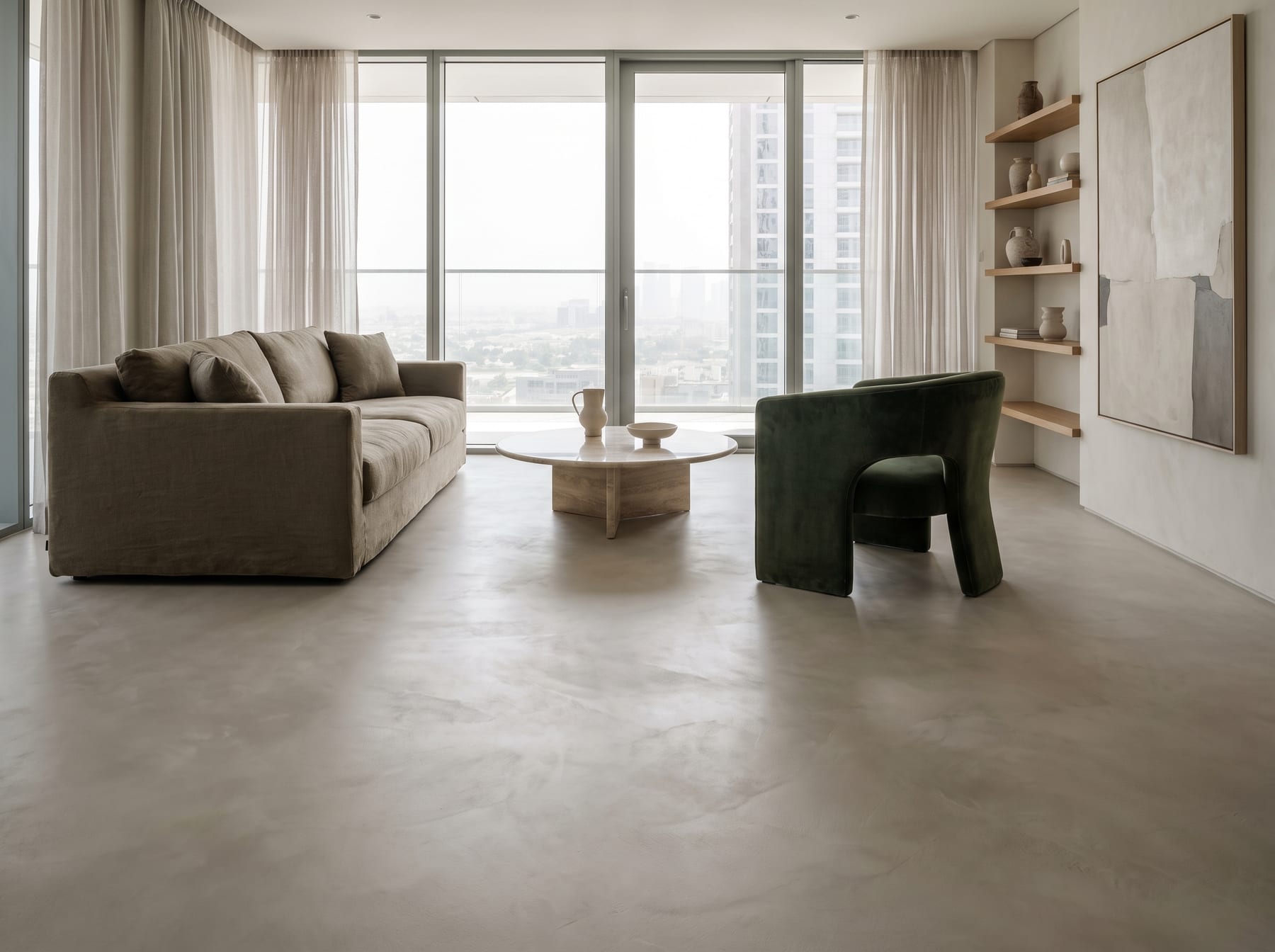
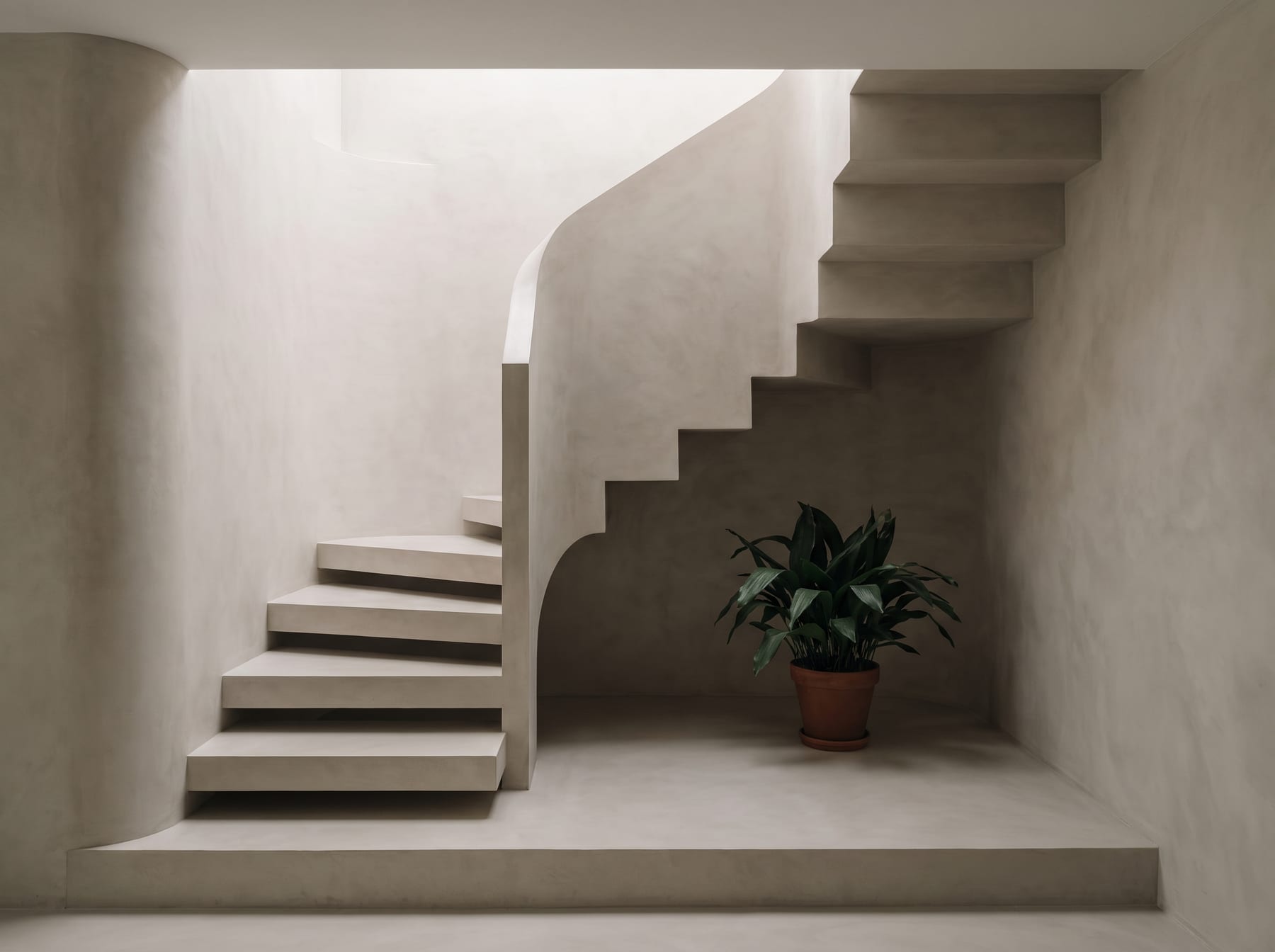
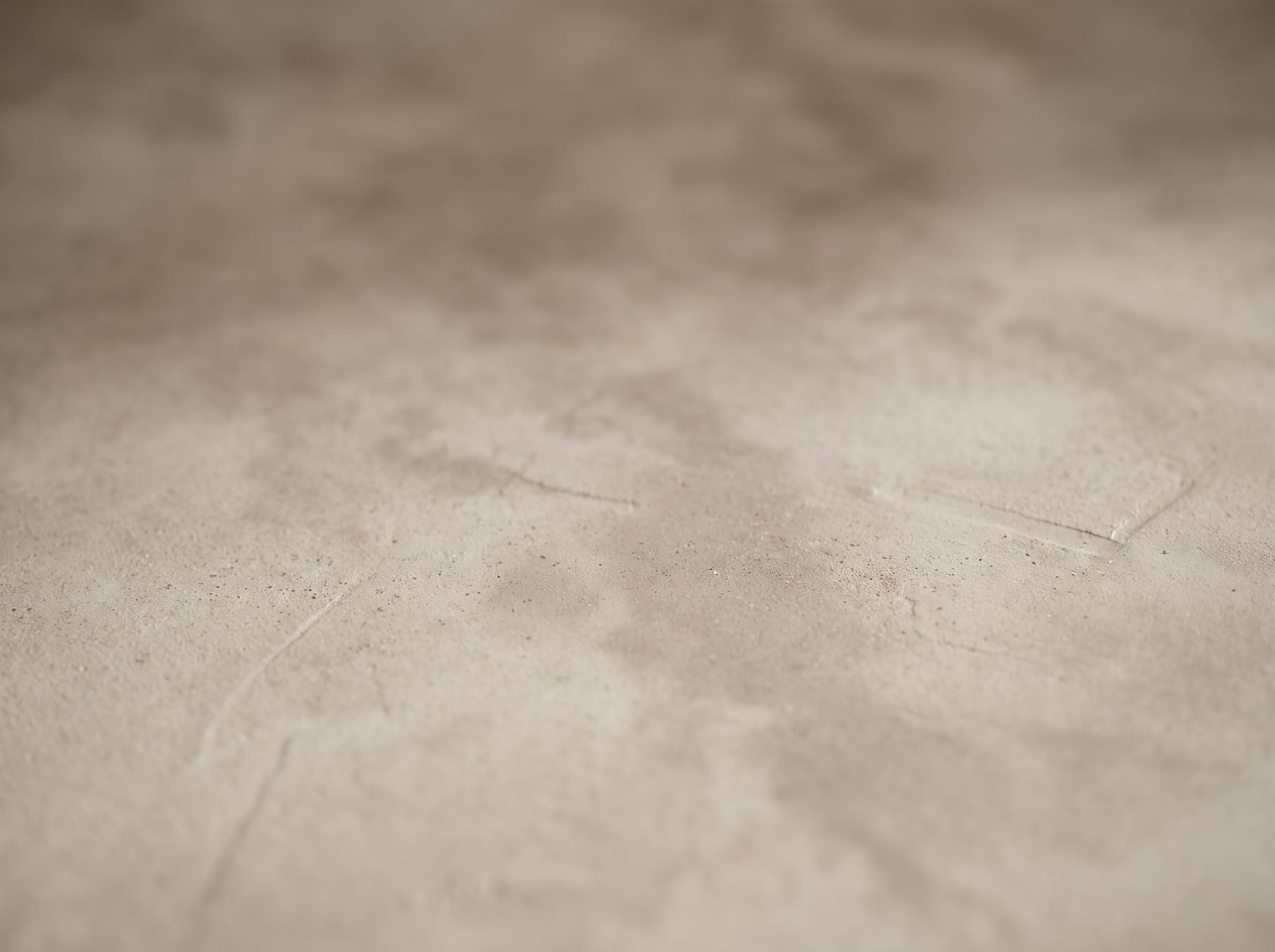
Microcement is a thin, polymer-modified cement coating — just a few millimetres thick — trowelled by hand into a smooth, continuous surface. Because it’s so thin, it wraps floors, walls, stairs and even bathrooms in one seamless mineral skin, usually laid straight over what’s already there. No grout lines, no joints: a calm, contemporary finish with a soft, cloudy movement all its own.
RBS is based in Dubai, but Abu Dhabi is home ground too — our crews work across Al Reem, Yas and Saadiyat islands, Khalifa City, Al Ain and the wider capital, with the same materials and the same standard of finish we’re known for. Distance changes nothing about how the surface is built.
One material, whole-home
The reason designers keep specifying it is continuity. A microcement floor can run from the living room through the kitchen and up the stairs; the same surface can climb a wall or line a shower. Fewer visual breaks make a space read larger and quieter — exactly what a modern capital home tends to want.
We apply a professional Italian microcement system, chosen for its colour stability and durability, and finished by our own trained crews. You pick the shade from our colour chart, approve a physical sample of the exact finish, and we take it from there — substrate to sealer.
Microcement or microtopping — one surface, many names
Search for it and you will find it spelled every way: microcement, micro cement, micro concrete, microtopping. In Abu Dhabi and across the UAE they all mean the same thing — a seamless, millimetres-thin cement finish laid over an existing floor or wall — and we apply it under any of those names. The choice that matters is not the word but the build-up: the primer and mesh below, the sealer above, and a crew that has laid hundreds of square metres of it. That is what the prices on this page buy.
Two Abu Dhabi substrates, one honest difference
Most of our capital enquiries fall into two groups, and the substrate underneath changes the job more than the postcode does. Older Khalifa City and Al Ain villas are usually tiled or, in the more finished ones, floored and skirted in marble — a hard, cold, often very sound substrate that microcement bonds to well once it is degreased and lightly keyed, but which needs its threshold strips and marble transitions detailed properly rather than simply coated over. Newer Al Reem, Yas and Saadiyat Island apartments are usually screed or porcelain tile over a concrete slab, in buildings that may still have active construction next door — which matters for a coating curing in place, not just for noise. Neither substrate is harder to work with than the other; they are different jobs, and we tell you which one you have at the site visit rather than after the quote.
How an RBS microcement job runs across the capital
The build-up is identical to any RBS microcement job — what changes on a capital site is the schedule around it, because our crews travel down from Dubai and a site visit is booked rather than same-day:
| Day | What happens |
|---|---|
| Site visit (booked ahead) | Substrate check — tiled, marble or screed — moisture reading, movement joints marked, any nearby construction noted, sample approved |
| 1 | Crew arrives, room protected, substrate degreased and primed; mesh embedded at movement points and marble-to-tile transitions; tanking laid first in wet zones |
| 1–2 | Base coat one, sanded once cured |
| 2–3 | Base coat two, sanded once cured — the structural layer, and the one a rushed crew shortens |
| 3–4 | Finish coat one — colour goes in here, hand-trowelled |
| 4–5 | Finish coat two — the cloudy, hand-worked movement that reads as microcement rather than paint |
| 5–6 | Sealing — two or more coats, immersion-grade in wet zones |
| 6–7 | Handover — walkable, not yet at full cure hardness; we set the safe-use window before we leave |
Cure time is chemistry, not labour, so it cannot be compressed by sending more people. On an island site with active building work nearby we also watch for transmitted vibration through a shared slab during the early cure — see the failure modes below — and will extend a coat’s cure window rather than seal over a floor that hasn’t settled.
A worked example: a 30 m² Al Reem Island apartment floor
Real numbers, from our published rates, walked through on a common capital job — a 30 m² living/ dining floor in an Al Reem Island apartment, laid over sound existing porcelain tile:
- Scope decided at the site visit. Tiles are sound and flat; mesh goes at the door threshold and one settlement crack in the screed the tiler’s grout had already telegraphed.
- Build-up: primer, mesh at the two movement points, two base coats, two colour finish coats, a wear-grade sealer — dry room, no tanking needed.
- Price: floors start from AED 250/m², so 30 m² starts from around AED 7,500, supply and install — the same rate this page quotes for Dubai, because it is the same crew and the same Italian system driving down the E11.
- Time: five working days including cure. Because the crew travels, the visit and the start date are fixed in advance rather than fitted in same-week — worth asking about early if you have a move-in date.
- What would have changed the number: an uneven screed, a bespoke colour mix, or turning the room into a wet zone — each moves the price and the timeline, which is exactly why every quote follows a site visit rather than a phone call.
Microcement vs tiles, marble, epoxy and polished concrete in an Abu Dhabi renovation
Marble earns its own column here — it is the default finish in a large share of the capital’s older villas, and it is the material microcement most often replaces or runs alongside during a renovation:
| Microcement | Tiles | Marble | Epoxy flooring | Polished concrete | |
|---|---|---|---|---|---|
| Added thickness | ~2–3 mm | 8–12 mm plus adhesive bed | 15–20 mm slab | A few mm, poured | None — the existing slab is ground down |
| Joints / grout lines | None | Yes, grout lines throughout | Yes, at every slab edge | None | None |
| Goes over existing floor | Yes, straight over sound tiles or marble | Only with demolition or a height allowance | No — this is the original floor, not an overlay | Usually needs a bare or primed substrate | No — needs the raw slab exposed |
| Feels underfoot | Warm, matte | Cold, glossy or matte | Cold, often glossy | Cool, glossy or matte | Cool, satin |
| Wet-zone use | Yes, with tanking + immersion sealer | Yes, standard bathroom material | Yes, but etches and stains without regular sealing | Rare in wet rooms | Not typical for showers |
| Starting price in Abu Dhabi | From AED 220/m² (walls) / 250/m² (floors) | Quote-only — not a system we install | Quote-only — not a system we install | Priced after a site visit | Priced after a site visit |
| Best fit here | A renovation that wants one seamless, warmer surface without ripping out the slab | New-build floors where grout lines are no concern | A villa that wants to keep and maintain its original stone | Garages, workshops, showrooms wanting a poured resin floor | Slabs meant to stay exposed, not covered |
We don’t lay tiles or supply marble, so those prices are left blank rather than guessed. Epoxy and polished concrete are priced after a site visit for a different reason: we do both, but neither has a published per-m² rate — see metallic epoxy and polished concrete for how each is actually quoted.
Failure modes we actually see in Abu Dhabi microcement jobs
Every one of these is preventable, and each is something we now check for on a capital site visit because a job — ours or someone else’s — was caught out by it once:
- Cracking that tracks a neighbouring construction site, not just the substrate. On Reem, Yas and Saadiyat, a tower still under build-out next door can transmit low vibration through a shared slab during a coat’s early cure. Mesh at the substrate’s own movement points doesn’t fix vibration coming from outside the room — the real fix is checking for active piling or heavy plant nearby before fixing a schedule, and lengthening the cure window between coats where it can’t be avoided.
- A haze at the balcony door that isn’t a sealing fault. Coastal, salt-laden air condensing on a cool, air-conditioned surface right at a sliding door can look exactly like an under-cured patch. It’s dew, not a defect — the fix is running the AC through the full cure window on hand-over day, not re-cutting a floor that was never actually wrong.
- A marble transition strip that lifts within a year. Common in part-renovated villas where microcement meets an untouched marble hallway: if the transition detail isn’t mechanically fixed and allowed to move independently of both materials, the strip telegraphs the marble’s temperature swing and lifts at the seam. We now detail every marble junction as its own line item, not an afterthought to the main floor.
- Sealer dulling fastest on the splashback behind a stove or hob. Heat and oil attack the sealer, not the cement underneath — the same story in every kitchen, capital or otherwise, and why the wall right behind a hard-used gas hob is detailed for that heat.
- Colour that reads patchy under a west-facing Corniche sunset. Caused by mixing finish-coat batches on site instead of pre-blending enough material for the whole wall or floor in one batch — a process discipline issue, not a material fault, and one raking evening light finds instantly.
More microcement guides
Why Abu Dhabi chooses RBS for microcement
Our own trained crews
Microcement lives or dies by the hands that lay it. RBS applicators are trained and directed in-house — never a subcontracted day-rate crew — and they work across Abu Dhabi, Al Ain and the islands.
Premium Italian materials
We apply a professional Italian microcement system, sealed with immersion-grade finishes — the difference between a surface that ages gracefully and one that dulls in a season.
Engineered against cracks
Hairlines come from movement and rushed prep, not the material. We stabilise the substrate, mesh where it's needed and build the coats properly, so the finish stays sound.
Colour matched, sampled first
Choose from our colour chart, and we'll prepare a physical sample of your exact shade and finish before a single square metre is committed.
Your questions, answered straight
Will it crack?
Not when it's built correctly. Cracking traces back to substrate movement and skipped preparation — so we stabilise and prime the base, embed a reinforcing mesh where it's needed, and lay the coats in the right thickness and cure time. Done this way, microcement holds.
Is it worth it over tiles or marble?
On a renovation, usually — it lays over the existing floor, saving demolition and disposal, and gives one seamless plane with no joints to date the room. Where a client wants natural stone's depth, we'll say so honestly; microcement is its own contemporary language, not an imitation.
Does it survive an Abu Dhabi bathroom?
Yes, with the right build-up. Wet zones get a full tanking system beneath the coating and an immersion-grade sealer above it, with slope and drainage detailing — engineered for coastal humidity and daily family use.
Will it yellow or need constant upkeep?
Indoors, our sealed finishes stay true and wipe clean with everyday care. Floors benefit from a re-seal every few years depending on traffic — a quick maintenance visit, not a re-installation.
Is microtopping the same as microcement?
In the UAE the names are used interchangeably. Microtopping, micro cement, micro concrete and microcement all describe the same family: a thin, polymer-modified cement coating hand-trowelled into one seamless surface over what is already there. What actually differs from job to job is the system underneath, the sealer on top and the hands applying it — which is what you are really choosing when you choose an installer.
Where we lay it
From a single feature wall to a whole-villa floor, microcement suits homes and normal-use rooms across the capital that want a calm, seamless, contemporary surface. In hotels, shops, restaurants and offices that means walls, bathrooms and quieter rooms, never busy floors:
- Private villas & apartments
- Hotels & hospitality
- Retail & showrooms
- Restaurants & cafés
- Offices & workspaces
- Staircases & feature walls
The finish
Frequently asked
How much does microcement cost per square metre in Abu Dhabi?
Microcement in Abu Dhabi starts from AED 220/m² for walls and feature surfaces, from AED 250/m² for floors, and from AED 350/m² for wet zones such as bathrooms and pools — supply and install. These are the same rates RBS runs across the UAE, and every price driver is explained in our microcement cost guide.
Do you actually cover Abu Dhabi, or just Dubai?
We cover Abu Dhabi properly. RBS works across the capital — Al Reem, Yas and Saadiyat islands, Khalifa City, Al Ain and beyond — with the same trained crews and materials we use everywhere else.
Can microcement go over existing tiles?
Yes. At only a few millimetres thick it bonds straight over sound existing tiles — no demolition, no rubble, and the joints disappear under one seamless surface. It's a favourite for capital renovations for exactly that reason.
How long does a microcement installation take?
A typical room takes four to seven days including cure time. It's applied by hand in thin layers, and each layer must cure before the next — plan the space out of use for the full period.
Is microcement waterproof enough for bathrooms?
Installed with the correct tanking system and an immersion-grade sealer, microcement performs reliably in showers, bathrooms and around pools, through coastal humidity and 45°C summers.
Are you a microcement supplier in Abu Dhabi, or an installer?
An installer that supplies its own material — supply and install as one job. Our crews apply a professional Italian microcement system we source directly, so the material and the workmanship are the responsibility of one company. We do not sell buckets of micro cement or microtopping product for DIY or to other contractors, because the finish depends entirely on the application.
Is there a microcement (micro cement) company near me in Abu Dhabi?
If you are in Abu Dhabi, Al Ain or the islands, yes — though honestly, our office is in Dubai and our crews drive down for the job. That changes nothing about the work: the same trained in-house applicators, the same Italian system and the same rates, with site visits and sampling done at your property. What it does mean is that a site visit is scheduled rather than same-day, so ask early and we will plan the crew around your dates. Whatever name you searched under, this is the page.
Do you offer microtopping flooring services in Abu Dhabi?
Yes. Microtopping flooring in Abu Dhabi is the same service as micro cement in Abu Dhabi on this page: our own crews lay the 2–3 mm coating over sound tiles, marble or screed in villas and apartments across the capital, Al Ain and the islands. Floors start from AED 250/m², supply and install, and the exact quote follows a site visit. It suits homes and normal-use rooms; for busy commercial floors, garages or anywhere with trolleys we will recommend a different surface.
Can microcement go on walls in Abu Dhabi, and is it cheaper than on floors?
Yes, walls are where microcement is most at home in Abu Dhabi: living-room feature walls, bedroom headboard walls and stairwells. Walls start from AED 220/m², against from AED 250/m² for floors and from AED 350/m² for wet zones such as showers, supply and install, after a site visit. Walls are lighter work because they take no foot traffic. Our microcement walls guide covers the finishes and the limits.
Is microcement flooring a good choice for an Abu Dhabi home?
Yes, for homes and normal-use rooms. A micro cement floor in Abu Dhabi is laid 2–3 mm thin over sound tiles, marble or screed, so living rooms, bedrooms, kitchens and stairs become one seamless surface without demolition. Floors start from AED 250/m², supply and install, with the exact quote after a site visit. It is not for heavy-use floors: busy commercial spaces, garages, trolleys or anywhere cars go need a different surface, and we will say so. Before you decide, read the honest microcement flooring pros and cons.
Start your project
Tell us about your space.
Send a few photos and rough sizes on WhatsApp — we'll come back with a real number and, if you'd like, a sample of the exact colour and finish.
Prices reviewed 16 October 2026. All rates supply & install, per m². Exact quotes follow a site visit.