
Tadelakt · Moroccan lime plaster — Dubai & all UAE
Tadelakt in Dubai
Updated 20 October 2026
The Moroccan lime plaster that goes where polished plaster cannot: burnished with a stone and sealed with soap until the wall itself sheds water. Seamless showers, bathrooms and hammams, applied in Dubai and across the UAE by our own crews.
- 8+ years of decorative surfaces in the UAE
- Trained in-house crews — never subcontracted
- Genuine lime, stone-burnished and soap-sealed
- Physical sample of your exact tone before we start
Pricing
Tadelakt is priced per project, supply and install, because the hours in it follow the shape of the room — curves, niches and a full hammam take far longer than a flat wall. The exact figure follows a site visit or a look at the drawings.
Floors, curved enclosures, niches and full hammams are all priced after we have seen the room or the drawings.
Tadelakt, the lime plaster made for a Dubai bathroom
Tadelakt in Dubai: RBS applies genuine Moroccan tadelakt with its own trained crews — shower and bathroom walls, walk-in showers, private hammams and basin walls in villas and apartments across Dubai, Abu Dhabi and the rest of the UAE — priced per project after a site visit, with a physical sample of your tone first.
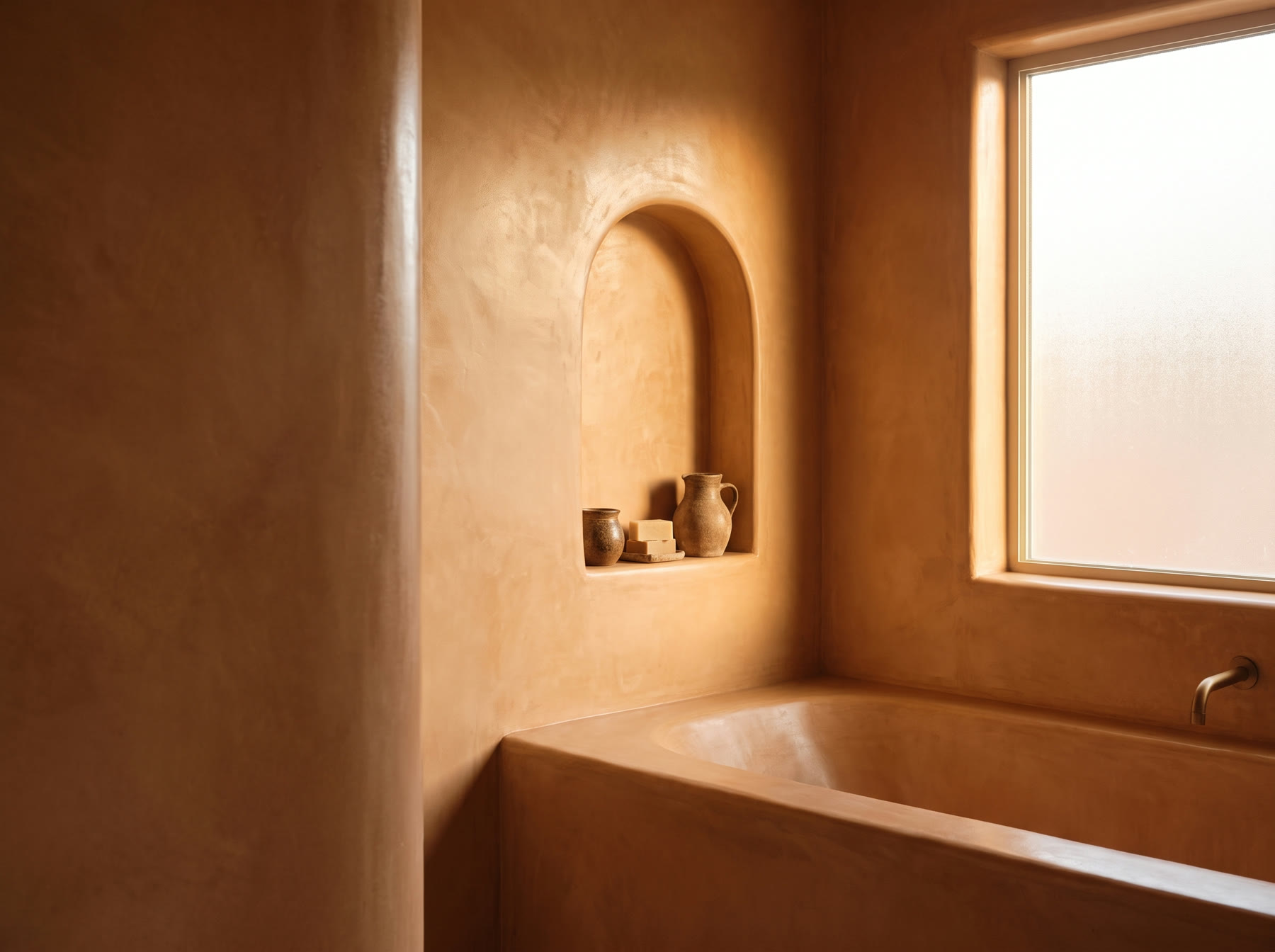
Tadelakt is the one lime finish that belongs inside a shower. Slaked lime is trowelled on in coats, compressed with a smooth polishing stone until the surface closes, then rubbed with olive soap: the soap reacts with the lime and the wall itself becomes water-repellent. No tiles, no grout lines to darken in Dubai’s humidity, no joints to interrupt the eye — a bathroom wrapped in one soft, seamless, faintly leather-like skin. It is what has lined Moroccan hammams for centuries, and it is at home in a villa ensuite, a powder room or a private spa in the UAE.
One tadelakt contractor, from supply to installation
We supply the lime, prepare the room, waterproof the wet zone and apply the tadelakt ourselves, so there is one company to hold responsible for the whole wall. Our applicators are trained and directed in-house; tadelakt is polished by feel, and the moment you start the stone decides whether the surface tightens or tears, which is not something we hand to a subcontracted crew. Before we start you get a physical sample of your exact tone and sheen, because burnishing deepens colour and a screen never shows that honestly. And if a room does not justify tadelakt — a family bathroom that will be cleaned with whatever is under the sink — we will tell you and quote the microcement instead.
Where tadelakt goes in a Dubai home
Tadelakt on shower and bathroom walls
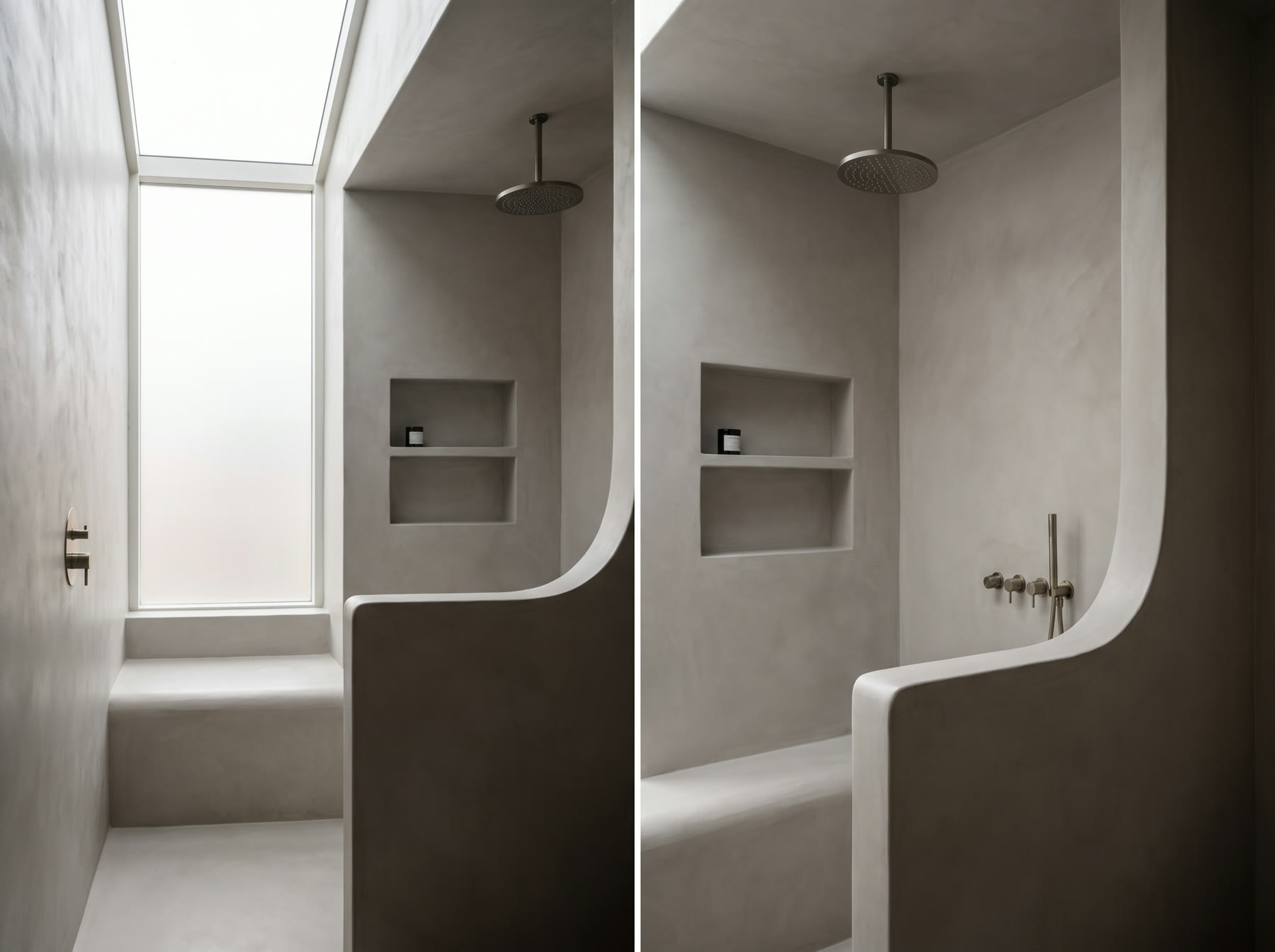
Shower walls, bathroom walls, basin surrounds, hammam benches and niches are tadelakt’s home ground — the wall finish it was born for, and the shower plaster of every Moroccan hammam. On a wall it is at its most efficient and its most beautiful: the stone closes the surface evenly, water beads and runs, and the whole room reads as one material. This is where we recommend it without hesitation, and it is the most economical way to have tadelakt at all.
A tadelakt floor in the bathroom: only sometimes
A tadelakt floor is possible and walkable, but it is slower work: heavier compaction, more careful build-up and more protection while it cures, so it costs more per metre than the same area standing upright. We apply it where the room is a retreat — a hammam, a spa bathroom — and the household will squeegee it after every shower. For a busy family bathroom floor, or where a hard-wearing, cleaner-proof floor matters more than the glow, we recommend a microcement wet zone from AED 350/m² instead, and we say so at the site visit.
Tadelakt in the kitchen: backsplash yes, countertops no
On a kitchen wall away from the hob, tadelakt is lovely. As a backsplash behind the cooker it is honest but demanding: lemon, vinegar, tomato and grease all reach it, and acid etches lime, so it needs wiping the moment it is splashed. If that will not happen, microcement is the seamless splashback we recommend. Tadelakt kitchen countertops we do not apply: a worktop takes knives, hot pans and acids every day, which no lime surface should be asked to survive. A microcement or stone top with tadelakt walls above it gives you the look without the regret.
Tadelakt bathroom ideas we actually build
The ones that work in the UAE: a walk-in shower with the tadelakt continuing across the ceiling, so steam meets one surface; a curved enclosure with a burnished niche for the shampoo, no shelf and no joint; a basin wall in warm sand or clay tones with the dry walls in matching marmorino; and the full hammam — walls, benches and floor in one lime, lit from low down so the stone marks show. Loud colours do not suit it; considered earth tones age best.
How we build a tadelakt wall, stage by stage
Tadelakt is hand-work in a fixed order — skip a stage or rush it and the wall either never closes properly or never seals at all. This is the sequence on every job, whether it is one feature wall or a full hammam:
| Stage | What happens |
|---|---|
| 1. Site visit & sample | We measure the room (or work from drawings), agree the curves and niches, and hand over a physical sample of your exact tone and sheen — burnishing deepens colour, and a screen never shows that honestly. |
| 2. Substrate prep & waterproofing | Any old finish comes off down to a sound mineral substrate. In wet zones, a waterproofing membrane goes in first, with falls and drains detailed before any lime touches the wall. |
| 3. Base coats | Slaked lime is trowelled on in two coats, each keyed so the next one grips — this is what gives the wall its body and lets it wrap curves without cracking. |
| 4. Compression / burnishing | While the final coat is still workable, a smooth stone is worked over it in overlapping passes, closing the surface’s pores and raising the leather-like sheen — this is the step that cannot be rushed or handed to an untrained hand. |
| 5. Soap sealing | Traditional black soap (savon noir) is worked into the closed surface. The soap reacts with the lime to form the water-repellent skin — the material’s own waterproofing, not a coat sitting on top. |
| 6. Cure | The wall is kept dry and untouched for the first few days, then used gently for about a month while the lime finishes carbonating and hardening fully. |
A tadelakt hammam, day by day — a worked example
To make the process concrete, here is a real shape we build often: an approximately 18 m² private hammam in a Dubai villa — walls, a bench and the floor, all in tadelakt, with two curved niches.
- Day 1 — site visit, room measured, sample approved, waterproofing detail agreed for the floor drain and bench.
- Days 2–3 — substrate prep and the waterproofing membrane across walls, bench and floor, with falls built into the floor screed.
- Days 4–7 — base coats trowelled across every surface — walls, bench, floor, both niches — each coat left to firm up before the next.
- Days 8–10 — burnishing, pass by pass, working the stone across walls first, then the bench, then the floor last so foot traffic does not disturb a curing surface.
- Day 11 — soap sealing across the whole room in one pass, so the sheen and the water-repellency are even from wall to floor.
- Weeks after — the room is usable but treated gently: no strong cleaning products, a squeegee after every use, full hardness in about a month.
That is roughly two weeks on site, in line with what we quote for a hammam. We do not attach an AED figure to this walk-through: a hammam’s price follows its curves, its niches and its floor-to-ceiling area, not a flat rate per square metre, and this one had two niches and a bench that a plainer room would not. The tadelakt cost guide explains exactly what moves the figure.
Tadelakt vs the other ways to build a wet room
| Tadelakt | Microcement wet-zone | Large-format porcelain tile | Natural stone tile | |
|---|---|---|---|---|
| How it keeps water out | Soap-sealed lime — the material itself repels water | A membrane underneath, sealed coating on top | Glazed tile face; grout is the weak point | Sealer reapplied over a porous stone; grout is the weak point |
| Joints | None — one continuous surface | None — one continuous surface | Grout lines throughout | Grout lines throughout |
| Curves & niches | Wraps them by hand, its natural strength | Coated over any shape, including curves | Cannot wrap a true curve; large format shows more cuts | Cannot wrap a true curve |
| Daily care | Squeegee; soap only, ever | Any normal cleaner | Any normal cleaner, but grout needs scrubbing | Any normal cleaner, but grout and sealer need attention |
| Repair | Hand-patched by a trained applicator; can be made invisible with time | Patched and re-coated | Cracked tile is replaced, colour rarely matches exactly | Cracked tile is replaced, colour rarely matches exactly |
| Cost tier | Priced per project — the most expensive of the four for a small, detailed room | From AED 350/m² — flatter, more predictable | Mid-range, but grout labour adds up on a curved room | Highest material cost of the four |
What decides the cost of a tadelakt job
Tadelakt has no published rate because the work is priced per project after a site visit, and the drivers are specific: the condition of the substrate (new cement board is quick, an old tiled wall needs assessing), the area of wet surface versus dry, how many curved or sculpted details there are (a niche, a bench or a basin takes more hand-burnishing than a flat wall), the number of soap-sealing passes the wet zones need, and access and finish schedule. A small shower with two walls and a plain niche is a very different job from a full hammam, so we would rather measure than quote a number that does not fit. Send photos of the space on WhatsApp and we will tell you honestly, before any visit, whether tadelakt suits it or whether a different lime finish such as Venetian plaster is the better call.
Where a tadelakt wall actually fails — and how we build against it
- Acid contact. One bottle of limescale spray or a splash of vinegar dissolves the lime’s surface permanently, leaving a dull, porous patch no scrubbing fixes. We brief every household on the soap-only rule before handover, in writing, and offer an annual soap-feed visit for households that would rather we did it.
- Rushed burnishing. A crew that moves the stone too fast leaves a patchy, less-closed sheen that absorbs water unevenly instead of shedding it. We use only our own trained applicators, timed to the lime’s own working window, never to a schedule.
- AC drying the surface too fast. Cold, dry air aimed straight at fresh lime dries the surface before it compresses, leaving a chalky, weak film that dusts off in patches. We cover or redirect AC vents during application and for the first week of curing.
- Waterproofing detailed carelessly at a niche or bench. Lime alone is not a waterproofing membrane; a poorly sloped floor or an undetailed corner behind the tadelakt lets water sit and eventually stain through, even though the visible lime itself is fine. We detail falls and upstands before the first coat goes on, not after.
- Applied over old non-breathable paint or sealer. Tadelakt needs a sound mineral substrate to bond and breathe; laid over leftover oil-based paint, it can bubble or delaminate within months. We strip back to a mineral substrate every time, even when that means more demolition than the quote first suggested.
- No annual soap feed in a heavy-use bathroom. The wall keeps working, but the seal thins over years without it, and water stops beading the way it should. The once-or-twice-yearly soap wash (see our care guide) is written into the handover notes on every job.
Why Dubai chooses RBS for tadelakt
Real tadelakt, not a sealed lookalike
Our tadelakt is genuine slaked lime, trowelled, tightened with a stone and sealed with soap — the water resistance comes from the material itself, not from a plastic coat on top. Where a plain plaster with a sealer is honestly all a wall needs, we will say so and quote you the cheaper thing.
Wet-zone build-up underneath
In a shower we do not rely on the lime alone. A waterproofing build-up goes beneath it, falls and drains are detailed, and only then does the tadelakt go on. That is why the quote includes the whole system, not just the visible coat.
Our own trained crews
Tadelakt is polished by feel. Every RBS applicator is trained and directed in-house — never a subcontracted day-rate crew learning the stone on your bathroom.
Honest about where it stops
Tadelakt has one rule for life: nothing acidic touches it. If a household will not keep that rule, a microcement wet zone is the better bathroom, and we build those too.
Your questions, answered straight
Is tadelakt a paint, and why does it look like leather?
It is not a paint — it is a lime plaster several millimetres thick, built in coats and then compressed with a polishing stone. That compression is what gives the finish its leather-like look: a soft, slightly mottled sheen with faint stone marks under it, warm rather than glossy. Paint sits on a wall; tadelakt becomes the wall's surface.
What are the pros and cons of tadelakt?
Pros: genuinely water-resistant lime, seamless with no grout, a hand-made glow no sealed surface imitates, and it wraps curves and niches that tile never could. Cons: it is priced per project and costs more than most wall finishes, acids etch it (no vinegar, no limescale spray, ever), it wants an occasional soap treatment, and a floor in it is slower and dearer than a wall. The full honest list is in our lime pros-and-cons guide, linked below.
Tadelakt vs Venetian plaster or limewash — which one?
Tadelakt for anywhere water hits the wall; Venetian plaster for dry walls that should gleam; limewash for a soft chalky matte on walls you look at rather than touch. They are one lime family at three different jobs, and we lay all three — so the answer depends on the room, not on which one we prefer to sell.
How do I live with it day to day?
A squeegee after the shower and a pH-neutral soap when it needs cleaning — ten seconds a day. Lime is etched by acids, so descalers, vinegar and lemon-based cleaners are the one real enemy. Every year or so a wipe of olive soap feeds the surface and brings the sheen back.
Where we lay it
Tadelakt suits the rooms where water, steam and a seamless wall have to live together. Recent work spans:
- Villa master bathrooms & ensuites
- Walk-in showers & wet rooms
- Private hammams & spa rooms
- Powder rooms & basin walls
- Boutique hotel bathrooms
- Feature walls that want the hammam glow
The finish

Frequently asked
What is the tadelakt price per square foot?
We do not publish a per-square-foot or per-square-metre rate for tadelakt. It is priced per project, supply and install, because the hours in it follow the shape of the room: a flat feature wall is the quickest work, and floors, curves, niches and a full hammam move the figure up. That is why we ask to see the room or the drawings first. Every driver is explained in the cost guide linked below.
Is there a tadelakt plaster company, contractors or installers near me?
Yes — RBS Group is based in Business Bay, Dubai; we are the contractor and the installers on every job, and our own in-house tadelakt crews work across the whole UAE: Abu Dhabi, Sharjah, Ajman and the northern emirates included. Send the room on WhatsApp and we will tell you honestly whether it justifies tadelakt before anyone visits. We have few public reviews yet; ask us to show you aged work instead, because a tadelakt wall five years on says more than a star rating.
Is there a tadelakt plaster supplier near me?
We supply and install as one job and do not sell the material for DIY or for another contractor. Tadelakt lives entirely in the application — the coat thickness, the moment you start the stone and the soap sealing decide whether it repels water or fails — so the material and the workmanship have to sit with one company. If you already have a contractor, we are happy to be the tadelakt specialist on their site.
How long does a tadelakt bathroom take?
Allow one to two weeks for a typical bathroom, longer for a hammam. The waterproofing build-up goes in first, then the lime in coats, then the stone-burnishing and soap sealing, each stage curing before the next. Lime keeps hardening for weeks afterwards, so we ask you to be gentle with it for the first month.
Can tadelakt go over existing tiles?
Not directly. Tadelakt bonds and cures best on a sound mineral substrate, so on a renovation the honest route is to remove the tiles and rebuild the waterproofing properly. If keeping the tiles is the whole point of the renovation, a microcement wet-zone system is the surface designed to go over them — and we will say so rather than force lime onto the wrong base.
Is a tadelakt bathroom a good idea in Dubai?
Yes, when the household will keep one rule: nothing acidic touches it. On shower and bathroom walls tadelakt is at its best — seamless, no grout to darken in the humidity, water beading off a soap-sealed lime skin, over a proper waterproofing build-up. A tadelakt bathroom floor is possible but slower and dearer, and suits a calm spa bathroom more than a busy family one. If the bathroom will be cleaned with whatever spray is under the sink, a microcement wet zone from AED 350/m² is the better choice, and we will say so.
Can tadelakt be used in a shower in Dubai?
Yes — a shower is what tadelakt was made for. We build the waterproofing, the falls and the drain detail first, then trowel, stone-burnish and soap-seal the lime over it. Day to day it needs a squeegee after showering and a pH-neutral soap for cleaning; descalers, vinegar and lemon cleaners are the one thing to avoid, because acid etches lime.
Does tadelakt cope with Dubai humidity and air conditioning?
Yes, once it is cured. Humidity and steam are its natural setting. The risk is during application: cold, dry air from an AC vent blowing straight onto fresh lime dries the surface before it is burnished, so we cover or redirect vents while we work and for the first week of curing. After that, the finished wall lives happily with the AC on.
Do you apply tadelakt in the UAE outside Dubai?
Yes. Dubai is our base, but the same crews travel to Abu Dhabi, Sharjah, Ajman and Ras Al Khaimah. Tadelakt is slow, hand-made work, so a job outside Dubai is planned as a block of days rather than a visit.
Start your project
Tell us about your space.
Send a few photos and rough sizes on WhatsApp — we'll come back with a real number and, if you'd like, a sample of the exact colour and finish.
Updated 20 October 2026. Every project is priced after a site visit.