
Technologies · Mineral
Tadelakt
A silken Moroccan lime plaster, burnished by hand until it turns to soft stone — seamless, sensual and naturally water-safe, at home in the most beautiful bathrooms.
What it is
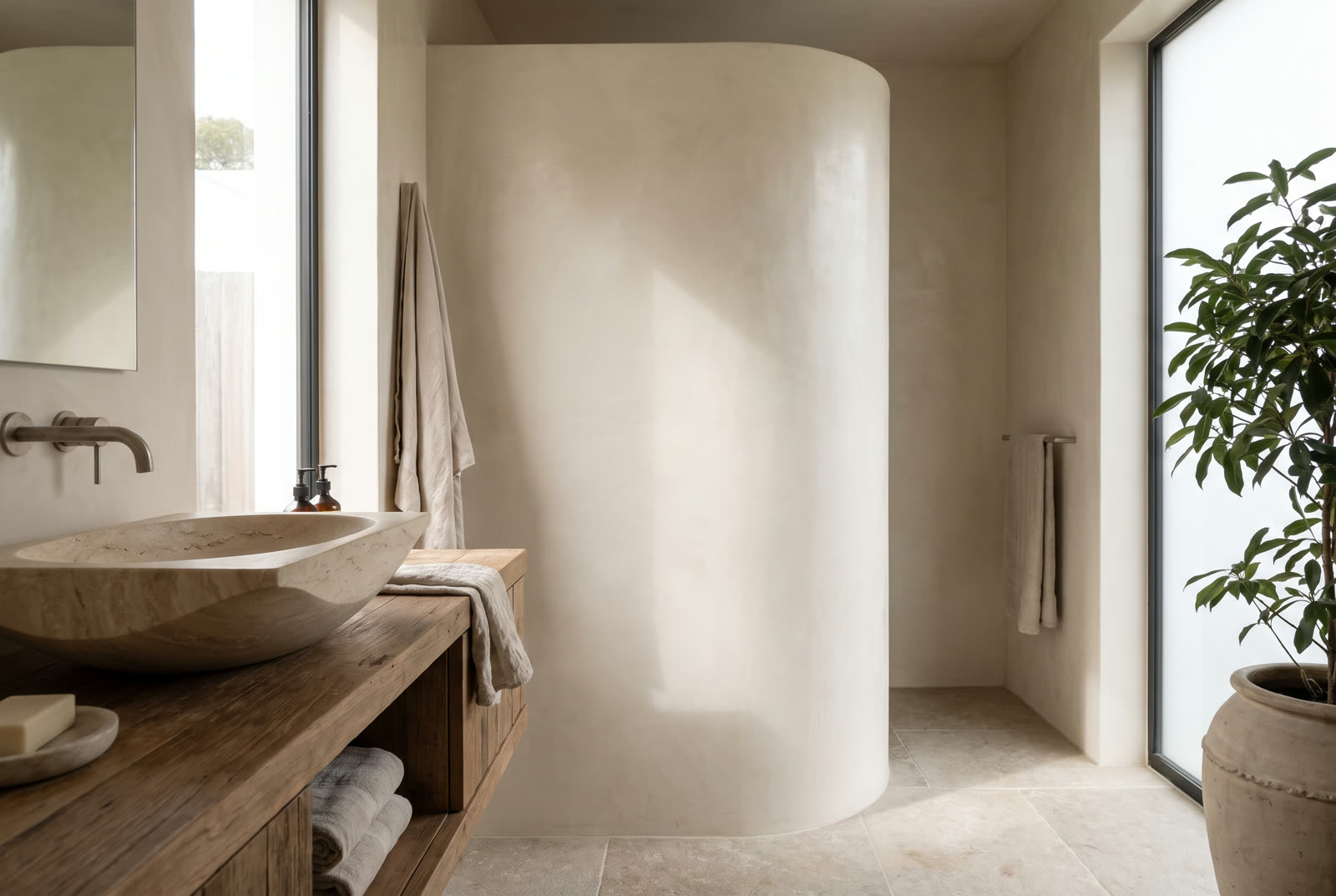
Tadelakt is lime plaster taken to its most refined and sensual conclusion. It is trowelled on, then patiently burnished with a smooth river stone until the surface tightens, deepens and begins to gleam. A final rub of soft soap seals it, leaving a finish that is quietly waterproof and utterly seamless — no tiles, no joints, no lines to interrupt the eye.
The feeling is what stays with you. Tadelakt has a soft, almost living quality: a mineral depth that catches the light and a warmth beneath the hand you simply don’t expect from a wall. It curves happily around basins and niches, wrapping a bathroom in a single, uninterrupted skin — which is why it has become the quiet signature of the most beautiful wet rooms. We apply tadelakt in Dubai and across the UAE, most often in villa bathrooms and hammams where steam, water and a seamless wall have to live together.
Is tadelakt available here, and who applies it?
Yes. RBS applies tadelakt in Dubai and across the UAE with its own trained crews, mostly in villa bathrooms, showers and hammams. It is priced per project after a site visit, because the wall area, the waterproofing build-up beneath it and the finish all differ. Where we apply it, with examples of the finish, is on our tadelakt in Dubai, Abu Dhabi and across the UAE page, and the honest comparison with the alternative is in tadelakt vs microcement for a bathroom.
Where it comes from
The name comes from the Arabic dellak, “to rub” — and the craft belongs to Morocco, where it has lined hammams, riads and fountains for centuries. Marrakech gave it its home, using local lime to create surfaces that could live happily with steam and water long before modern sealants existed. That heritage still shapes every wall today: patient, tactile, and made entirely by hand.
What is tadelakt used for?
Tadelakt is used for the walls of showers, bathrooms, hammams and powder rooms, for basin and vanity surrounds, and for feature walls that want the hammam glow — anywhere a seamless surface has to live with water. A tadelakt floor is possible in a spa bathroom, but it is slower, dearer work and we recommend it selectively; a family bathroom floor is better served by microcement. On kitchen walls it is lovely, as a splashback it is honest only if acid splashes are wiped at once, and as a countertop we do not apply it at all. Where we lay it in Dubai, and what it costs, is on our tadelakt in Dubai page.
Why tadelakt looks like leather
Tadelakt looks like leather because of the stone. After the last coat of lime is trowelled on, the surface is compressed with a smooth polishing stone until it tightens and closes; the stone leaves faint, overlapping marks and a soft, slightly mottled sheen, warm rather than glossy — the look of worn saddle leather rather than polished marble. The olive-soap sealing deepens that effect: the soap reacts with the lime to form a water-repellent skin, and the colour under it reads a shade richer and more alive. It is the opposite of a flat, uniform finish, and that is the point.
Is tadelakt a paint or a plaster?
Tadelakt is a plaster, never a paint. It is slaked lime built up in coats several millimetres thick, and its water resistance comes from compaction and the lime-soap reaction inside the material, not from a coating on top. A “tadelakt paint” or “tadelakt-effect” product is an acrylic paint imitating the look; it can be a fair choice for a dry wall on a budget, but it will not do what the real thing does in a shower, and we would rather say so than let the name be borrowed.
The tadelakt wall finish, coat by coat
The tadelakt wall finish is built in stages, and each one matters. In a wet zone a waterproofing build-up goes on first; then the lime is applied in coats and left to firm; then the stone-burnishing begins at exactly the moment the surface will take it — too early and it tears, too late and it will not close; then the olive soap is worked in and polished. Lime keeps hardening for weeks afterwards, so a new tadelakt wall is treated gently for its first month. After that it asks only for pH-neutral care — see how to clean and care for tadelakt.
Start a project
Considering Tadelakt for your space?
Tell us about your project on WhatsApp and we'll take it from there.