
Venetian plaster · polished plaster · marmorino — Dubai & all UAE
Venetian Plaster in Dubai
Updated 27 October 2026
Slaked lime and marble dust, laid in thin coats and burnished by hand until the wall glows like polished stone — or left soft and cloudy as marmorino. Real lime, real craft, applied by our own crews.
- 8+ years of decorative surfaces in the UAE
- Trained in-house crews — never subcontracted
- Genuine lime plasters, applied the Italian way
- Physical sample of your exact finish before we start
Pricing
Priced per project after a site visit, supply and install. The finish decides the cost — matte marmorino is quicker to lay than a mirror-polished stucco veneziano — and the wall underneath decides more than the sample board does, so we see it before we quote.
Send a few photos and rough sizes on WhatsApp to start. Bespoke colours, metallic and textured effects are priced at the same consultation.
Venetian plaster, made for Dubai walls
Venetian plaster in Dubai — also called polished plaster — is applied by RBS Group’s own crews across Dubai, Abu Dhabi and the rest of the UAE: genuine lime and marble dust, sampled on a board before work starts, and priced per project after a site visit.
What is Venetian plaster? A hand-trowelled lime and marble-dust wall finish, built up in thin coats and burnished smooth. Marmorino, the matte, cloudy member of the family, has its own guide to marmorino, and a Venetian plaster bathroom means the walls and shower surrounds only, never the floor (see the bathroom section below).
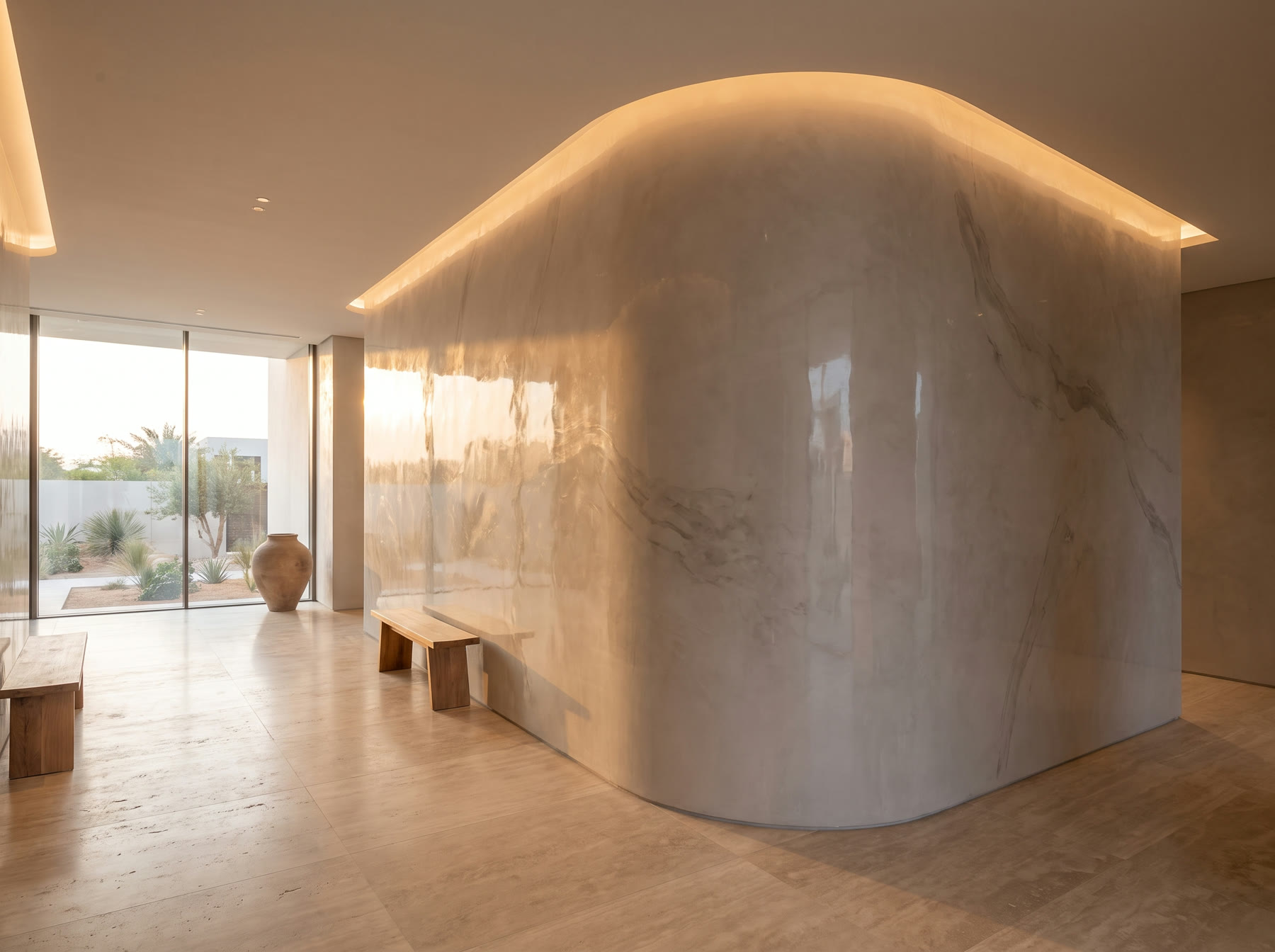
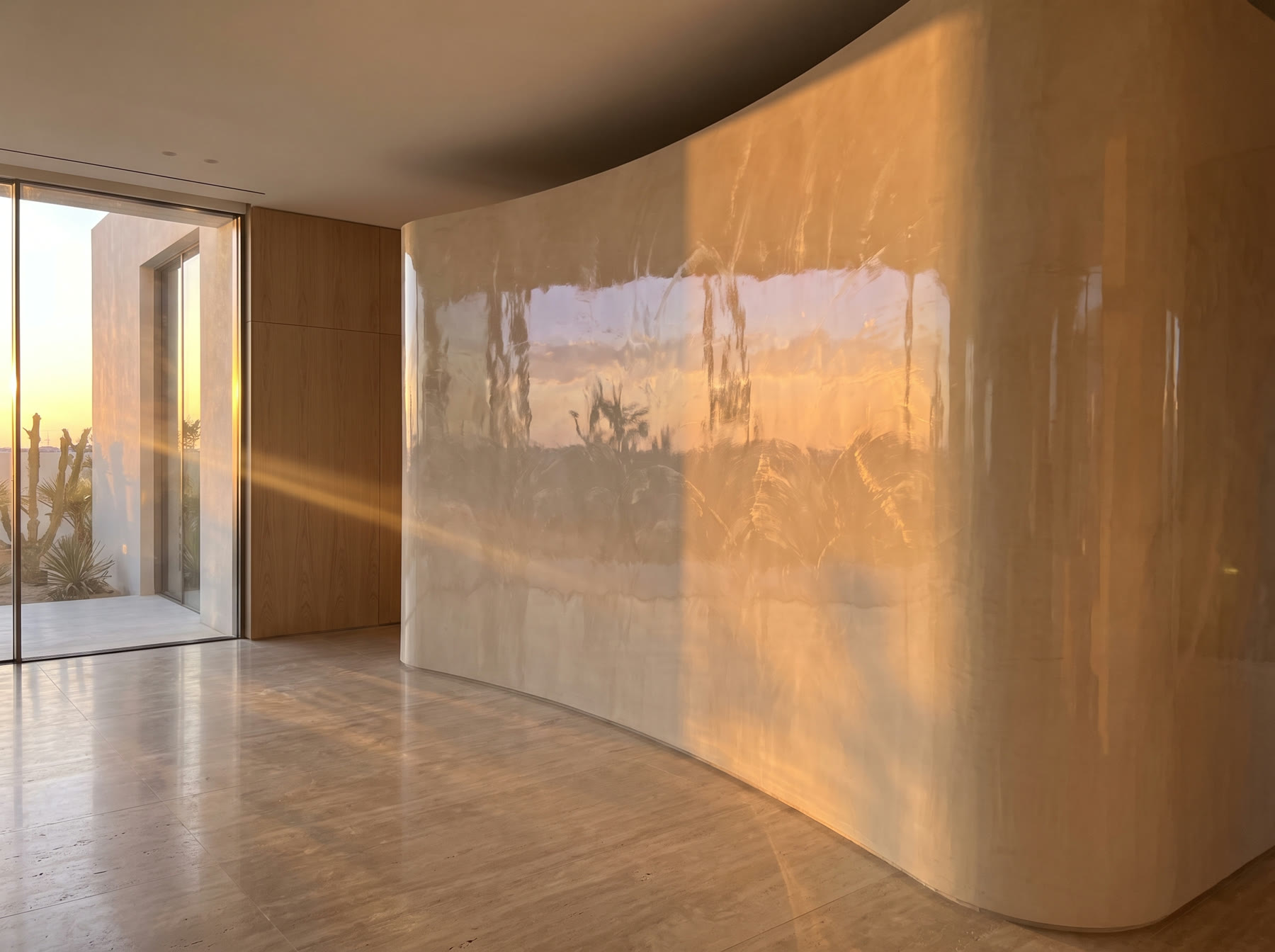
Venetian plaster is slaked lime and marble dust, laid by trowel in thin coats and burnished until the wall takes on the depth of polished stone. Because the colour lives inside the lime rather than in a film on top, light sinks into the surface and moves as you cross the room — the effect that no paint imitates convincingly. In a Dubai villa, a hotel corridor or a majlis, it turns a plain wall into the quietest kind of luxury: seamless, jointless and cool under strong light.
The same family gives you a range of moods. Marmorino keeps the lime matte and cloudy, like soft stone at rest. Stucco veneziano — Venetian plaster proper, often sold as polished plaster — is burnished to a marble-bright gloss. Travertino imitates the pores and bedding of travertine, and tadelakt takes lime into the wet room. We lay all of them with our own crews and show you each on a sample board before choosing.
How a Venetian plaster wall is built, stage by stage
Installation is the whole product. A Venetian plaster wall is not bought and fitted; it is built on site, and the hands doing it decide everything — which is why we keep it in-house rather than send a subcontracted crew to learn on your wall.
| Stage | What happens | Why it matters |
|---|---|---|
| Site visit & sample | We check the wall — flat, sound, dry — and prepare a physical sample board in the agreed tone before any lime touches the room | The sample is burnished the same way the wall will be; a screen or a paint-chip guess never matches the real depth |
| Prep & priming | Loose paint, hollow patches and damp plaster are fixed or hacked back, never plastered over; the substrate is primed so the lime keys and does not draw moisture out unevenly | Lime laid over a problem does not fail on day one — it fails months later, once the wall behind it moves |
| Base coats | One or two levelling coats build a flat, even plane and give the finish coats something consistent to sit on | A wall that is not flat first will telegraph every dip through the burnish later, however good the top coat is |
| Finish coats | Two to three thin coats of the chosen system — marmorino, stucco veneziano or travertino — each applied and left to firm before the next | Each coat is thin on purpose; a thick coat cracks and hides less of the wall behind it, not more |
| Burnish | For stucco veneziano, the trowel compresses and polishes the final coat while it is still workable, which is what raises the marble-like sheen; marmorino is left matte | Timing is everything here — burnish too early and the lime tears; too late and it will not take a shine |
| Cure | The visible cure takes days; lime keeps hardening and hardening its colour for weeks after that | This is why we ask for a settling-in period before final judgement on tone — lime looks different cured than fresh |
A single feature wall runs three to five days on site; a full room or a lobby corridor runs longer, because each coat needs its own drying window rather than a shortcut. The same crews and the same sequence travel from Dubai to Abu Dhabi, Sharjah and the northern emirates.
A worked example: a majlis feature wall
A shape of job we see often: a 30–40 m² majlis or living-room feature wall, existing paint in reasonable condition, stucco veneziano finish. No AED figure here — every Venetian plaster job is quoted after a site visit, never from a rate card — but the shape of the job is worth walking through, because it explains why two walls the same size can take different time and cost:
- Day 1 — site visit and sample. We check the paint for soundness (a tap test finds hollow patches paint alone hides), agree the tone, and burnish a sample board in that exact colour.
- Days 2–3 — prep and base coats. Sound paint is keyed and primed directly; any hollow or flaking section found on day 1 is hacked back and re-based first, which is the one step that can add a day to an otherwise straightforward wall.
- Days 3–4 — finish coats and burnish. Two to three thin coats go on, each left to firm; the final coat is burnished by hand while still workable.
- Day 5 (or later) — final look. We ask for a short settling-in period before judging the tone, because lime keeps deepening in colour for weeks after it visibly dries.
The variable that actually moves the job is never the room’s size on its own — it is what the site visit finds behind the existing paint. A sound wall in good repair and a wall with hidden damp behind old paint are the same square metres and a different job; we say which one we are looking at before we quote, not after.
Venetian plaster against the other ways to finish a feature wall
For a Dubai villa or hotel wall that wants to look like more than paint, these are the realistic choices and how they actually compare — not on a price we cannot publish, but on what the wall does for years afterwards:
| Venetian plaster (marmorino / stucco veneziano) | Textured / mineral-effect paint | Wallpaper | Solid stone cladding | |
|---|---|---|---|---|
| Where the depth lives | Inside the lime itself — light sinks in and shifts as you move | A film on top of the wall — reads flat under raking light | A printed or textured surface layer | Real, but from a heavy slab rather than a hand-worked surface |
| Joints | None — one continuous hand-trowelled plane | None, but shows roller/brush texture at repairs | Seams at every panel width | Visible joints between slabs, however tight |
| Repair | A skilled hand can blend a patch into the existing burnish | A repainted patch usually shows as a slightly different sheen | A damaged panel is replaced, and dye-lot colour rarely matches years later | A cracked or stained slab is a structural repair, not a touch-up |
| Humidity in an AC interior | Breathes and stays cool to the eye; the one exception is a direct wet zone, which wants tadelakt instead | Fine in normal rooms; cheap paints can bloom in poorly ventilated corners | Can lift or mould at the seams in a humid, poorly ventilated room | Inert to humidity, but the grout lines are not |
| Weight on the structure | Thin coats, negligible load | Negligible | Negligible | Real weight — a factor on upper floors and existing structures |
| Where it stands relative to cost | A premium hand-applied finish: more than paint, and typically a fraction of solid stone cladding once material, fixing and joint-sealing are counted | The lowest-cost option here by a wide margin | Mid-range, and recurring — panels are a consumable, not a one-time cost | The highest of the four once slab, cutting, fixing and sealing are all counted |
Venetian plaster vs paint: which is better for your home?
Paint is better when a wall only needs colour, a quick refresh or the lowest cost; Venetian plaster is better when you want depth, a hand-burnished finish and a wall that ages well. Ordinary paint is a thin film on the wall. Venetian plaster is real lime and marble dust, trowelled in several coats and polished, so the colour sits inside the surface and the light moves across it. It is a premium finish, not a paint upgrade, and we price it per project after a site visit.
| Venetian plaster | Paint (including Venetian-effect paint) | |
|---|---|---|
| Look | Depth and a soft marble-like sheen from the lime itself | A flat film; effect paints imitate the look but stay a coating |
| Feel and finish | Smooth, cool, hand-burnished, no joints | Roller or brush texture |
| Ageing | Deepens and mellows over time | Fades, chips and gets repainted |
| Repair | A skilled hand blends a patch into the burnish | A repainted patch can show a different sheen |
| Cost and speed | Higher; several coats, each left to firm | Lower and faster |
Choose paint for rental walls, bedrooms you repaint often and any wall on a tight budget; we would not sell you lime there, and RBS does not supply paint. Choose Venetian plaster for a majlis, a feature wall, a lobby or a living room that should look like stone. In a wet shower zone use tadelakt, and for floors use microcement. The full side-by-side is in our guide to Venetian paint vs Venetian plaster in the UAE. To compare your own wall, send photos on WhatsApp.
Venetian plaster or microcement for a Dubai wall?
For a feature wall Venetian plaster is usually the better choice, and for a floor, a shower or a busy kitchen splashback microcement is the only one of the two that works. Venetian plaster is lime: it is soft, breathable and burnished, so it is made for walls and ceilings and is not a floor. Microcement is a sealed cement coating made for home floors and, with tanking, for water. The two also look different, since Venetian plaster has the depth and sheen of polished stone while microcement reads as a calm, matte, concrete-like plane. If you want one continuous finish from wall to floor, that is microcement (see microcement installation in Dubai); if you want the wall itself to look like stone, it is Venetian plaster. Our side-by-side is in Venetian plaster vs microcement.
Venetian plaster in a bathroom, and how to clean it
Venetian plaster suits the dry walls of a Dubai bathroom, away from direct shower spray, but a wall that is soaked every day wants tadelakt or microcement instead. In a wet zone the honest answer is to use the finish made for it; the reasoning, wall by wall, is in Venetian plaster in bathrooms. For everyday cleaning, wipe with a soft, damp cloth and a little pH-neutral soap, and avoid abrasive pads and acidic cleaners, which take the burnish off. A small mark or scuff can be blended by a skilled hand rather than repainted; the routine is in Venetian plaster wall care.
Where Venetian plaster goes — and where we say no
Venetian plaster, marmorino and travertino are superb on living-room, dining and lobby walls, columns, stairwells and ceilings; anywhere a room wants depth without shine. Where a wall simply needs texture on a budget, a mineral-effect paint is the honest answer — we apply those too. The rooms people ask about most:
Bathroom: Venetian plaster on the walls, not the floor
Bathroom walls outside the shower take Venetian plaster or marmorino well, sealed sensibly and with an extractor that runs. Inside the spray zone the lime answer is tadelakt. A Venetian plaster or lime plaster bathroom floor we do not do: a burnished lime wall finish is not built for feet, water and grit together. Underfoot the seamless answer is a microcement wet zone from AED 350/m² — see microcement bathrooms in Dubai.
A Venetian plaster kitchen hood or island
Kitchen walls, the front of an island and a plastered range hood are excellent in Venetian plaster — the hood especially, where the polish catches the light and the lime shrugs off the gentle warmth. Kitchen cabinets we do not plaster: doors flex and slam, and lime wants a wall that stays still. The worktop is never lime either; a stone, quartz or porcelain slab with plastered walls above it is the pairing that works.
A Venetian plaster kitchen backsplash (splashback)
A backsplash or splashback behind the hob is honest but conditional: lemon, vinegar and tomato etch lime, so it must be wiped promptly and sealed properly. In a kitchen that cooks every day and cleans hard, microcement is the seamless splashback we recommend instead, and we will say so at the site visit rather than sell you the finish that will disappoint you.
Venetian plaster on a fireplace
A fireplace surround and chimney breast are a natural home for it — lime is mineral and tolerates the gentle warmth of a modern gas or electric fire without any trouble. It should stop short of the firebox itself and any surface that gets genuinely hot to the touch.
Venetian plaster on a floor? No, that is microcement
Not on a floor, ever, in our hands. Polished plaster is a wall finish: thin coats of soft lime that foot traffic and grit would scratch through in months. For a seamless floor with the same calm, mineral look we apply microcement from AED 250/m², which is a cement-polymer system engineered for feet — see our microcement in Dubai page. Walls in lime, floor in microcement is a pairing we build often, and it is the honest one.
The faults we see most on Dubai walls, and what prevents each
Most of what goes wrong with Venetian plaster is not the material — it is the wall behind it or the climate around it, and it shows up months after the crew has left, not on handover day:
- Hairline crazing from a fast, air-conditioned cure. Cold, dry AC air pulls moisture out of a finish coat faster than a naturally humid room would, and lime that dries too fast crazes. We time finish coats around the room’s AC schedule rather than lay on a full-blast, freshly cooled wall.
- A patchy, uneven burnish. The sheen depends on trowel timing, not trowel pressure alone — burnish a coat too early and the lime tears; too late and it will not take a shine at all. This is a training problem, which is exactly why we never send a day-rate crew to learn the timing on a client’s wall.
- “Picture framing” — faint lines at coat overlaps. Rushed work joins coats at visible edges instead of feathering them, and once burnished those edges catch the light as faint rectangles. It is avoided by planning the coat sequence before starting, not by fixing it after the wall is dry.
- Moisture blooming behind old, non-breathable paint. Lime wants to breathe; sealing it over a wall still trapping damp behind a previous coat of gloss or vinyl paint traps that moisture in and can bloom or discolour the finish weeks later. This is why the site visit checks what’s already on the wall, not just its surface condition — and why we hack back and re-base a damp patch rather than plaster over it.
- A repair patch that never quite matches. Lime deepens in colour for weeks after application, so a same-day patch on an older wall is patching a lighter colour into a darker one. We match a repair against the wall’s current aged tone, not the original sample board, and say plainly when a patch will be visible until it, too, has weeks to darken.
- Dust settling into a curing finish near an active fit-out. On villas still being finished around the room — flooring being sanded, joinery being cut — airborne dust settles into a tacky coat and dulls it. We sequence the plastering after dust-heavy trades wherever the programme allows, and flag it at the site visit when it does not.
Why Dubai chooses RBS for Venetian plaster
Real lime, not a lookalike
Our Venetian plasters are genuine slaked-lime and marble-dust systems. The depth you see — light sinking into the wall rather than bouncing off a film — only comes from real lime, burnished by hand. Acrylic imitations cannot do it, and we will tell you when a cheaper effect paint is honestly all a wall needs.
Our own trained crews
Polished plaster is a craft: the trowel pressure, the timing between coats and the burnish decide the finish. Every RBS applicator is trained and directed in-house — never a subcontracted day-rate crew learning on your wall.
Sampled before it's laid
You choose the tone and the sheen; we prepare a physical sample of your exact finish on a board before a single square metre is committed. No surprises in the room.
Built for UAE interiors
Lime breathes and stays cool to the eye under strong light, which is why it suits a Dubai villa or lobby so well. We detail it for air-conditioned interiors, and we are honest about where it stops — a shower wants tadelakt, not a burnished mirror.
Your questions, answered straight
Venetian plaster, polished plaster, marmorino, stucco — what is the difference?
They are one family of lime finishes with different sheens. Marmorino is the matte-to-satin one that reads like soft stone; stucco veneziano — Venetian plaster proper, often called polished plaster — is burnished to a marble-like gloss; travertino imitates travertine stone; tadelakt is the Moroccan waterproof lime for wet rooms. We lay all of them, and the sample board shows you the difference in a minute.
Is Venetian plaster expensive?
It is a premium wall finish, not a paint — the cost is skilled hand labour over several coats, and every wall is priced after a site visit. Against paint it is a step up; against real marble cladding it is a fraction of the price with no joints and no weight.
Does Venetian plaster work in a bathroom or a kitchen?
On bathroom walls outside the shower, yes — sealed correctly it handles humidity well; inside the wet zone the honest lime answer is tadelakt. In a kitchen it suits the walls, the island front and a range hood, and it can be a splashback if the household wipes it promptly, because acids etch lime. Behind a hob that gets hard use we recommend microcement instead. The room-by-room detail is further down this page.
How is it maintained?
A soft cloth and, when needed, a pH-neutral cleaner. Lime is etched by acids, so no vinegar, no descaler, no limescale spray — that one rule is nearly all of the care. Scuffs and small marks can be blended by hand rather than repainting the wall.
Where we lay it
Venetian plaster suits any interior that wants depth and quiet luxury on its walls — and a few that want drama. Recent work spans:
- Private villas & majlis walls
- Hotel lobbies & corridors
- Restaurants & cafés
- Retail & showrooms
- Apartments & penthouses
- Feature walls, columns & stairwells
The finish

Frequently asked
What is Venetian plaster, and is it the same as stucco lustro?
Venetian plaster is a lime wall finish: slaked lime and marble dust trowelled in thin coats and burnished until it reads as polished stone, and in the UAE we apply it in Dubai, Abu Dhabi and the other emirates. Stucco lustro is a different material with a similar glow: it is polished gypsum, not lime, so it suits dry interiors only and cannot go in a wet room. Read stucco lustro in the UAE for the gypsum version, and Venetian plaster in a bathroom before putting any polished plaster near water.
Is Venetian plaster the same as Venetian paint?
No, although the names get mixed up. What is sold as Venetian paint is usually an acrylic effect paint that imitates polished plaster in a thin film; Venetian plaster is real lime and marble dust, trowelled in several coats and burnished to a sheen. The paint is quicker and cheaper; the plaster has real depth, breathes, and ages rather than dates. If a quote says 'Venetian', ask whether it is real lime or an effect paint. We apply the real lime finishes — and where a wall only needs colour, paint is the honest answer.
How much does Venetian plaster cost per m² and per square foot?
We price Venetian plaster per project, supply and install, after a site visit — we do not publish a per-m² or per-square-foot rate for it. The finish moves the figure most: matte marmorino and travertino are quicker to lay than a mirror-polished stucco veneziano, and tadelakt for wet rooms is priced separately, per room. The wall's flatness and the total area come next — larger walls price lower per square metre. Every driver is in the cost guide linked below.
Is there a Venetian plaster company or contractor near me?
Yes — RBS Group is based in Business Bay, Dubai, and our own in-house crews are the contractor and the installers on every job; we never subcontract the trowel work. Dubai is the base, but the same crews work across the UAE — Abu Dhabi, Sharjah, Ajman and the northern emirates included. Send a photo of the wall on WhatsApp and we will tell you honestly which lime finish suits it before anyone visits.
Are you Venetian plaster suppliers, or is there a store near me?
We supply and install as one job. Our crews apply professional Italian lime plaster systems we source directly, so material and workmanship sit with one company. We do not run a store and do not sell supplies for DIY or for another contractor — the finish lives entirely in the application, and a bag of marmorino without the hands that know it is not worth selling you.
Are you a lime plaster company or contractors, with suppliers near me?
Yes. In the UAE 'lime plaster' in practice means the marmorino, travertino, Venetian, tadelakt and limewash family, and RBS Group applies all of it with its own crews from Dubai. We are the supplier as well as the installer, which is the arrangement we recommend: one company owning the lime, the preparation and the finish, and one company to call if anything is ever wrong.
Is there a lime wash supplier, or limewash contractors, near me?
Limewash — the brushed, lightest member of the lime family — is applied by the same RBS crews as the rest of our lime work, from Dubai across the UAE. We supply and install it as one job rather than selling wash on its own; see limewash paint in the UAE for what it is and where it works.
Is there a polished plaster company, reviews, suppliers or contractors near me?
Yes — RBS Group is a Dubai polished plaster company, and polished plaster is simply the trade name for the stucco veneziano on this page. We are the suppliers and the contractors in one: we source the lime and apply it with our own in-house crews across the UAE. On reviews we are honest — we have few public ones yet. Ask us instead to show you aged work, a wall laid years ago that still looks right; that is a better test of a polished plaster contractor than a star count.
Are there Venetian plaster supplies or installers near me?
We don't sell Venetian plaster supplies on their own — no lime, pigment or tools counter to buy from — because the finish lives in the trowel hand, not the bag. What we do offer is the installer: our own in-house crews, who source the professional Italian lime system and apply it, across Dubai and the wider UAE. If you only need materials for another installer, we are honestly not the right supplier.
Is Venetian plaster better than paint for a home?
It depends on the wall. Venetian plaster gives real depth, a hand-burnished sheen and a surface that ages well, but it costs more than paint and takes several coats. Paint is the better choice for a quick refresh, a rental or a low budget. For a feature wall, majlis or living room that should look like polished stone, Venetian plaster is worth the step up. Every wall is priced after a site visit.
Can it go over existing paint or plaster?
Over sound, properly prepared walls, yes. We prime and key the surface so the lime bonds; loose paint, damp or crumbling plaster has to be fixed first, and we will say so at the site visit rather than plaster over a problem.
Which colours are available?
Pigments are mixed into the lime itself, so almost any tone is possible — from chalky whites and warm stone neutrals to deep, saturated colours. Burnishing deepens the shade, which is why we always sample on a board first.
Start your project
Tell us about your space.
Send a few photos and rough sizes on WhatsApp — we'll come back with a real number and, if you'd like, a sample of the exact colour and finish.
Updated 27 October 2026. Every project is priced after a site visit.