
Rubber surfaces · rubber flooring · EPDM wet-pour — Dubai, Abu Dhabi & all UAE
Rubber Flooring & Rubber Surfaces in Dubai
Updated 28 October 2026
A soft, seamless rubber floor poured in place — cushioned underfoot, with no joints or edges to trip on. For play areas, pool edges, home gyms and garden paths, laid in Dubai and across the UAE by our own crews.
- 8+ years of exterior surfaces in the UAE
- Trained in-house crews — never subcontracted
- Poured seamless on site — no tiles, no rolls, no joints
- Built up for the equipment above it
Pricing
Rubber flooring is priced per project, supply and install, after a site visit. The biggest cost driver is the cushioning thickness, and that is set by what goes on top of it — a toddler area, a three-metre climbing frame and a home gym need different build-ups — so a price without the site plan would be a guess.
Send the site plan or a few photos, including the equipment that is going in, on WhatsApp to start.
Rubber flooring in Dubai, poured in one piece
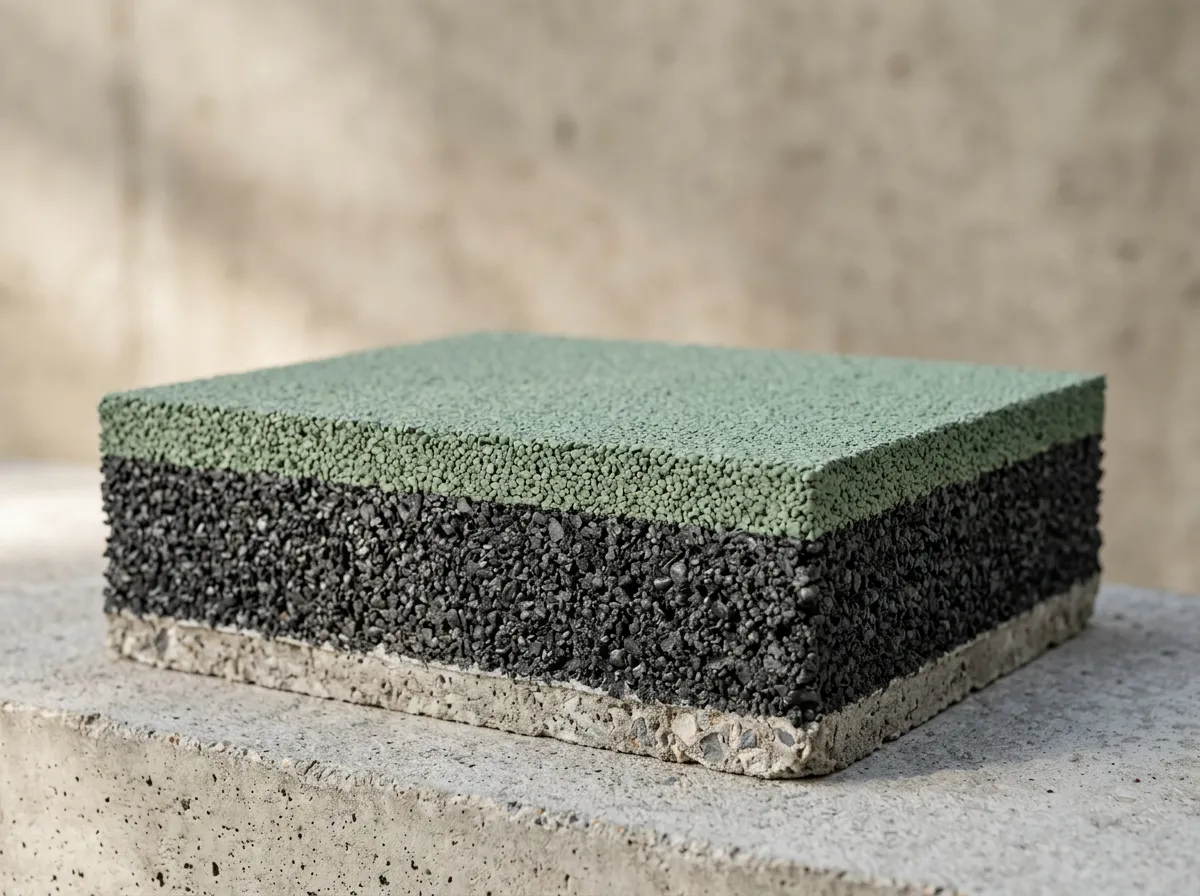
Rubber flooring in Dubai, as RBS lays it, is poured EPDM flooring: one seamless rubber surface made in place — playground flooring for villa play areas and nursery yards, and a soft floor for pool edges, home gyms and garden paths — priced per project after a site visit. Our rubber flooring is not a roll or a tile. It is built on site: a cushioning base of coarse rubber granules, then a coloured wear layer of finer granules — the EPDM rubber most people search for — bound in polyurethane and trowelled by hand into one seamless, soft surface. Because it is poured, it follows curves, mounds and equipment posts without a joint. There is no edge to trip on and no tile to lift; it drains, it gives a little underfoot, and it comes back up after impact. That resilience is the whole point, and it is why the same floor is called wet-pour, EPDM rubber flooring and rubber safety surfacing depending on who is selling it.
Playground flooring in Dubai, specified to the equipment above it
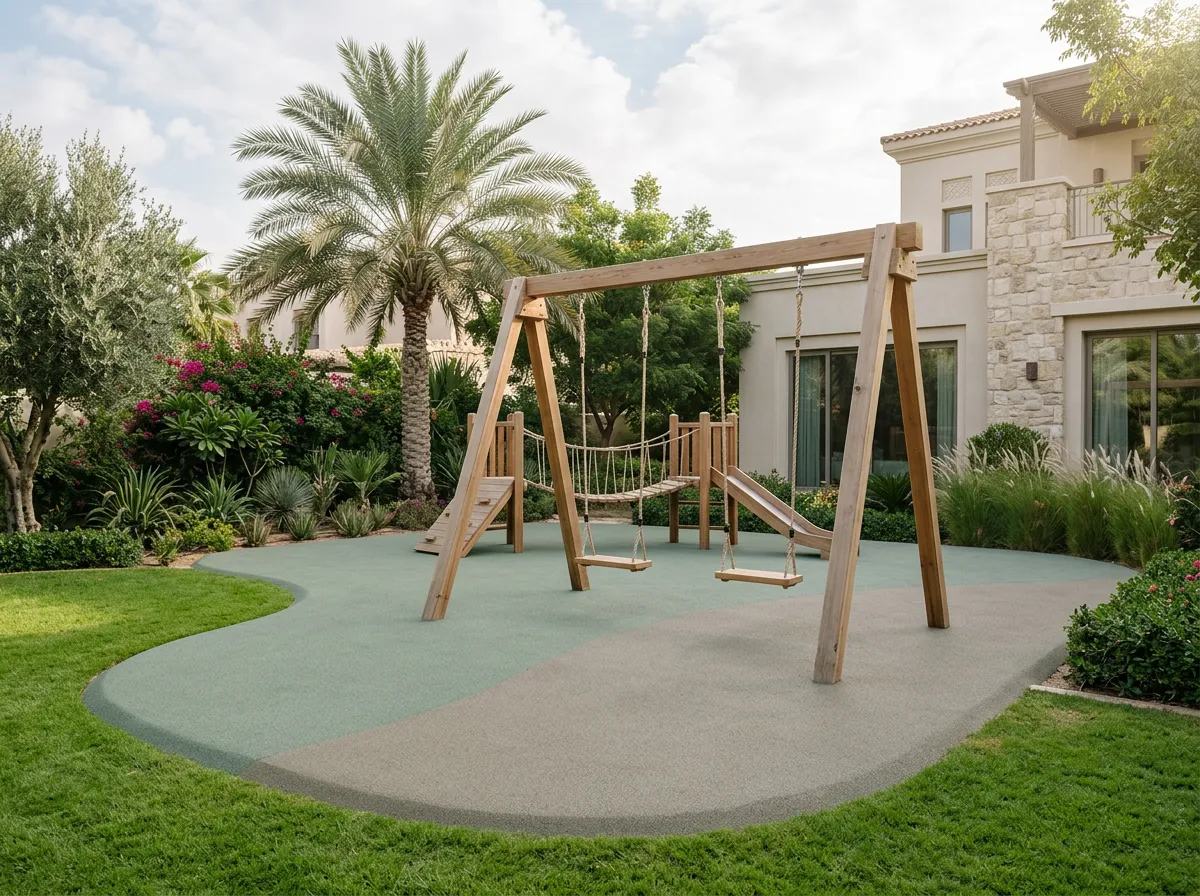
Where children play, the floor is part of the safety design, not the decoration. Impact-absorbing surfaces are specified by critical fall height — the fall height a given build-up has been tested to protect against — and that rating belongs to the build-up, not to “rubber” in general. A toddler springy and a three-metre climbing frame do not need the same floor.
So the first question we ask about a play area is not the colour; it is what stands on it, and how high the tallest piece is. The cushioning layer is set from that answer, and it is the biggest single driver of the price. It is also the question to put to any contractor you speak to: what fall height is this build-up rated for, and does it match the tallest equipment here? If they cannot answer, they are selling a colour.
Where rubber belongs — and where it does not
Rubber is the floor for places where people fall, run, train or walk barefoot: villa play areas, playgrounds and nursery yards, family pool edges, home and outdoor gyms, wellness rooms and garden paths. It is soft, warm and quiet where stone and tile are hard, cold and loud.
It is the wrong floor in three places, and we will say so before we quote:
- Formal rooms and driveways. Rubber reads as a play-and-movement surface. For a driveway, a formal terrace or a pool deck where the brief is elegance, stone carpet (resin-bound) is the better surface — and we lay that too.
- Heavy point loads. Softness is the point, and it is also the limit: very heavy equipment on small feet is hard on a soft floor.
- Gym rolls and tiles. Many people searching “rubber gym flooring” want rolls or interlocking tiles for a commercial gym. We pour seamless floors; we do not sell or lay rolls and tiles, and for that job a flooring supplier is the honest answer.
Honest about the UAE sun
Rubber flooring in the Gulf has real trade-offs, and you should hear them before you order. Colours fade: bright reds, greens and blues soften over years of sun, while blacks, greys and earth tones age far more gracefully. Heat: dark rubber in full summer sun gets hot, like every dark surface here; lighter tones and shading help. Wear points: under swing seats and at slide exits the wear layer works hardest and can eventually need patching — possible, because the floor is poured, but a patch in a faded field will read newer than its surroundings. None of this argues against rubber where safety is the brief. It argues for designing with the material’s ageing in mind, which is why we put the calmer, darker colours where the wear and the sun will be.
Rubber surfaces in Dubai, Abu Dhabi and across the UAE
Rubber surface, rubber flooring, EPDM flooring, wet-pour and rubber safety surfacing are five names for the same poured floor, and we lay it across the Emirates. Dubai is our base; the same in-house crews and the same two-layer system go to Abu Dhabi, Sharjah, Ajman and Ras Al Khaimah, so a villa play area in Abu Dhabi and a nursery yard in Dubai are built the same way and quoted the same way — per project, after a site visit. What changes from site to site is the equipment, the sun on the floor and the base underneath, not the emirate.
How poured EPDM flooring goes down, stage by stage
A poured rubber floor is built in a fixed order, and the order is where quality lives.
- Site visit and equipment list. We measure, check the base and write down the tallest piece of equipment, because that sets the cushioning thickness.
- Base check. The slab or compacted base must be sound, drain properly and be dry enough to take the floor. A base that holds water will lift a rubber floor from below, so a poor one is fixed first.
- Cushioning layer. Coarse rubber granules are mixed and trowelled to the thickness the equipment calls for, finished to the falls and levels of the design, including mounds and curves.
- Cure. The base layer sets before anything goes on top. Rushing this is the most common cause of a wear layer that marks or separates later.
- Coloured wear layer. Finer EPDM granules in the chosen colours are trowelled seamless over the cushioning layer, with any bands, shapes or edges cut in while the floor is still workable.
- Final cure and handover. The floor is kept clear until it has set; we then walk the site with you and show you where wear will show first.
Because every stage waits on the one before it, a rubber floor is a matter of days, not hours, and the weather matters: we avoid pouring into rain or the hottest hours of a summer afternoon.
Poured rubber, stone carpet or cork resin: which floor for which job
The three floors we lay that are kinder than stone each win a different place, and the honest choice depends on the spot, not on the look.
| Poured rubber | Stone carpet | Cork resin | |
|---|---|---|---|
| Underfoot | Soft, springy | Hard, like fine gravel | Warm, slightly soft |
| Falls from height | Right floor, if built to the equipment | Not suitable | Not for outdoors |
| Pool edge | Good for kids’ pools | Best for elegant decks | Not for outdoors |
| Driveway | No | Yes | No |
| Sun and heat | Colour fades, dark tones get hot | Stable colour, warm in full sun | Keep indoors |
| Priced | Per project, after a site visit | Per project, after a site visit | Per project, after a site visit |
If one garden has a play area, a pool and a driveway, the right answer is usually two floors meeting at a clean edge, not one floor everywhere.
Pool edges, home gyms and garden paths
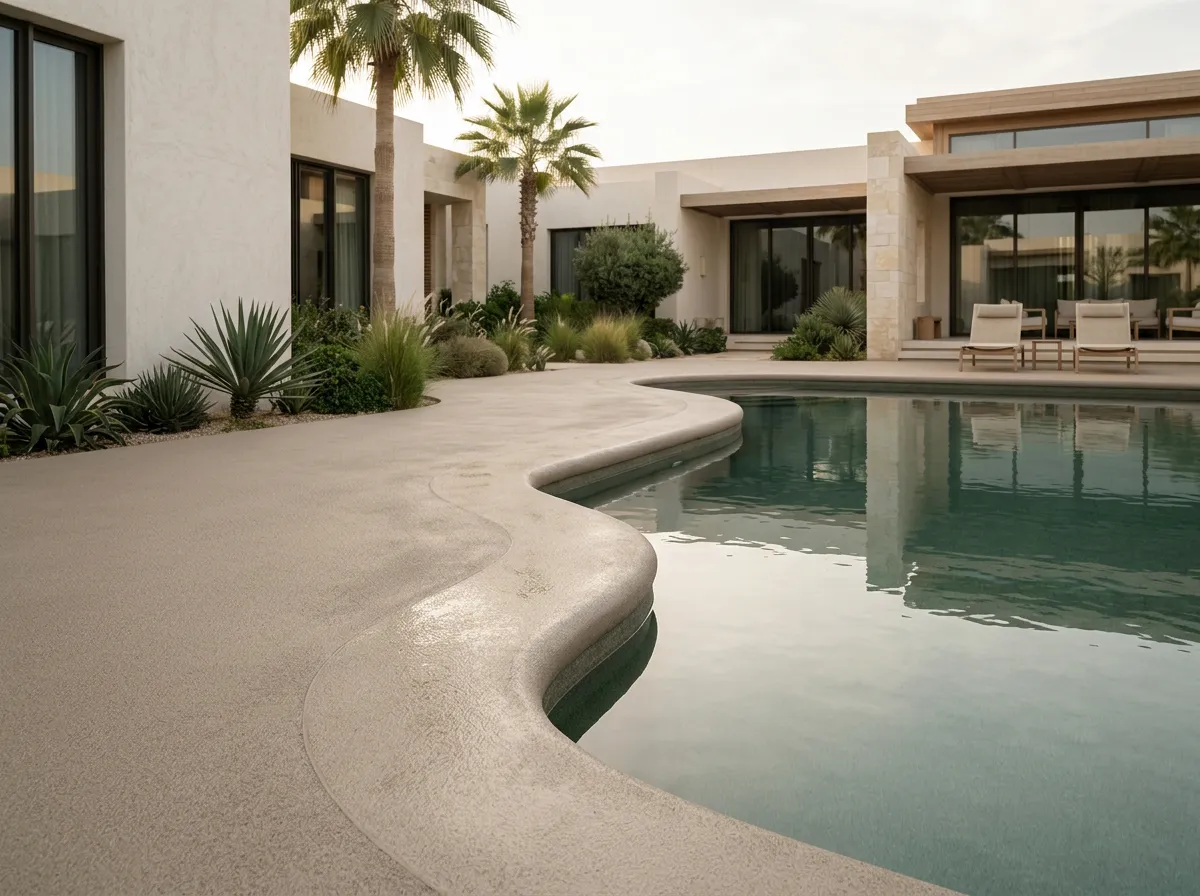
Pool edges are a judgement call. Rubber gives a soft, slip-resistant, child-friendly apron, and it is a common choice around family and kids’ pools; its trade-off is that it looks like a safety surface, not a stone one. Where toddlers run, that forgiveness is worth the look. Where the brief is barefoot elegance, stone carpet usually wins the deck — the whole field is compared in our pool deck materials guide.
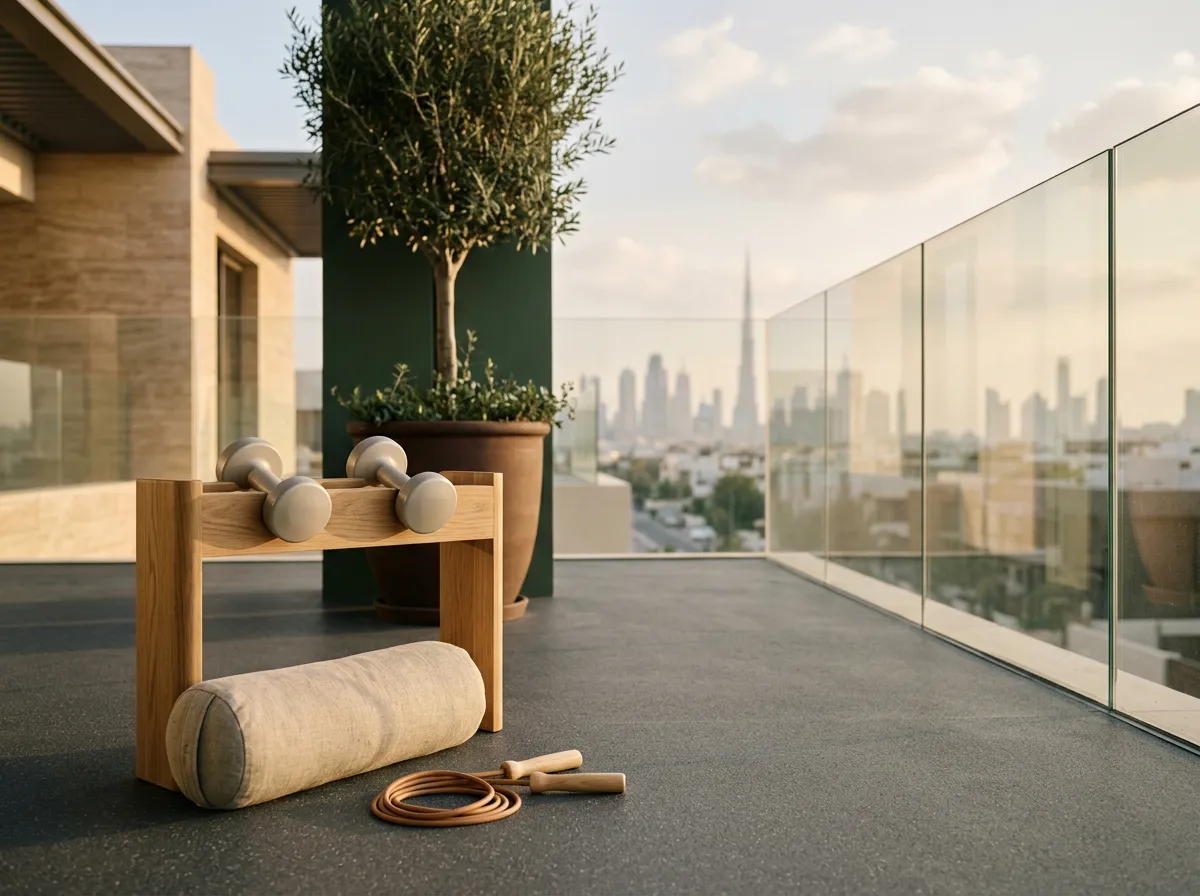
Home and outdoor gyms want rubber for dropped weights, vibration and joint comfort; a denser build-up takes a dumbbell without cratering and is kinder to knees than any hard floor.
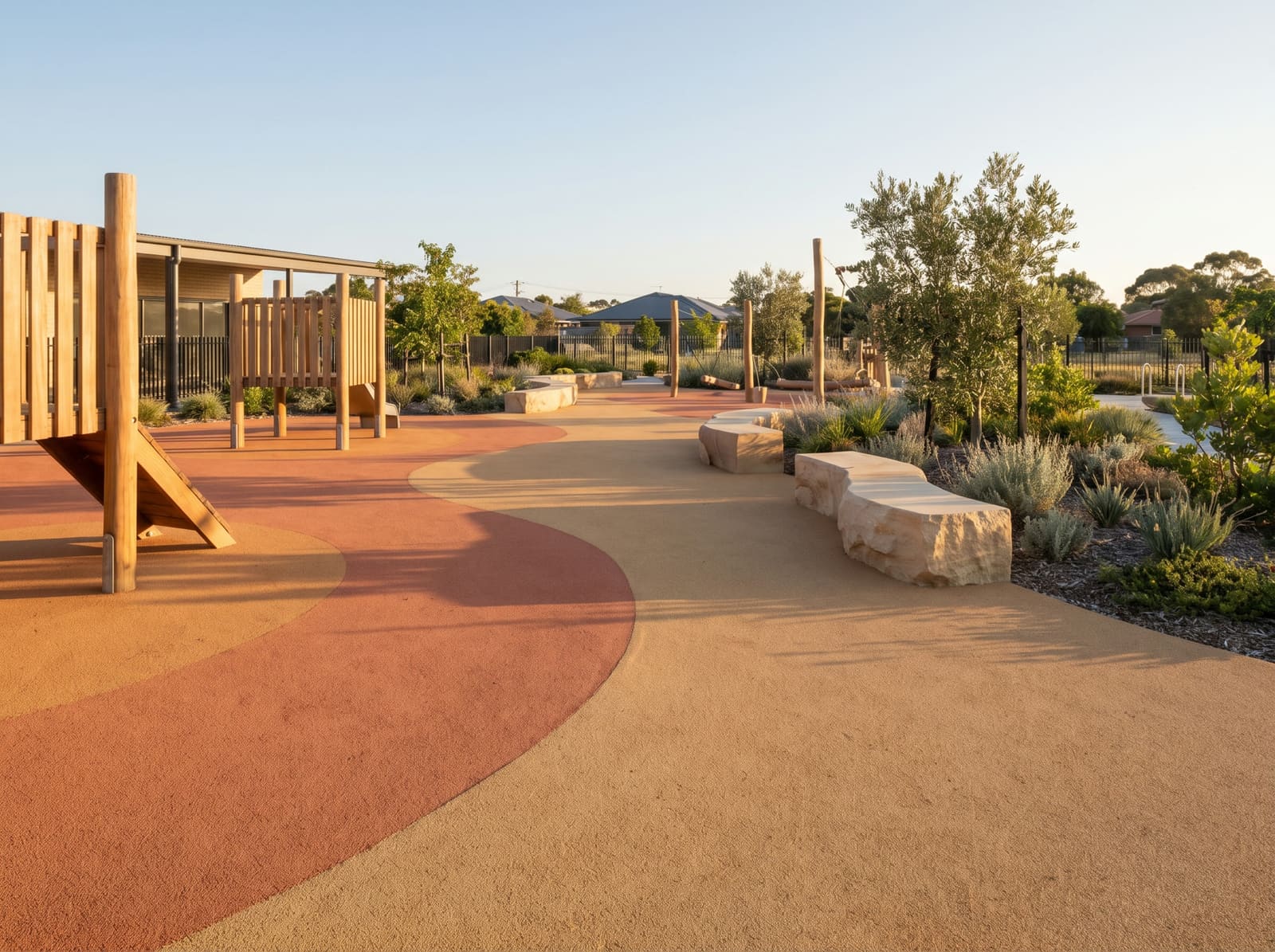
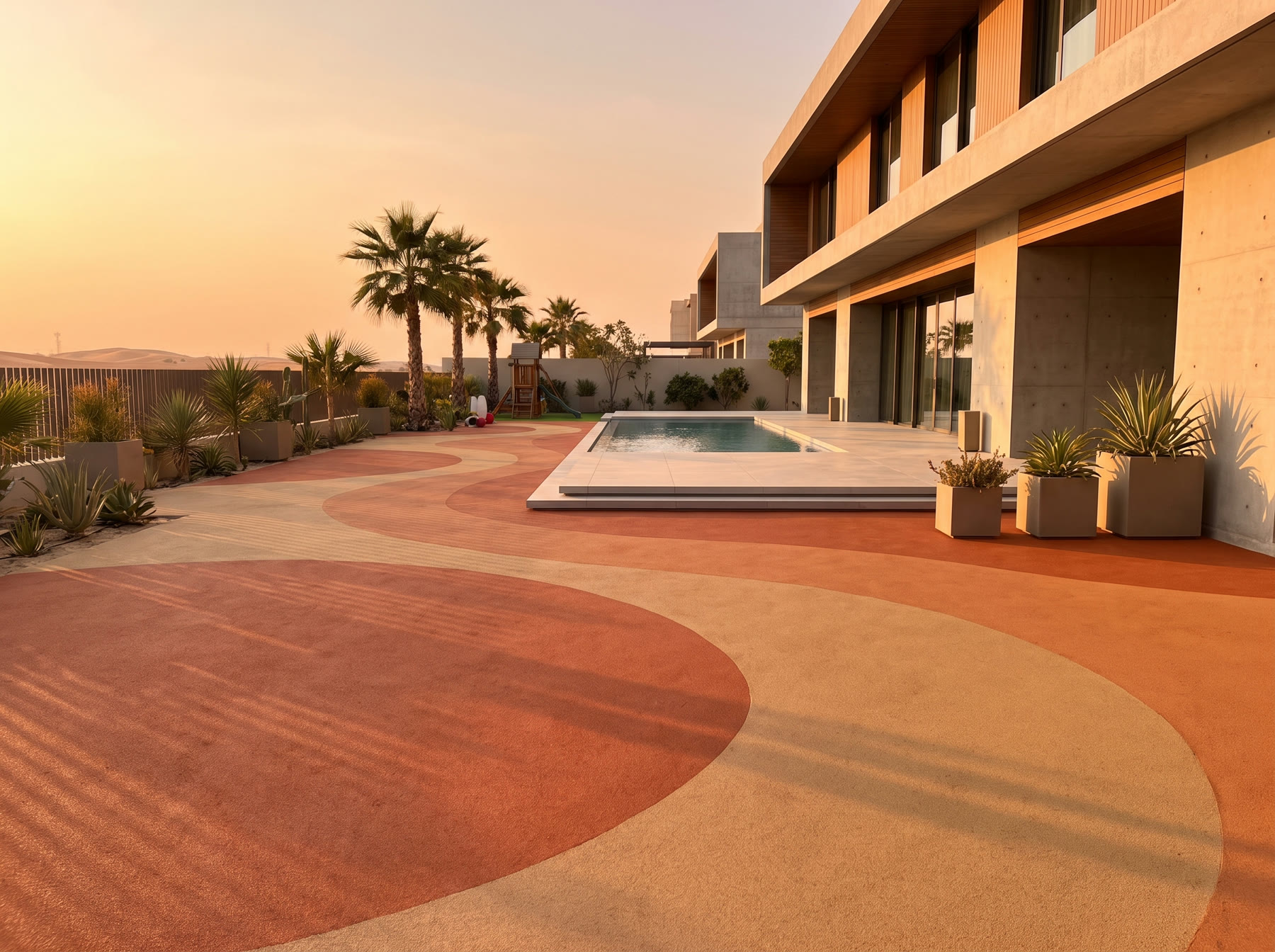
Garden paths and play zones are where poured rubber looks its best: it sweeps around planting and benches in soft bands of colour, with no edges to trip a running child.
How we price rubber flooring
Rubber flooring is priced per project, supply and install, after a site visit. The cushioning thickness the equipment dictates is the largest cost driver; the area, the shape and the state of the base beneath come next. To start, send the site plan or a few photos — including what equipment is going in — on WhatsApp, or call +971 4 587 7086. For the material itself, see how poured rubber works; for the full safety picture, read rubber safety flooring in the UAE.
Why Dubai chooses RBS for rubber flooring
Poured, not laid in pieces
We build the floor in place: a cushioning base of rubber granules, then a coloured wear layer bound in polyurethane and trowelled seamless. It follows curves, mounds and equipment posts without a single joint — nothing to lift, nothing to trip on.
Specified to the equipment
A playground floor is engineered to what stands on it. The first thing we ask about is the tallest piece of equipment, because the cushioning build-up has to match the height a child can fall from. A contractor who never asks is decorating, not protecting.
Our own trained crews
Every RBS applicator is trained and directed in-house — never a subcontracted day-rate crew. The same people who quote the job are the ones who pour it.
Honest about where it stops
Rubber is the right floor where people fall, run, train or walk barefoot. It is the wrong floor for a formal room or a driveway, and if what you want is gym rolls or tiles, a flooring supplier is the better call — we will tell you so.
Your questions, answered straight
Will the colours fade in the Dubai sun?
Some, yes. UV is hard on coloured rubber granules: bright reds, greens and blues soften noticeably over years of UAE sun, while blacks, greys and earth tones age far more gracefully. If a design depends on vivid colour staying vivid, we will steer the palette rather than promise what the sun will not keep.
Does rubber get hot?
A dark rubber surface in full summer sun gets hot, like every dark surface here. Lighter tones and shading help. Barefoot afternoon play in August is a shade-structure conversation, not a flooring one — and we would rather say that now than after the first summer.
Where does it wear first, and can it be repaired?
Under swing seats and at slide exits, where the wear layer works hardest. Because the floor is poured, those spots can be patched — but a patch in a faded colour field will read newer than its surroundings, so we put darker, calmer colours where the wear is going to be.
Is rubber better than resin-bound stone for a play area?
Yes, and we lay both. Resin-bound stone is hard: it looks soft and gravelly, but a child falling from equipment onto it hits something as unforgiving as concrete. On one villa plot the honest split is resin-bound for the driveway, paths and pool deck, and poured rubber under the swings and the trampoline, meeting at a clean edge.
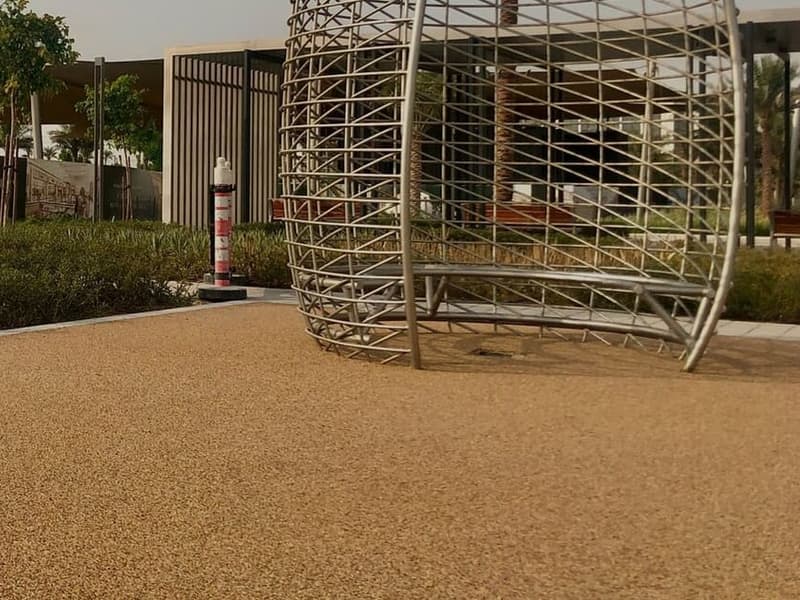
The finish

Frequently asked
What is rubber flooring, and where is it used in the UAE?
Rubber flooring is a soft, cushioned surface made from rubber granules. We pour it in place as one seamless layer: a rubber cushioning base, then a coloured wear layer bound in polyurethane. In the UAE it goes where people play, train, run or walk barefoot: villa and nursery play areas, pool edges, home gyms and garden paths. It is priced per project after a site visit, and we do not lay rubber tiles, mats or rolls.
What is the rubber flooring price in Dubai, per square metre or per square foot?
We do not publish a per-square-metre or per-square-foot rate for rubber flooring. It is priced per project, supply and install, after a site visit, because the cushioning thickness — set by the equipment above it — drives the cost more than the area does. A toddler area, a playground under a tall climbing frame and a home gym are three different build-ups. Send the site plan and the equipment list and we will price the real job.
What is EPDM rubber flooring, and do you lay EPDM flooring in Dubai?
EPDM is the coloured rubber granule usually used in the top layer of a poured rubber floor. The floor is usually built in two layers: a coarse black cushioning base of recycled rubber granules, then a coloured wear layer of finer granules bound in polyurethane and trowelled seamless on top. EPDM rubber flooring, wet-pour and rubber safety surfacing are the same poured floor under three names — and yes, we lay EPDM flooring in Dubai and across the UAE with our own crews.
What is the best playground flooring in Dubai?
For a playground, nursery yard or villa play area in Dubai, poured rubber is the playground flooring we recommend: soft, seamless, with no joints to trip on, and built to the fall height of the tallest equipment. The cushioning depth is set from that height, so ask any contractor what fall height their build-up is rated for. Natural grass wears through to hard ground under swings and slides, and resin-bound stone is a hard surface: it belongs on the paths around the play area, not under the equipment.
Is rubber flooring good around a pool?
Yes, for a family pool edge or a kids' pool apron. Poured rubber drains rather than seals, gives a soft landing to a slip and has no gaps where sand collects, unlike decking boards. Two honest limits: bright colours fade in UAE sun, and dark rubber gets hot, so choose light or earth tones and add shade. For an elegant open pool deck, resin-bound stone is the better surface, and we lay both.
Is rubber flooring waterproof?
A poured rubber floor drains rather than seals: water passes into and off it instead of pooling, which is why it works at pool edges and in outdoor play areas. It is not a waterproofing membrane, though — if the slab beneath needs waterproofing, that is a separate layer and a separate conversation.
Is poured rubber good for a home gym?
For a home gym or an outdoor gym corner, yes — it is kinder to knees than a hard floor, and a denser build-up takes a dropped dumbbell without cratering. Its honest limit is heavy point loads: very heavy racks and machines standing on small feet are harder on a soft floor. And if you want rubber gym rolls or interlocking tiles for a commercial gym, a flooring supplier is the right call — we pour seamless floors, we do not sell or lay rolls and tiles.
Are you rubber flooring suppliers, or contractors near me?
Contractors — RBS Group is based in Business Bay, Dubai, and our own crews supply and install the floor as one job, anywhere in the UAE. We do not sell rubber granules, binder or rolls on their own: a poured floor lives in the build-up, the mix and the trowelling, so the material and the workmanship sit with one company.
Do you lay outdoor rubber flooring in Dubai?
Yes — most of the rubber flooring we pour in Dubai is outdoors: villa play areas, nursery yards, pool edges and garden paths. It drains, gives a little underfoot and has no joints to lift. Two honest caveats for UAE sun: bright colours soften over the years while blacks, greys and earth tones age well, and dark rubber gets hot in summer, so shade matters for barefoot play. Send the area and a photo on WhatsApp.
Do you install rubber surfaces in Abu Dhabi and across the UAE?
Yes. Dubai is our base, and the same crews lay the same poured rubber surfaces in Abu Dhabi, Sharjah, Ajman and Ras Al Khaimah — one system, one company, whichever emirate the site is in.
Start your project
Tell us about your space.
Send a few photos and rough sizes on WhatsApp — we'll come back with a real number and, if you'd like, a sample of the exact colour and finish.
Updated 28 October 2026. Every project is priced after a site visit.