
Lime plaster · lime walls · lime plastering — Dubai & all UAE
Lime Plaster in Dubai
Updated 14 October 2026
Lime plaster is a breathable wall finish of slaked lime, laid by hand in thin coats, that slowly turns back into stone on your wall. One family, many finishes: soft matte marmorino, polished Venetian plaster, water-shedding tadelakt, chalky limewash and more. We apply all of them in Dubai and across the UAE with our own crews, and we will tell you which one your room actually needs.
- 8+ years of decorative surfaces in the UAE
- Trained in-house crews — never subcontracted
- Genuine slaked lime, not an acrylic lookalike
- Physical sample of your exact finish before we start
Pricing
Lime plaster is priced per project after a site visit, supply and install. The finish you choose, the state of the wall underneath and the shape of the room decide the figure far more than the area does, so we see the wall before we quote.
Send a few photos and rough sizes on WhatsApp to start. Bespoke colours, curved walls, wet rooms and floors are all priced at the same consultation.
What lime plaster is, and why it is not just plaster
Lime plaster starts as limestone, burned and then slaked back into a soft putty. Mixed with marble dust, fine sand or crushed terracotta, it is laid on a wall in coats and worked by hand. Then it does something no other wall finish does: over weeks and years it draws carbon dioxide from the air and slowly turns back into calcium carbonate, which is to say back into stone. The wall you live with is not a coating on the surface; it becomes the surface.
That slow chemistry is the source of everything people choose lime for. The wall stays vapour-open, so moisture inside it can leave instead of being trapped behind a film. It is naturally alkaline, so it resists mould without a fungicide. It stays faintly flexible, so it moves hairline with a building instead of cracking sharply. And because the colour sits inside the lime rather than on top of it, light sinks into the surface and moves as you cross the room.
In Dubai and across the UAE, lime plaster in practice means a family of decorative finishes rather than one product: matte marmorino, polished stucco veneziano, water-shedding tadelakt, brushed limewash and more. This page is the hub for that whole family and for the choice between its members. If you already know you want the polished, glossy Venetian finishes, our Venetian plaster in Dubai page goes deeper on those; this page covers every lime finish we apply and how to pick the right one for each room.
Lime, gypsum and cement plaster: the real differences
Lime, gypsum and cement are the three plasters people weigh up, and they behave very differently on a UAE wall.
| Lime plaster | Gypsum plaster | Cement plaster / render | |
|---|---|---|---|
| How it hardens | Slowly reabsorbs CO₂ from the air, over weeks to years | Crystallises with water, in hours | Flashes off hard, far faster than lime |
| Surface | Soft mineral depth, subtle movement | Dead-flat, hard, uniform | A harder surface than lime |
| Moisture | Breathes; tolerates moisture with the right craft | Dislikes it, so dry interiors only | Resists salt and driven weather better than lime outdoors |
| What it is for | Decorative finishes: marmorino, tadelakt, limewash and the family | Fast levelling skims; stucco lustro and scagliola | Exterior render, and the binder of marmorino cementizio |
| How it ages | Mellows and gains patina | Stays exactly as installed | Stays composed on an exposed wall, without lime’s glow |
The full comparison is in lime plaster vs gypsum plaster, and the two polished finishes side by side in stucco lustro vs Venetian plaster. The honest summary is that they are not always rivals. In most modern Dubai villas a gypsum levelling coat provides the flat substrate, and the decorative lime finish above it decides the wall’s character. Where they genuinely compete, gypsum wins on speed and dead-flat perfection in a dry, air-conditioned room, and lime wins wherever a wall meets humidity, age, or the wish for a surface that mellows. The full comparison is in our guide to gypsum vs lime plaster.
Cement has its own place in the family tree. For an exposed facade that takes the full UAE day, marmorino cementizio, a marmorino look on a cement binder, is often the harder-working answer than pure lime. Indoors, side by side, lime wins on depth and glow.
Lime plaster walls in a UAE villa: why they work here
The UAE is hard on walls in a specific way. Interiors run chilled by air conditioning against hot, moisture-loaded outdoor air for most of the year. Wherever that humid air meets a cold surface (the wall behind a wardrobe, the corner an AC vent blows across, a window reveal) it condenses, then the AC cycles off and the moisture sits. Coastal air also carries salt, and older villas often hold residual damp in their blockwork.
Walls fail in that climate when moisture arrives and cannot leave. A vapour-closed acrylic film traps it, and it shows up as blistering, powdery patches and mould in the damp layer behind the paint. Lime takes the opposite route. It is vapour-open, so moisture passes through and out, and salts crystallise harmlessly at the surface rather than pushing a coating off from behind. Its high pH means a cured lime wall resists mould without additives, which is why lime has always been the material of humid-climate architecture. The detail is in breathable wall finishes for the UAE and wall finishes, humidity and AC.
Two honest caveats. First, a finish is not a cure for a leak: fix the moisture source and make sure the extractor actually runs, and lime then keeps the wall healthy. Second, breathable finishes are less scrubbable as a family. If a wall will be wet-cleaned every week, a sealed surface is the better servant, and we will say so.
The lime finishes we apply
Every finish below is genuine slaked lime, applied by our own crews, and each has its own page. One honest line on each:
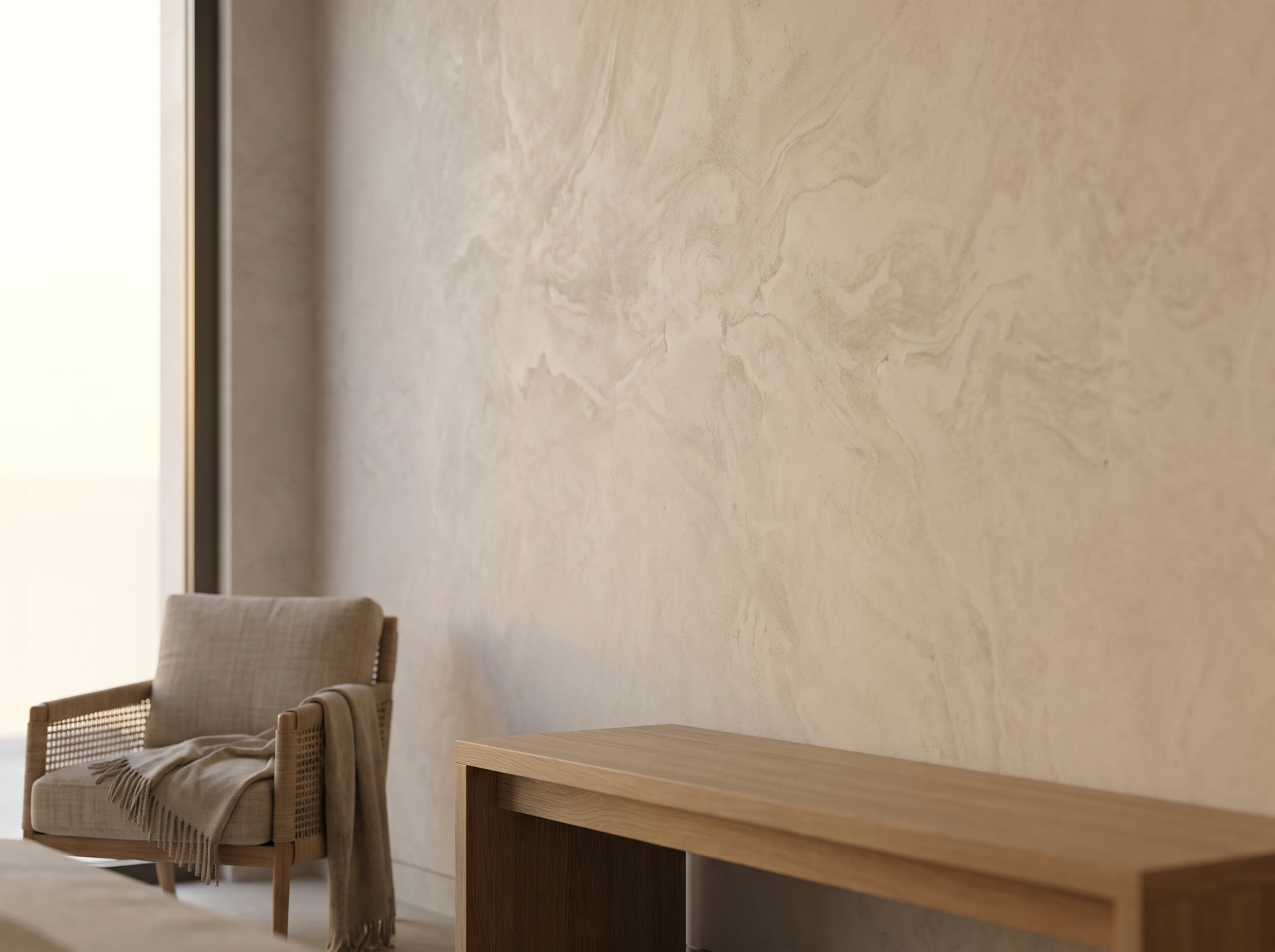
- Marmorino — lime and marble dust with the soft, cloudy depth of stone, matte to gentle satin. The calm default for living rooms, bedrooms and majlis walls.
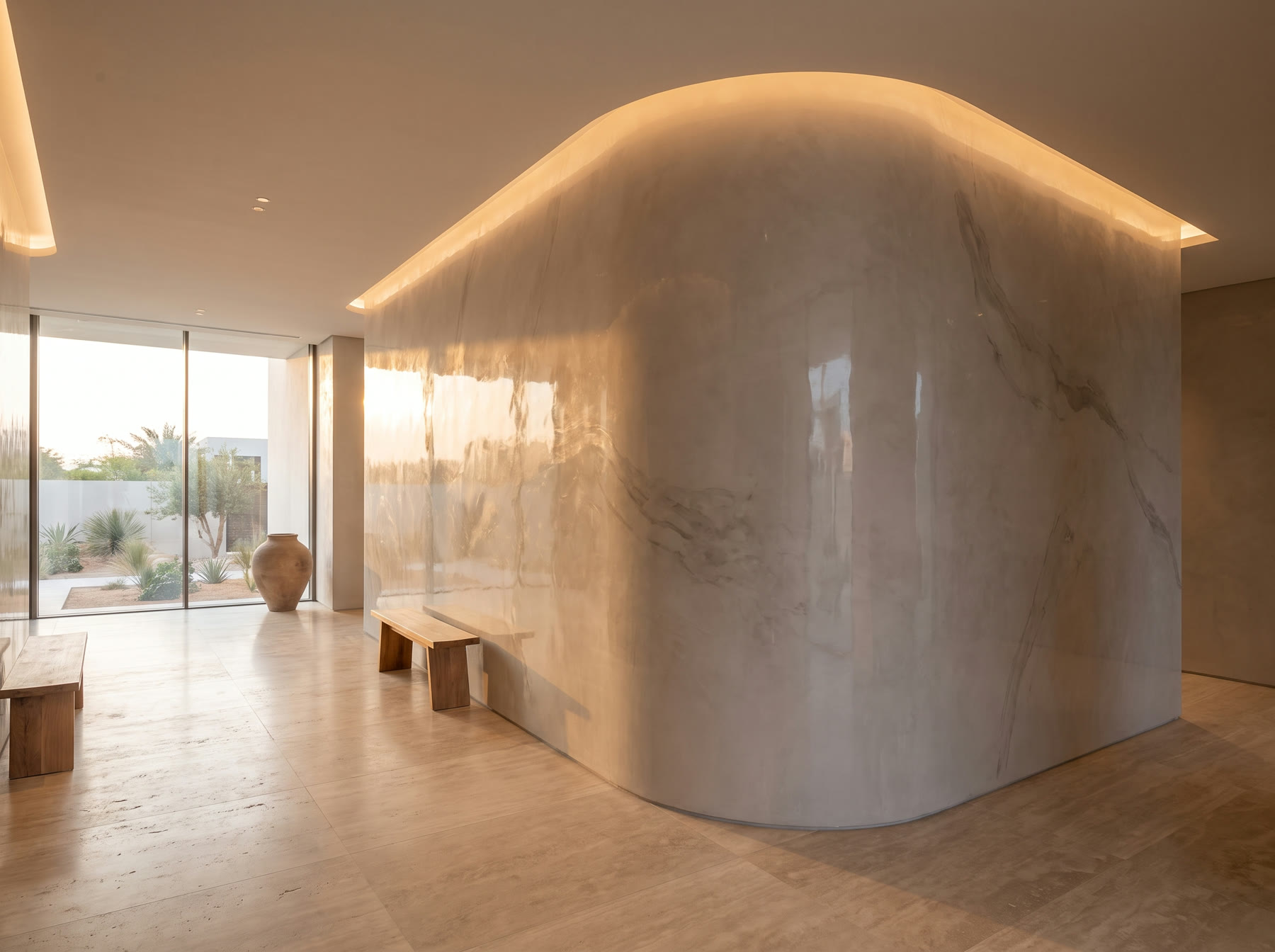
- Stucco veneziano — Venetian plaster proper, burnished to a glassy, marble-like gloss. For the walls meant to be noticed, and it needs a flat, well-prepared wall.
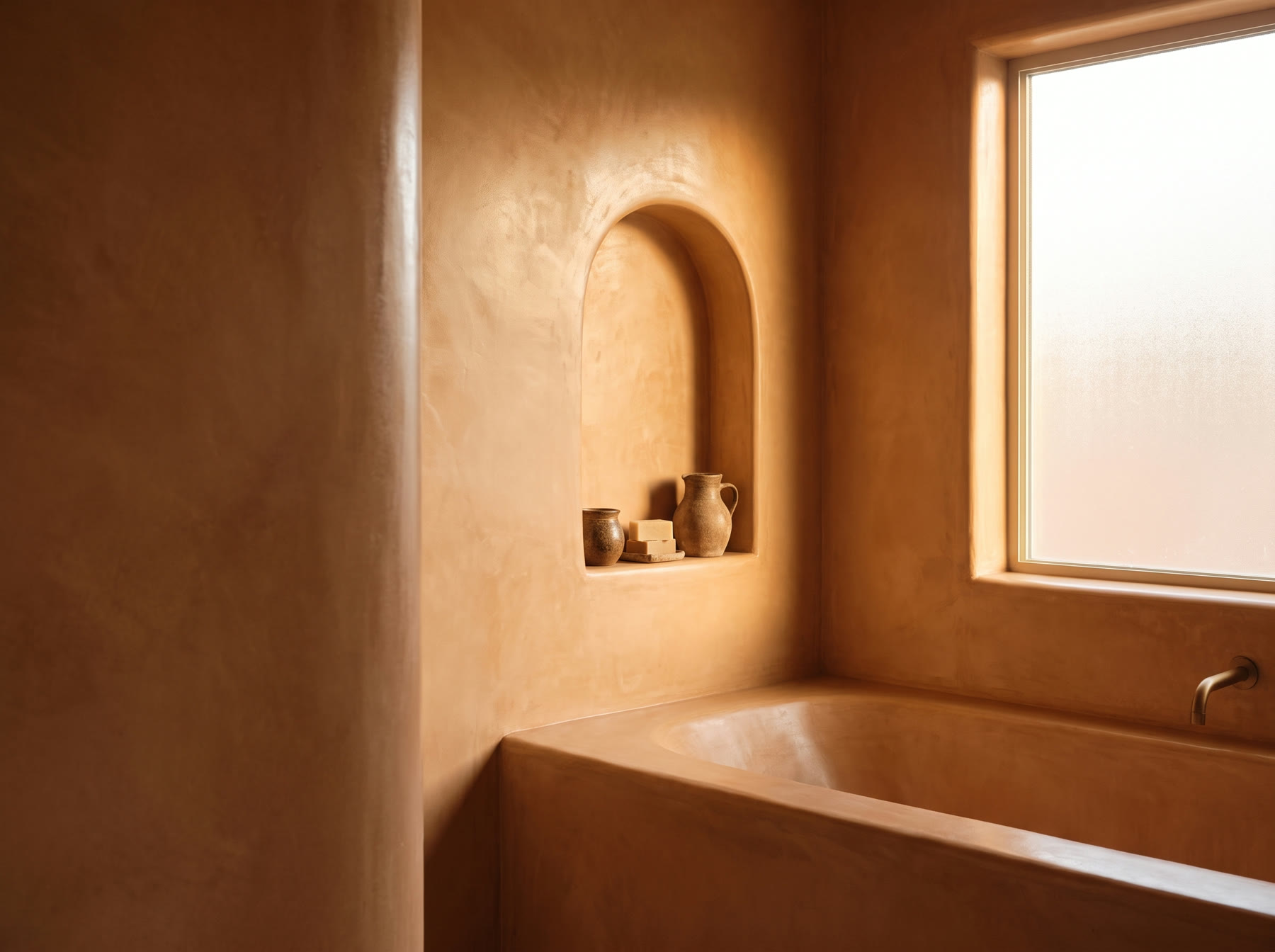
- Tadelakt — Moroccan lime compressed with a stone and sealed with soap until the wall sheds water. The only lime finish we put inside a shower; see tadelakt in Dubai.
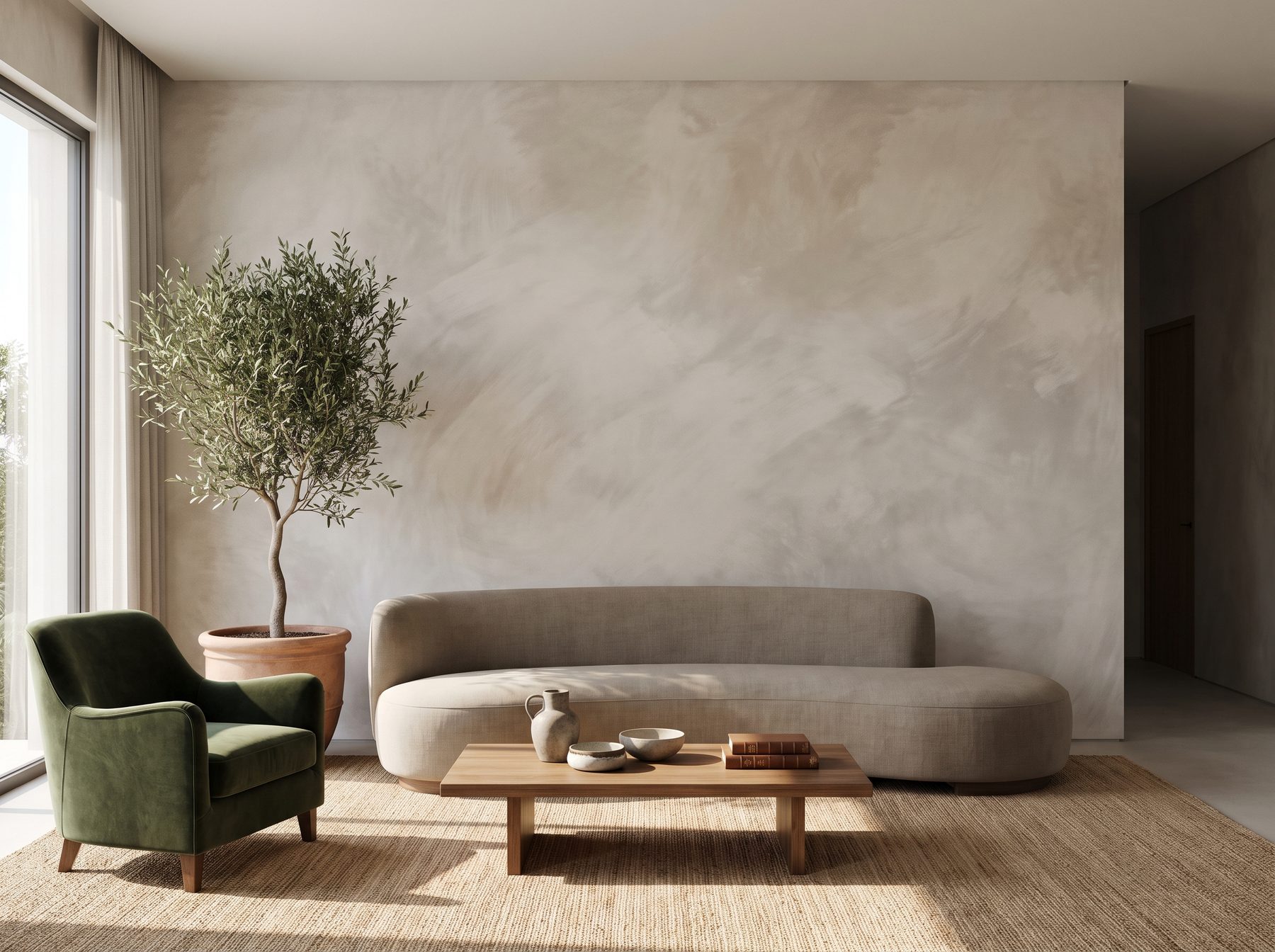
- Limewash — slaked lime brushed on thin, drying to a chalky, cloudy matte. The least expensive way into real lime, but a wash with no body, and it can chalk on walls you brush past. More at limewash in Dubai.
- Travertino — lime plaster with the open pores and drift of travertine stone. Tactile and forgiving, best on interior walls away from constant wetting.
- Intonachino — fine sand in lime: a flat, matte wall with a faint grain. The calmest choice, and comfortable running straight out onto a facade.
- Grassello di calce — aged lime putty worked to a soft satin glow, the base every Venetian finish is built on. Quiet, even and indoor only.
- Spatolato — trowelled lime with tone-on-tone cloudy movement, matte to satin. A modern, restful backdrop for interiors, not for floors, showers or outdoors.
- Encausto — Venetian lime finished with burnished wax for a warm satin glow that takes a wipe. The wax seals the lime’s breathing, so it is for interior walls only.
- Marmo antico — a textured lime built to look a century old. One wall in a hallway or stair is atmosphere; every wall in the house is a theme park.
- Sgraffito — a pattern scratched through two coloured lime layers, so the design lives in the wall. Craft-intensive and permanent once cut, so it is for one considered wall.
- Cocciopesto — lime warmed with crushed terracotta, the Roman water-loving plaster. A warm pink-earth palette only; it will never read cool or grey.
- Pastellone — the Venetian lime floor: one seamless, tinted, waxed plane. Warm underfoot, but softer than terrazzo, and it wants re-waxing.
If two of these sound alike, they often are, which is why the sample board matters more than any description. Intonachino vs marmorino untangles the most common pair.
How to choose lime plaster by room
Living rooms and majlis
The wall a room is built around is where lime earns its cost. Marmorino gives calm, cloudy stone; stucco veneziano gives polished depth for an entrance or formal room; travertino or marmo antico add texture and weight; spatolato keeps it tone-on-tone and modern. A ceiling in polished lime catches the light beautifully. If a majlis wall will be leaned on and touched, encausto’s wax skin takes the daily contact better than bare lime.
Bedrooms
Bedrooms are where the quiet finishes belong: grassello di calce, intonachino, spatolato, marmorino, or limewash for a soft chalky matte. The breathing is felt most in the rooms you sleep in, and nobody drags a shoulder along a headboard wall, so limewash’s tendency to chalk rarely matters here.
Hallways and stairwells
These are the hardest dry walls in a house, because bags, shoulders and hands brush past all day. A polished finish marks more than a matte marmorino here, so choose the sheen for the traffic, or choose encausto for its wipeable wax. Bare limewash on a busy corridor is a poor choice unless it is fixed or waxed. Marmo antico and sgraffito suit a stair elevation you look at, not one you lean on.
Bathrooms
A good lime bathroom is zoned. Inside the shower: tadelakt, with a waterproofing build-up beneath it. On the dry walls (vanity, WC, behind a tub): marmorino, Venetian plaster or encausto, sealed sensibly, with an extractor that runs. A powder room or a well-ventilated ensuite wall away from the spray can take limewash. Cocciopesto, the terracotta lime, is the warm-toned alternative where its colour suits. The zoning, wall by wall, is in Venetian plaster in bathrooms.
Kitchens
Kitchen walls, the front of an island and a plastered range hood are excellent in lime. A splashback behind the hob is conditional: lemon, vinegar and tomato etch lime, so it only works in a household that wipes it at once. In a kitchen that cooks hard every day, microcement is the seamless splashback we recommend. We never plaster cabinet doors, because they flex and slam, and a worktop is never lime.
Exteriors
Intonachino is built to carry the same matte skin from the entrance hall out to a facade or courtyard. Limewash suits shaded, sheltered exterior walls that someone will recoat every few years. Marmorino and travertino belong in protected spots such as a loggia, a shaded courtyard wall or a deep porch. For an exposed facade, boundary wall or pool-side elevation, the honest answer is often marmorino cementizio, which keeps the look on a tougher cement binder, and the reasons are in marmorino outdoors in the UAE.
Floors
Most lime is a wall finish. Pastellone is the one lime built to be a floor, and tadelakt goes on a spa bathroom floor selectively. Everything else stays on the wall; see which lime finish can go on a floor.
How we carry out lime plastering, stage by stage
A lime wall is not bought and fitted; it is built on site, and the hands doing it decide everything. The sequence below is the same on every job. The closing step changes with the finish.
| Stage | What happens | Why it matters |
|---|---|---|
| 1. Site visit & sample | We check that the wall is flat, sound and dry, agree the finish, and prepare a physical sample board in your exact tone | Burnishing deepens colour, and lime looks different cured than fresh; a screen never shows that honestly |
| 2. Prep & priming | Loose paint, hollow patches and damp plaster are fixed or hacked back, never plastered over; the surface is keyed and primed so the lime bonds. In a shower, a waterproofing membrane goes in first, with falls and drains detailed | Lime laid over a problem does not fail on day one; it fails months later, once the wall behind it moves |
| 3. Base coats | One or two levelling coats build a flat, even plane | A wall that is not flat first telegraphs every dip through the finish |
| 4. Finish coats | Two to three thin coats of the chosen lime, each left to firm before the next; limewash is brushed on in thin coats, wet-into-wet across a whole wall | Thin coats are deliberate; a thick coat skins over while the body stays soft, and crazes as it dries |
| 5. Closing the surface | Stucco veneziano is burnished by trowel; marmorino stays matte or takes a light burnish; tadelakt is compressed with a stone and sealed with soap; encausto and pastellone are fed with wax | Timing is everything: burnish too early and the lime tears, too late and it will not take a shine |
| 6. Cure | The visible cure takes days; lime keeps hardening and deepening in colour for weeks. A new tadelakt wall is treated gently for its first month | We ask for a settling-in period before anyone judges the final tone |
A single Venetian plaster feature wall runs three to five days on site, and a full room runs longer, because each coat needs its own drying window. A tadelakt bathroom takes one to two weeks, and a hammam longer. The same crews and the same sequence travel from Dubai to Abu Dhabi, Sharjah, Ajman and Ras Al Khaimah.
Where lime plaster fails, and how we build against it
Most of what goes wrong with lime is not the material. It is the wall behind it, the climate around it, or the speed of the crew, and it shows up months after handover. The full reasoning is in does lime plaster crack in the UAE.
- A moving or unsound substrate. Fresh blockwork still shrinking, a gypsum-board partition that flexes, or two materials meeting with no joint detail. Lime faithfully reports whatever moves beneath it. We spend the effort on preparation, and we tell you when a crack is structural and has to be fixed before any finish.
- Laid too thick, too fast. Piled on to save a day, the surface skins over while the body is still soft, and it crazes. We build in thin coats, each left to firm before the next.
- Drying too fast in heat or AC air. Lime that flashes dry loses the slow set it depends on, and cold, dry AC air aimed at fresh lime leaves a weak, chalky film or hairline crazing. We time coats around the room’s AC, cover or redirect vents where needed, and shade exterior walls from direct sun while they cure.
- Trapped under a non-breathable coat. Lime laid over old gloss or vinyl paint on a damp wall, or sealed under the wrong topcoat, traps moisture that blooms or delaminates weeks later. We check what is already on the wall and strip back to a sound, mineral-friendly surface.
- Acids. Vinegar, lemon, descaler or a limescale spray etch lime permanently. Every household gets the no-acids rule at handover, and where a wall will be splashed we specify wax or a protective finish at the quoting stage, or a different surface.
- Rushed burnishing and visible coat joins. A patchy sheen or faint rectangles where coats overlap are training problems. That is why we never send a day-rate crew to learn the timing on your wall.
- Dust from other trades. Sanding and joinery dust settles into a tacky coat and dulls it. Where the programme allows, we plaster after the dusty trades, and we flag it at the site visit when it does not.
Where lime plaster is the wrong choice
Honesty is the reason to trust a lime specialist, so here are the walls we turn down or redirect.
- A wall you will repaint in five years, a rental, or a plain ceiling. Quality paint over a gypsum skim is the right answer and costs a fraction as much.
- A wall you scrub. A kitchen splash zone, a clinic corridor, a wall children draw on: a sealed, washable surface serves it better.
- A shower in anything but tadelakt. Polished Venetian plaster, marmorino and limewash streak and wear under daily spray.
- A floor, unless it is pastellone or a selective tadelakt spa floor.
- An exposed facade in full sun and salt air, where marmorino cementizio is the harder-working answer.
- A household that cleans with acids and will not change. Lime will lose that argument every time.
- A precise brand colour or bright, saturated shades. Lime always moves a little, and limewash only takes mineral pigments.
- A fast programme. Lime cures for weeks, and that cure time cannot be negotiated away.
What decides the cost of lime plaster
Lime plaster is priced per project after a site visit, supply and install, because the wall and the finish decide the figure more than the area does. These are the drivers:
- The finish. Limewash is the least expensive way into real lime. Matte marmorino and travertino need less burnishing than polished stucco veneziano, which is hours of trowel work. Tadelakt is the most labour-intensive of all.
- The number of coats and the sheen. Deeper, more layered and more polished finishes take more passes, and every pass is hand time.
- Wall preparation. Lime shows whatever sits beneath it, so an uneven wall, loose paint or hidden damp has to be put right first.
- The shape of the room. Curves, niches, benches, columns and ceilings take longer than a flat wall.
- Wet-zone work. Tadelakt adds the waterproofing build-up and stone burnishing.
- Protection. Wax or a protective finish specified for a hallway, a powder room or a splash zone.
- Bespoke work. Deep custom pigments, sgraffito patterns or textured effects.
- Scale and access. A small feature wall carries the same set-up as a large one, so several walls in one visit cost less per metre than a single small wall.
Labour, not material, is most of what a lime quote prices. When you compare quotes, compare supply and install together, and ask whether the crew is in-house or subcontracted. The driver-by-driver detail is in the Venetian plaster cost guide and the tadelakt cost guide.
Caring for lime plaster walls
Lime asks for very little, and the one rule matters more than everything else.
- Dust dry. A soft microfibre cloth is most of the maintenance; in the UAE, fine dust is the main thing that settles on an interior wall.
- Wipe marks gently. A cloth wrung almost dry, with a drop of pH-neutral soap if needed, then a dry cloth. Never soak the wall.
- No acids, ever. Vinegar, lemon, limescale and hard-water removers, bathroom power sprays, bleach and abrasive cream cleaners all etch lime. Near basins, wipe hard-water film before it dries rather than reaching for a descaler.
- Feed the finishes that need it. Tadelakt wants a squeegee after the shower and a soap feed every year or so; encausto and pastellone want re-waxing every so often; limewash refreshes with a new coat brushed straight over the old.
- Never repair it yourself with filler or paint. Gypsum filler dries white and cannot be burnished, and paint seals a breathing wall. A chip or scuff left alone is a small job for a trained hand, who can blend it into the existing finish.
The routines are in Venetian plaster wall care, tadelakt care and Venetian plaster repair.
Lime plaster vs paint, gypsum and microcement
Four realistic ways to finish a Dubai wall, compared on what they do for years afterwards:
| Lime plaster | Paint (emulsion) | Gypsum skim | Microcement | |
|---|---|---|---|---|
| What it is | Slaked lime that carbonates into the wall | A polymer film on the wall | A fast-setting, dead-flat plaster | A cement-polymer coating under a sealer |
| Breathes? | Yes, vapour-open | Largely seals the wall | Dislikes moisture | No, sealed once finished |
| Look | Depth and movement inside the material | Uniform colour, any shade | Flat, ready for paint | Calm, matte, concrete-like plane |
| Cleaning | Dust and a gentle wipe; no acids | Washable, scrubbable in better grades | Depends on the paint on top | Normal cleaners, washable |
| Repair | Blended by hand into the existing finish | Repainted; patches can show | Repaired, then repainted | Patched and re-coated |
| Floors | Only pastellone, and tadelakt selectively | No | No | Yes, home floors and normal-use rooms |
| Wet zones | Tadelakt only | No | No | Yes, as a full wet-zone system |
| Cost | Priced per project after a site visit | The lowest | Low | Published starting rates on its page |
Against paint, lime is a permanent mineral wall rather than a film you replace; read limewash vs normal paint for the closest comparison. Against gypsum, lime is slower but breathes and mellows. Against microcement, the question is usually wall or floor: lime is the wall that looks like stone, microcement is the seamless surface for home floors, splashbacks and wet zones, and the two pair well. Microcement is not a surface for heavy-use commercial floors. The side-by-side is in Venetian plaster vs microcement.
One lime plastering company, from sample to handover
RBS Group is based in Business Bay, Dubai, and we have worked on decorative surfaces in the UAE for 8+ years. We source a professional Italian system for our Venetian finishes, supply and install every lime finish as one job, and apply it with crews trained in-house and never subcontracted. One company owns the lime, the preparation and the finish, and one company answers the phone if anything is ever wrong.
We do not sell lime plaster on its own, and we do not offer a plain lime skim without a decorative finish: for a flat wall to paint, gypsum does that job better and for less. What we do is help you pick the right lime for each room and lay it properly. Send a photo of the wall and the room on WhatsApp or call +971 4 587 7086, and we will tell you honestly which lime finish suits it, or whether your wall would be better off with something else. For the wider picture of the family, read lime finishes: pros and cons and is lime plaster safe.
Why Dubai chooses RBS for lime plaster
The whole lime family, so no finish is forced
We apply marmorino, Venetian plaster, tadelakt, limewash and the rest of the lime family, so we have no reason to push one of them onto the wrong wall. A shower gets tadelakt, a bedroom might get limewash, and the wall a room is built around might get polished stucco veneziano.
Our own trained crews
Lime is laid by feel: the timing between coats, the trowel pressure and the moment to burnish decide the wall. Every RBS applicator is trained and directed in-house, never a subcontracted day-rate crew learning lime on your wall.
The wall is checked before the lime goes on
Most lime failures start underneath, in loose paint, damp or a moving substrate. We check the wall at the site visit, fix or hack back what is unsound, and only then plaster. You also get a physical sample of your exact finish on a board first.
Honest about where lime stops
Lime is wrong for a floor (with two exceptions), for a wall you scrub, for an exposed facade and for a household that cleans with acids. Where that is your room, we say so and point you to the surface that suits it, even when the honest answer is plain paint.
Your questions, answered straight
Is lime plaster a paint?
No. Lime plaster is slaked lime, often with marble dust or sand, trowelled on in coats and worked by hand until it becomes the surface of the wall. Paint is a film that sits on top. Limewash is the one lime finish that is brushed on like a paint, but even that is pigment in lime that carbonates into the wall, not colour in plastic.
What is the difference between lime plaster and Venetian plaster?
Venetian plaster is one branch of the lime family: the polished, burnished finishes such as stucco veneziano, plus matte marmorino. Lime plaster is the whole family, which also takes in tadelakt for wet rooms, limewash for soft matte walls, intonachino for facades and pastellone for floors. Our Venetian plaster page covers the polished finishes; this page helps you choose across all of them.
Is lime plaster worth it over paint?
On a wall you intend to keep, often yes: lime breathes, resists mould without additives, can be repaired by hand and ages rather than dates. On a rental, a ceiling or a wall you will repaint in five years, quality paint is the better buy, and we will tell you so.
How do I look after a lime wall?
Dust it dry, wipe a mark with a barely damp cloth and a pH-neutral cleaner, and keep every acid away from it: no vinegar, lemon, descaler or limescale spray. That one rule is nearly all of the care. Tadelakt also wants a squeegee after the shower and an occasional soap feed.
Where we apply it
Where we apply it: lime plaster suits the rooms where a wall should breathe, glow or simply feel calm, and a few where it has to live with water.
- Living rooms & majlis walls
- Bedrooms & headboard walls
- Entrance halls, stairwells & ceilings
- Bathrooms, showers & private hammams
- Kitchen walls & range hoods
- Sheltered courtyards, loggias & facades
The lime family


Frequently asked
Lime plaster vs gypsum plaster: which is better for a UAE wall?
Neither is better; they suit different walls. Gypsum sets in hours and gives a dead-flat, hard surface, but it dislikes moisture, so it belongs in dry interiors. Lime cures slowly by drawing carbon dioxide from the air, breathes, tolerates moisture with the right craft and mellows with age. For a chilled, dry room the choice is the look. For a humid stairwell, an exterior wall or anything near water, choose lime. In most modern villas the two work together: a gypsum levelling coat underneath, a decorative lime finish on top. Our full comparison is in the gypsum vs lime plaster guide linked on this page.
What are lime plaster walls, and what do they look like?
Lime plaster walls are walls finished in a mineral plaster made from slaked lime, laid by trowel in thin coats and left to harden slowly back towards limestone. The look runs from a soft, chalky matte (limewash and Grassello di Calce) through the cloudy depth of marmorino to a polished, stone-like sheen. Unlike a paint film they breathe, so they suit humid UAE rooms, and they are priced per project after a site visit.
Is lime plaster safe for a family home?
Yes, once it has cured. A cured lime wall is mineral and inert: it has carbonated back towards limestone, releases no VOCs and resists mould without a fungicide. The caution belongs to wet lime, which is caustic while it is being mixed and applied. That is an applicator's matter, handled on site with gloves and eye protection. Keep children and pets out of the room while wet lime is being worked, and normal life resumes once it is dry.
Does lime plaster crack?
Good lime plaster on a sound wall does not craze or crack the way people fear. Lime stays faintly flexible and moves hairline with a building rather than cracking sharply. When a lime wall does crack, the cause is almost always underneath or in the build: a moving substrate, coats laid too thick and too fast, lime drying too fast in heat or AC air, or a non-breathable coat trapped over it. Fine settlement hairlines in a new building can be repaired in the same lime; a structural crack that keeps opening is a building problem to fix first.
Can lime plaster go in a bathroom or a shower?
In a bathroom, yes. On the dry walls, such as the vanity wall, the WC or behind a tub, marmorino, Venetian plaster or encausto work well when sealed sensibly and with an extractor that runs. Inside the shower, the lime finish to use is tadelakt: compressed with a stone and sealed with soap until the wall sheds water, with a waterproofing build-up underneath. Polished Venetian plaster and limewash never go inside a shower. If the household will clean with acidic products, a microcement wet zone is the better bathroom.
Can lime plaster be used outside in Dubai?
Selectively. Intonachino and limewash are at home on facades and sheltered garden walls, though limewash outdoors is a finish you recoat every few years. Marmorino and travertino suit protected positions such as a loggia, a shaded courtyard or a deep porch. On an exposed facade taking full sun, salt air and driven dust, lime weathers on a UAE schedule, and we usually recommend the cement-based marmorino cementizio instead, which keeps the look and adds toughness.
Can lime plaster go over existing paint, plaster or tiles?
Over sound existing paint or plaster, yes, once it is properly prepared: we key and prime the surface so the lime bonds. Loose paint, hollow patches, damp or crumbling plaster are fixed or hacked back first. Old non-breathable gloss or vinyl paint over a damp wall has to go, or moisture blooms behind the lime. Over tiles, no: tadelakt needs a sound mineral substrate, so tiles come off. If keeping the tiles is the point, a microcement system is designed to go over them.
How long does lime plaster last?
Laid properly on a sound wall indoors, lime plaster is a decades-long surface. Lime finishes on walls hundreds of years old are still intact, and a polished lime wall treated properly will still look beautiful in twenty years. It ages by mellowing rather than failing, and chips and scuffs can be blended in by hand rather than repainted. Limewash is the exception in the family: it lasts for years indoors, but it is a wash, refreshed by brushing on another coat, and outdoors it is meant to be recoated every few years.
How much does lime plaster cost in Dubai?
We do not publish a per-square-metre or per-square-foot rate for lime plaster. Every job is priced per project after a site visit, supply and install. The finish moves the figure most: limewash is the least expensive way into real lime, matte marmorino and travertino come next, and mirror-polished stucco veneziano and tadelakt take the most hand work. The state of the wall, the area, curves and niches, wet-zone waterproofing and any bespoke colour come after that. Several walls done in one visit cost less per metre than one small wall.
Can lime plaster go on a floor?
Only two lime finishes belong underfoot. Pastellone is the Venetian lime floor, built for it from the first coat: warm, waxed and softer than terrazzo or polished concrete, so it marks more readily and wants re-waxing. Tadelakt can go on a spa bathroom floor, selectively, as slower and dearer work. Marmorino, Venetian plaster, encausto and limewash are wall finishes only. For a hard-wearing seamless floor in a home, microcement is the honest answer, though it is not a surface for heavy-use commercial floors either.
Does lime plaster stop mould?
Lime is naturally alkaline, so a cured lime wall resists mould without a fungicide additive, and because it is vapour-open, moisture in the wall can leave instead of being trapped behind a film. That suits humid coastal air and AC-chilled walls. It is not a cure for a leak or a dead extractor fan: fix the moisture source and the ventilation first, and lime then keeps the wall healthy.
Do you sell lime plaster, or only apply it?
We supply and install as one job across the UAE, and we do not sell lime plaster on its own for DIY or for another contractor. The finish lives in the application: the coat thickness, the timing and the burnish. We also do not offer a plain lime skim without a decorative finish; for a flat wall to paint, gypsum does that job better and for less.
Start your project
Tell us about your space.
Send a few photos and rough sizes on WhatsApp — we'll come back with a real number and, if you'd like, a sample of the exact colour and finish.
Updated 14 October 2026. Every project is priced after a site visit.