
Limewash · real lime paint — Dubai & all UAE
Limewash in Dubai
Updated 29 October 2026
Real limewash paint: slaked lime and mineral pigment, brushed on in thin coats until the wall dries to a soft, chalky matte with colour that clouds and moves with the light. Not an acrylic look-alike from a tin. Applied in Dubai, Abu Dhabi and across the UAE by our own crews.
- 8+ years of decorative surfaces in the UAE
- Trained in-house crews — never subcontracted
- Genuine slaked lime, not a limewash-effect emulsion
- Colour sampled on a board before we start
Pricing
Limewash is priced per project after a site visit, supply and install. A brushed wash takes fewer skilled hours per metre than a trowelled plaster, so what moves the figure is the wall itself: how much preparation it needs to take lime, how many coats the colour needs, and whether it is one accent wall or a whole house.
Send the room dimensions and a photo on WhatsApp; we will tell you honestly whether the wall suits real limewash before anyone visits.
Limewash in Dubai, applied by our own crews
Limewash is the oldest and simplest member of the lime family, and the one most often confused with an imitation. It is slaked lime, thinned with water, tinted with mineral pigment and brushed onto a wall in thin coats; we supply and apply the genuine article, not the acrylic “limewash-effect” emulsion, in Dubai, Abu Dhabi and across the emirates. It dries to a soft, chalky matte with a cloudy movement in the colour, it breathes, and it ages into a patina instead of peeling. It is also a finish with clear limits, and this page is honest about both.
This is the “in Dubai, applied by us” page: who does the work, which walls it suits here, how we build it up, how it ages in this climate and how it is priced. If you want the material itself explained — where limewash comes from, why it carbonates, and its full list of strengths and limits — that lives in the encyclopedia entry on limewash. “Limewash”, “lime wash”, “limewash paint”, “lime wash paint” and “lime paint” are one product under several spellings; you will see all of them used here because people search for all of them.
What limewash is: a lime paint, not an acrylic
Limewash is lime putty — slaked lime — thinned to a wash, coloured with mineral pigment and brushed on. That is the whole recipe, and it is thousands of years old: around the Mediterranean and far beyond, the default way to colour a building was to slake lime, thin it and brush it on. The soft, living white of Greek and southern Italian hill towns, and of old courtyards across the Levant and North Africa, is limewash, not modern paint.
What makes it different from paint is how it cures. Emulsion dries into a plastic film that sits on top of the wall. Limewash has no plastic binder at all; it cures by drawing carbon dioxide from the air, and as it carbonates it turns slowly back toward stone, becoming part of the mineral wall rather than a skin over it. That one fact explains almost everything else on this page: why it breathes, why it never peels, why it can chalk, why only certain colours survive in it, and why a new coat goes straight over an old one.
It is worth being precise, because this is where most buyers get caught out. Our texture paints include a limewash-effect option — an acrylic paint engineered to mimic the cloudy movement of real lime. It is a genuinely good product on a ceiling, a back wall or a fast fit-out, and we will recommend it where it fits. But it is a plastic film imitating lime. Real limewash is the lime: breathable, mineral, alkaline, carbonating. The test is simple — real lime paint has no plastic binder and carbonates on the wall. If you want the look for the least effort, the effect paint is the honest answer. If you want the real thing, that is this page.
Limewash is also the thinnest finish in the family. It is a wash, not a plaster: a few coats, each a fraction of a millimetre thick, sitting in the pores of the wall. It has none of the body, relief or polish of a trowelled lime plaster such as marmorino or grassello — the same slaked lime, only brushed on as a wash instead of laid on as a plaster. That makes it the most understated way into real lime, and the most affordable one.
The look: chalky, cloudy, and moving with the light
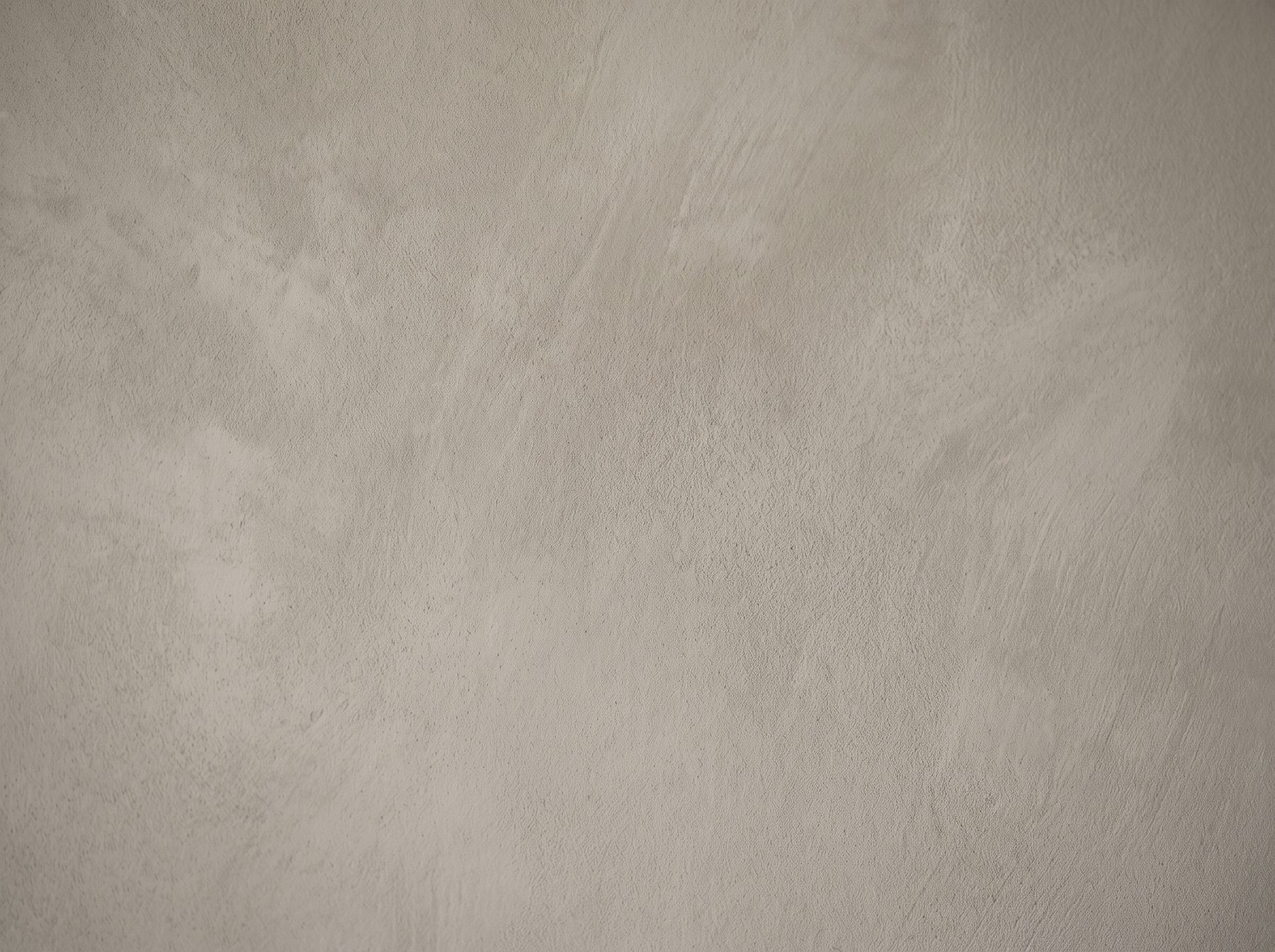
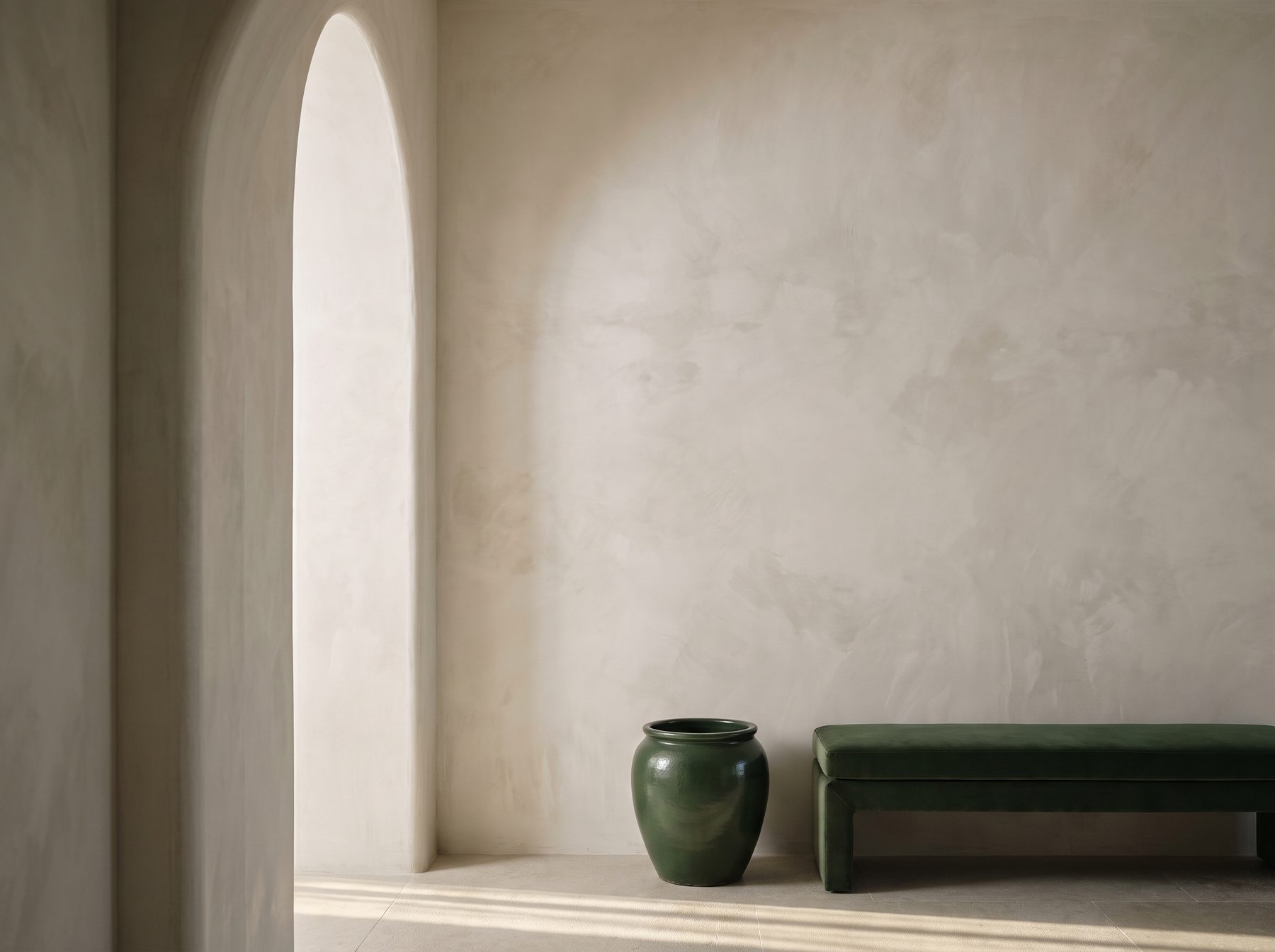
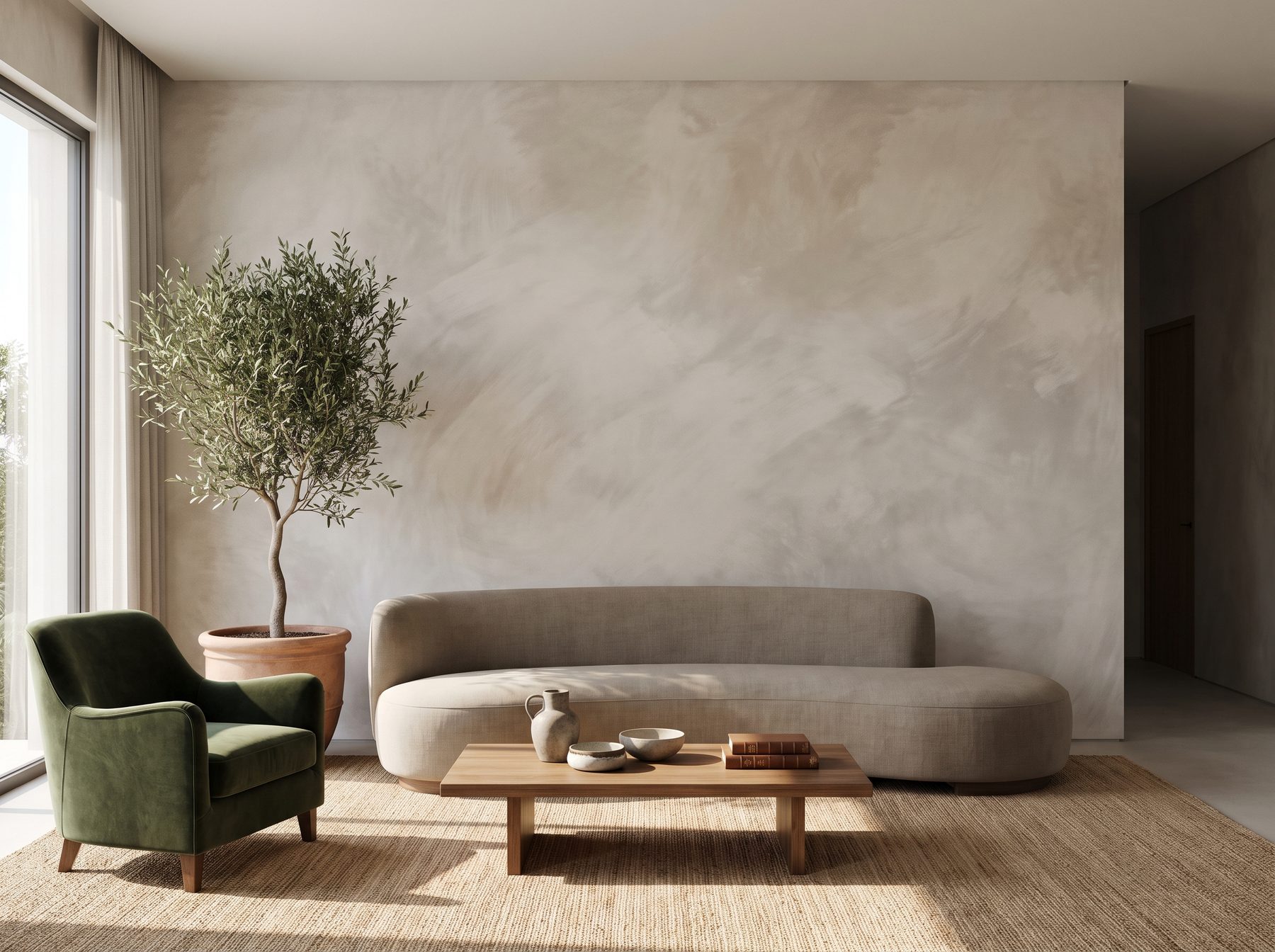
A limewashed wall is ultra-matte. There is no sheen and nothing to reflect, just pigment held in lime. What it has instead is movement: pale and deep tones drifting gently across the same wall, so the surface seems to breathe rather than sit dead-flat the way ordinary emulsion does.
That cloudiness is not a defect to be evened out; it is the entire reason to choose limewash. The lime carbonates a little unevenly, and the brush leaves its own soft record, so the wall reads as one quiet colour at a glance and reveals depth as the light moves across it through the day. Because limewash is built from translucent veils of mineral colour rather than one opaque film, light travels into the surface and back out — the same wall looks different at noon and at dusk. Under strong UAE light it reads softer than any emulsion. It suits Mediterranean, rustic and wabi-sabi interiors and any room that values materials honest about what they are, which is why limewash has come back as a quiet luxury in an age of sealed acrylic walls.
The flip side is just as real: limewash will never look flat and uniform, and it will never repeat itself from one wall to the next. If the brief is a precise brand colour, an exact match to a fabric, or ten identical apartments, limewash is the wrong finish, and emulsion is the honest answer.
Limewash colours: soft, earthy and mineral
Lime is alkaline, so only mineral pigments survive in it. The palette is chalky whites, sands and soft earth tones — no strong, saturated or bright shades, and no neon. That restraint is part of why limewash sits so easily in Gulf interiors and ages so well. We sample your colour on a board before the job, because the first coat dries paler and patchier than the finished colour and the movement cannot be judged on a screen or a printed card.
Lime wash paint in Dubai: what to expect on the wall
In Dubai the lime is the same as anywhere. What changes is the setting, and the practical questions are the same ones each time:
- Which walls take it. Porous mineral surfaces such as cement render, lime or cement plaster and brick take limewash directly. An existing painted wall, or gypsum, takes it once we have primed it for lime. Sealed, glossy or acrylic-painted walls are badly suited until they are prepared.
- How long it takes. The coats are brushed thin and each must dry before the next, so we plan the job as a run of coats rather than one visit, and we time the work around air-conditioned rooms so the drying is even.
- What it looks like at first. Paler and patchier than the final colour. This alarms people, and it is normal; the later coats build the depth.
- What the setting does. Air-conditioned rooms dry the coats quickly, and strong light shows every brush mark, so in Dubai the application matters more than the tin. Inside a chilled villa a finished wall then cures slowly and evenly, which is why the look is so calm.
- What it costs. Priced per project after a site visit, with no figure we could honestly print in advance.
If a Dubai painter offers “lime wash paint” from a tin at a low price per square foot, ask one question: is it slaked lime, or an acrylic look-alike? The two age very differently. For a lime wall with more body and a polished sheen, see Venetian plaster in Dubai; for trowelled lime with more substance than a wash, see lime plaster in Dubai.
Where limewash works in a UAE home — and where it doesn’t
The rule of thumb we give every client: limewash for the walls you live beside, a sealed surface for the ones you lean on, scrub or splash.
Bedrooms, living rooms, hallways and ceilings
Limewash belongs on the walls you look at: bedrooms, living-room walls that want a soft cloudy matte, hallways out of the scrub zone, ceilings, and whole-room schemes that want calm. Bedrooms are the textbook case; the soft, matte surface lowers the light rather than bouncing it. It also suits restaurants and boutique hospitality interiors that want atmosphere over polish, and older or damp-prone substrates that should never be sealed under plastic, because it lets the wall breathe.
Bathrooms and kitchens: away from the water only
In a bathroom, limewash is fine outside the splash zone — a powder room, the wall behind a tub, a well-ventilated ensuite away from the shower — and wrong inside it, where water and cleaning streak and wear a chalky surface. In a kitchen it suits the walls away from the cooker; behind the hob it will not survive grease and wiping. For the shower the lime that works is tadelakt; for a splashback, tadelakt or a sealed microcement.
Outside: sheltered walls yes, full sun unmaintained no
On sheltered courtyard, terrace and garden walls, limewash has protected buildings for centuries. It is a sacrificial finish by design: it weathers gently and is meant to be recoated every few years, which in the old Mediterranean towns was simply part of looking after a house. In the UAE that makes it a good choice for a shaded, sheltered exterior wall that someone will recoat now and then, and a poor one for a fit-and-forget exterior. An exposed south-facing wall that nobody will ever recoat is asking more than a sacrificial finish can give; for a facade that must hold colour in direct Gulf sun for years, silicate mineral paint is the honest choice, and we apply that too.
UAE sun, humidity and air-conditioning
Three local variables decide how limewash behaves here. Sun: exterior limewash on a south-facing wall dries fast and needs damp-down and thin coats to avoid patchy carbonation. Humidity: lime is naturally high-pH and vapour-open, so it resists mould without additives and suits humid coastal air better than a sealed film; moisture in the wall passes through it instead of being trapped. AC: cold, dry air dries fresh coats quickly, so we time the work around the air-conditioning to keep the drying even, and once finished a limewashed wall inside a chilled villa cures slowly and evenly.
Floors: limewash flooring does not exist
A brushed lime wash a fraction of a millimetre thick would be worn through by feet within weeks, so we never quote limewash on a floor — marmorino, Venetian plaster and limewash are all wall finishes only. If you want that soft, chalky, mineral look underfoot in a home, the surface that delivers it is microcement flooring in a pale, matte tone; the lime finish actually built for floors is pastellone. Limewash on the walls above either is a beautiful pairing. The full answer is in which lime finish can go on a floor.
Limewash compared with the finishes it gets confused with
Limewash vs normal paint
They both go on with a brush or roller, but they are different materials doing different jobs.
| Limewash | Normal paint (emulsion) | |
|---|---|---|
| What it is | Slaked lime and mineral pigment — becomes part of the wall | Acrylic polymer film — sits on the wall |
| The look | Cloudy, moving colour; ultra-matte chalky depth | Perfectly uniform; matte to gloss on demand |
| Breathability | Vapour-open — moisture passes through | Film-forming — largely seals the wall |
| Cleaning | Dust and a gentle wipe — not a scrubbing surface | Washable; scrubbable in higher grades |
| Ageing | Develops patina — softens and gains character | Stays identical, then needs a repaint |
| Touch-ups | Blend in, because the finish is already variegated | Can flash against aged paint on a big wall |
| Substrate | Wants a mineral or properly primed wall | Goes over almost any painted wall |
Choose limewash when you want depth, breath and patina you will like more each year. Choose emulsion and a good painter when you want exact, repeatable, scrubbable colour with no ceremony — a hallway full of school bags is an emulsion wall, and we will say so. The full comparison is in limewash vs normal paint.
Limewash vs limewash-effect and textured paint
Texture paint is a decorative acrylic coating with sand, chalk, clay or limewash-effect tooth: quick, forgiving of a wall that is not perfectly flat, available in almost any colour, and the lightest budget of the decorative finishes. It is more scrubbable than limewash and will not chalk, so on a busy or occasionally damp wall it is genuinely the more practical choice. But it largely seals the wall, its movement is more regular close up, it can eventually peel or scuff through, and it copies the photograph of limewash, not the physics. Real limewash will not peel and refreshes with a single coat, but it wants the right wall. The effect paint wins the corridor and the rental; real lime wins the bedroom wall where depth and breathability are the whole point. The three-way comparison is in textured paint vs limewash vs marmorino.
Limewash vs Venetian plaster and marmorino
Same lime, opposite ends of the range. Venetian plaster is slaked lime and marble dust trowelled on in coats and burnished until the wall gleams like stone; marmorino is its matte trowelled sibling, with the soft cloudy depth of stone. Both are true plasters, millimetres thick, with body you can feel. Limewash is a finish you can barely feel: a few brushed coats, chalky to the touch. That difference in thickness drives everything else. A burnished Venetian wall can be wiped with a soft cloth; a limewashed wall would rather not be. Lime plaster takes almost any pigment and burnishing deepens it; limewash holds only mineral pigments. And one costs skilled days where the other costs skilled hours. All share lime’s virtues: they breathe, resist mould through alkalinity, carry no plastic film, and are etched by acids for life. Choose Venetian plaster or marmorino when the wall should have body, sheen and permanence; choose limewash when it should be soft, breathing and quiet, and will not be scrubbed. More in Venetian plaster vs limewash.
Limewash vs silicate mineral paint
Both are genuinely mineral and breathable; they part ways on permanence versus atmosphere. Silicate mineral paint reacts with a mineral substrate and bonds into it permanently, which makes it the honest pick for facades, boundary walls and any elevation that must hold colour in direct sun without a repaint cycle. Limewash is a living wash that wants an occasional fresh coat and gives the soft, cloudy, hand-brushed depth silicate’s surface does not. Interiors people live beside go to limewash; elevations left to fend for themselves go to silicate. The verdict wall by wall is in silicate mineral paint vs limewash.
How we apply limewash, stage by stage
Limewash is easy to buy and hard to apply. The order below is the same on every job, whether it is one accent wall or a whole villa:
| Stage | What happens |
|---|---|
| 1. Site visit | We check the substrate — limewash needs a mineral or properly primed wall, not bare acrylic — and look at the light, the air-conditioning and how the walls will be used. If a wall will be scrubbed or splashed, we say so here and suggest the right finish instead. |
| 2. Colour sample | Your colour is brushed onto a board, so you see how it dries and how it moves before a wall is touched. |
| 3. Surface preparation | Porous mineral walls — cement render, lime or cement plaster, brick — take lime directly once sound and clean. An acrylic-painted or gypsum wall is primed with a mineral primer that gives the lime a key; old glossy paint gets the right primer coat. The work is timed around the air-conditioning so the coats dry evenly. |
| 4. First coat | Brushed thin, wet-into-wet across the entire wall in one session, with a wide brush in crossing strokes — never stopping mid-wall, or the lap shows. It dries much paler and patchier than the final colour; that is normal. |
| 5. Second and third coats | Each coat is left to dry fully before the next, and each builds the depth and the cloudy movement. On an exterior wall in the sun we damp the wall down and keep the coats thin. |
| 6. Finish and handover | Left bare on a wall you look at; on a wall that will be touched, a breathable mineral fixative or a light natural wax goes over the cured limewash to lock the surface without sealing it. You get the care rules — no scrubbing, no acids — before we leave. |
Is lime paint safe to live with?
Yes. Cured lime paint is one of the safest wall finishes there is: inert mineral, no plastic film, no solvents, very low odour, and naturally mould-resistant through its alkalinity. Once carbonated it is, in effect, thin stone on the wall. The caution belongs to the applicator, not the household: wet, freshly mixed slaked lime is caustic, so our crews wear eye and skin protection while brushing it, and a room is kept clear until the coats have dried. Lime is also the low-energy binder among real wall finishes — it is burned at a far lower temperature than cement and reabsorbs part of its kiln carbon dioxide from the air as it cures on your wall. The full picture, including children and pets, is in is lime plaster safe.
How a limewashed wall ages: rubbing, chalking and patina
Real limewash lasts for many years on an interior wall. It does not peel or flake the way emulsion eventually does, because there is no film on the surface to yellow, crack or lift — the pigment is bonded into the wall. It ages by softening: a scuff blends into the cloudscape, and the wall gains character rather than losing it.
The honest catch is chalking. Limewash cures by carbonation, and until that is well advanced — and sometimes lightly afterwards — an uncoated surface can shed a faint chalk when rubbed hard with a dry hand. On a bedroom or hallway wall nobody drags a sleeve along, you will never notice. In a narrow corridor where shoulders and bags brush past all day, you will. Two things change the picture: on a porous mineral substrate the lime keys in far better and chalks far less, and where a wall sees contact we apply a breathable mineral fixative or light natural wax over the cured limewash. That is the standard move for a limewashed wall in a slightly busier room — stairwell walls at hand height, a hallway that doubles as a thoroughfare.
Outdoors runs on a different clock. On a sheltered wall limewash weathers gently and is meant to be recoated every few years; that renewal is part of owning it, not a failure of the material. Limewash asks you to love patina — if you want a wall that stays exactly as it was on day one, it is not your finish. The honest lifespans and refresh cycles are in does limewash last in the UAE.
Care, cleaning and touch-ups
Gently, and rarely:
- Dust with a soft dry brush or a barely damp cloth.
- Blot spills, never scrub them. Limewash tolerates a gentle wipe, not weekly scrubbing; wet-scrubbing it repeatedly will wear it.
- Keep acids off it. Lime is alkaline, so vinegar, lemon and acidic bathroom cleaners etch it, just as they etch tadelakt and marmorino. That rule is for life.
- Touch up by washing over. If a patch scuffs or you want to freshen a room, another wash is brushed on. There is no filler, no sanding and no colour-matched touch-up that never quite matches, because the finish is already variegated and a new coat blends in. Care and repair are the same simple act, which is a large part of why limewash ages so gracefully.
What decides the cost of limewash
Limewash is priced per project after a site visit, supply and install. We would rather say that plainly than invent a number. What we can say honestly is what moves the figure — and it is the wall more than the area:
- Preparation. A sound, porous mineral wall takes lime directly. An acrylic-painted, glossy or gypsum wall has to be primed for lime first, and that preparation can be the largest single part of the job.
- The number of coats. However many coats the colour needs to build its depth, each dried fully before the next.
- The scope. One accent wall is a very different job from a whole house, a run of ceilings or a courtyard.
- Height, access and conditions. Tall walls, stairwells and ceilings are slower to reach; an exterior wall in the sun needs damp-down and thin coats; air-conditioned rooms need the work timed around them.
- Protection afterwards. A wall that will be touched may want a breathable fixative or wax over the cured limewash.
- Location. Jobs outside Dubai are planned as a block of days from our Dubai base.
Why there is no limewash price per square foot
There is no limewash price per square foot or per square metre to publish, for the reason above: the wall, not the area, sets the figure. If someone quotes you limewash per square foot, ask two questions. Does the figure include priming the substrate for lime and every coat? And is it real slaked lime or an effect emulsion? The answers change the comparison more than the number does.
Is limewash expensive?
No, by the standard of lime finishes; yes, by the standard of a tin of emulsion. A brushed wash takes fewer skilled hours per metre than a trowelled plaster, which makes limewash the most accessible way into real lime. But it is skilled work applied by a crew, so it costs more than a painter rolling on paint, and it does not give you a scrubbable wall in return. What it gives you is depth, breath and a surface that ages gracefully. Whether that is worth the difference depends on the wall — and where it is not, we will say so and point you to emulsion or an effect paint.
One limewash company, from supply to the last coat
Is there a limewash or lime paint company near me? Yes. RBS Group applies real limewash from Business Bay, Dubai, with its own in-house crews, and we travel across the UAE. We are the company, the contractor and the crew; the brush work is never subcontracted, which matters more for limewash than for most finishes, because it has to go on wet-into-wet across a whole wall or the laps read as patches. Ask us to show you aged limewash walls rather than photos of fresh ones.
Limewash contractor in Dubai or Abu Dhabi. The work is the same in both: a site visit to check the substrate, a colour sample on a board, then the coats brushed by our own crew. Abu Dhabi, Sharjah and northern-emirates jobs are planned as a block of days from the Dubai base.
Limewash paint suppliers. We supply and install as one job and do not sell limewash on its own for DIY. The reason is technical rather than commercial: limewash is easy to buy and hard to apply, and a wall we did not apply is a wall we cannot stand behind. If you already have a contractor, we are happy to be the lime specialist on their site.
Where limewash goes wrong — and how we build against it
- Laps and dry edges. Stop mid-wall, or let one section dry before the next is brushed in, and the joins read as patches forever. We brush every wall wet-into-wet in one session, with our own trained crew.
- Brushed onto bare acrylic. Over an unprepared acrylic-painted wall the lime has nothing to key into and chalks badly. We check the substrate at the site visit and prime for lime wherever it is needed.
- Coats dried too fast. Air-conditioning aimed at fresh limewash, or full sun on an exterior, dries the coats unevenly and leaves patchy carbonation. We time the work around the AC indoors, and damp down and thin the coats outdoors.
- The wrong wall. A splashed bathroom wall, a scrubbed kitchen wall, a busy corridor left raw: limewash wears, streaks or chalks there, and no application skill changes that. We turn those walls down and recommend tadelakt, a sealed surface or a limewash-effect paint instead.
- Acid cleaners. Vinegar, lemon or an acidic bathroom spray etches lime. The care rules are part of every handover.
- Expecting a uniform wall. The most common disappointment is not a failure at all: someone wanted an even, wipeable colour and got a cloudy, living one. That is why we sample on a board first, and why we will tell you at the site visit if emulsion is what your wall really wants.
- An exterior nobody will recoat. Limewash outside is renewed every few years. If that will not happen, silicate mineral paint is the better facade, and we say so before the job, not after.
The rest of the lime family, and when to choose it instead
Limewash is the lightest member of a family we apply in full, so the honest recommendation follows the wall:
- A wall that should gleam like polished stone — Venetian plaster; see Venetian plaster in Dubai.
- Trowelled lime with body, matte to a soft satin — marmorino and the other lime plasters; see lime plaster in Dubai.
- A shower, a wet room or a hammam — tadelakt, the lime that sheds water; see tadelakt in Dubai.
- A wall people lean on or wipe daily — a sealed surface such as a microcement wall.
- A ceiling, a rental or a fast fit-out that wants the look — a limewash-effect texture paint.
The honest pros and cons of every lime finish, side by side, are in Venetian plaster pros and cons, and why breathing walls matter in AC-cooled homes is in breathable wall finishes in the UAE.
Next step
If the wall is a bedroom, a hallway, a ceiling or a sheltered courtyard and you want the softness only real lime gives, limewash is the honest choice. If it will be scrubbed, splashed or walked on, it is not, and we will tell you so. Send a photo of the room and the look you are after on WhatsApp, or call +971 4 587 7086. 8+ years in the UAE, with trained in-house crews, never subcontracted.
Why Dubai chooses RBS for limewash
Real lime, not a plastic imitation
Our limewash is slaked lime thinned with water and tinted with mineral pigment. It carbonates on the wall and has no plastic binder at all. Where an acrylic limewash-effect paint would honestly serve the wall better, on a ceiling, a rental or a corridor, we apply that too and say so.
Brushed wet-into-wet by people who know lime
Limewash shows the hand. It has to go on wet-into-wet across a whole wall in one session, or the laps and dry edges read as patches. Every RBS applicator is trained and directed in-house, never a subcontracted day-rate crew.
The wall prepared before the colour
Limewash needs a mineral or properly primed wall, not bare acrylic. We check the substrate at the site visit and prime it for lime where it needs it, because the preparation decides whether the wash keys in or chalks.
Honest about where it stops
Limewash is for the walls you live beside, not the ones you lean on, scrub or splash. For a shower we build tadelakt; for a wall wiped daily, a sealed surface. We would rather lose the limewash job than sell it onto the wrong wall.
Your questions, answered straight
Is limewash just paint with lime in it?
No. Real limewash is slaked lime thinned with water and tinted with mineral pigment, with no plastic binder. It cures by drawing carbon dioxide from the air and turning slowly back toward stone, so it becomes part of a mineral wall rather than a film sitting on top. The tins sold beside ordinary emulsion as 'limewash-effect' are acrylic paints engineered to copy the look.
What are the pros and cons of limewash paint?
Pros: a soft, cloudy matte with depth flat paint cannot fake, a breathable and naturally mould-resistant wall, no plastic and very low odour, and a refresh that is simply another coat brushed over the old. Cons: it is a wash, not a plaster, so no body or polish; bare lime can chalk onto a sleeve; only soft, earthy mineral colours survive in it; it never looks uniform; and it is wrong in a splash zone or on a scrubbed wall.
Limewash, Venetian plaster or tadelakt — which one?
Limewash for a soft, chalky matte on walls you look at; Venetian plaster for dry walls that should gleam with the body of polished stone; tadelakt for anywhere water hits the wall. They are one lime family at three different jobs, and we apply all three, so the answer depends on the room.
What is it like to live with?
Quiet. Dust it with a soft dry brush or a barely damp cloth, blot spills instead of scrubbing, and keep acids such as vinegar and lemon away from it. When a patch scuffs or the room wants freshening, another wash brushes straight over the old with no stripping and no sanding.
Where limewash belongs
Where we apply it:
- Bedrooms and master suites
- Living rooms and hallways out of the scrub zone
- Ceilings and whole-room schemes that want calm
- Sheltered courtyard, terrace and garden walls
- Powder rooms and bathroom walls away from the shower
- Restaurants and boutique hospitality interiors
The finish
Frequently asked
What is limewash paint, and is it the same as lime wash paint?
Yes, limewash and lime wash are the same thing: real slaked lime thinned with water, tinted with mineral pigment and brushed on in thin coats, so it dries to a soft, chalky, cloudy matte that becomes part of the wall. It is not a tinned acrylic paint. We apply it in Dubai, Abu Dhabi and across the UAE and price it per project after a site visit. For the contrast with ordinary emulsion, read limewash vs normal paint.
Does a lime wash wall have a texture?
Only a soft one. A lime wash wall is a thin, brushed mineral wash, not a texture coat: it adds cloudy tonal movement and a faint brush record, but it follows the texture the wall already has rather than building a new one. Over smooth plaster it reads smooth and chalky; over a rougher render it shows that render. If you want real relief you can feel, the honest choice is a trowelled lime finish such as lime plaster or marmorino, and if you want a low-cost patterned wall, an acrylic texture paint is the cheaper route.
What is the difference between limewash and normal paint?
Limewash is slaked lime and mineral pigment, a mineral wash that becomes part of the wall: cloudy, moving colour, an ultra-matte chalky depth, and a surface that lets moisture pass through. Normal paint, emulsion, is an acrylic film sitting on the wall: perfectly uniform colour, matte to gloss, washable and scrubbable in its better grades, but largely sealing the wall. Choose limewash for a wall with life in it and patina you accept as a feature; choose emulsion for exact, repeatable, wipeable colour on any wall.
Does limewash rub off?
A little, if it is left bare and you provoke it. An uncoated limewashed wall can shed a faint chalk when rubbed hard with a dry hand or a sleeve, especially before the lime has carbonated well. On a bedroom or living-room wall nobody brushes past you will never notice it; in a narrow, busy corridor you will. On a porous mineral wall the lime keys in better and chalks less, and on a wall that sees contact we apply a breathable mineral fixative or a light natural wax over the cured limewash to lock the surface without sealing it under plastic.
Can limewash be used outside in the UAE?
Yes, on sheltered courtyard, terrace and garden walls where someone will recoat it every few years. Outdoors limewash is a sacrificial finish by design: it weathers gently and is meant to be renewed. On a south-facing wall it dries fast in the sun, so we damp the wall down and keep the coats thin to avoid patchy carbonation. An exposed facade in full sun that nobody will ever recoat is the wrong place for it; silicate mineral paint is the honest choice there, and we apply that too.
Can limewash go over existing paint?
Yes, once the wall is prepared. Limewash wants a porous mineral surface to key into, such as cement render, lime or cement plaster, or brick. An acrylic-painted or gypsum wall is first primed with a mineral primer that gives the lime a key; over old glossy paint it needs the right primer coat. Brushed straight onto bare acrylic it will not bond properly and will chalk badly, which is why we check the substrate at the site visit.
Can I use limewash in a bathroom?
Outside the splash zone, yes: a powder room, the wall behind a tub, a well-ventilated ensuite away from the shower. Inside the splash zone, no: water and cleaning streak and wear a chalky surface. For a shower wall the lime that works is tadelakt, burnished and soap-sealed until it sheds water, or a sealed microcement wet-zone system.
What colours does limewash come in?
Soft, earthy, mineral colours: chalky whites, sands and soft earth tones. Lime is alkaline, so only mineral pigments survive in it, which means no strong, saturated or bright shades. The colour also never sits perfectly even; pale and deep drift across the wall, and that is the point. We sample your colour on a board first, because the first coat dries paler and patchier than the finished colour, and a screen cannot show its movement.
How do I check a limewash sample in my own room light?
Look at it on your own wall, not on a card or a screen. Put the sample up and look at it in the morning, at midday and in the evening, and again with the room lights on, because limewash is built from thin translucent coats and the colour moves with the light. Check it wet and dry: limewash dries lighter and chalkier than it looks when it goes on, so judge only the dry patch, after it has fully dried. If the room faces the sun, look at it in the sun and in the shade of the same day. Send the room and its light on WhatsApp and we will tell you what to expect before anything is applied.
How long does limewash last?
Indoors, on the walls it suits, for many years. There is no plastic film to yellow, crack, peel or lift, and it ages by softening into a patina rather than failing. When you want to refresh it, a new coat brushes straight over the old with no stripping. Outdoors it weathers by design and wants a fresh coat every few years. Where it does not last is a wet zone, a scrubbed wall or an unmaintained full-sun exterior.
How much does limewash cost in Dubai?
Limewash is priced per project after a site visit, supply and install, and we do not publish a per-square-metre or per-square-foot rate for it. The wall sets the figure more than the area does: preparing an acrylic-painted wall for lime, the number of coats the colour needs, ceiling height and access, and whether it is one wall or a whole house. Send dimensions and a photo on WhatsApp and the quote follows the visit.
Do you sell limewash for DIY?
No. We supply and install as one job. Limewash is easy to buy and hard to apply: the wall must be primed for lime, the wash brushed thin and wet-into-wet across the whole plane, and the coats built up patiently, or the result is patchy and chalks. If you already have a contractor on site, we are happy to be the lime specialist on their job.
Do you apply limewash outside Dubai?
Yes. Dubai is our base, and the same in-house crews work in Abu Dhabi, Sharjah, Ajman and Ras Al Khaimah. Jobs outside Dubai are planned as a block of days from the Dubai base, because limewash is built up as a run of coats rather than finished in one visit.
Start your project
Tell us about your space.
Send a few photos and rough sizes on WhatsApp — we'll come back with a real number and, if you'd like, a sample of the exact colour and finish.
Updated 29 October 2026. Every project is priced after a site visit.