
Textured paint · wall texture paint — Dubai & all UAE
Textured Paint in Dubai
Updated 16 October 2026
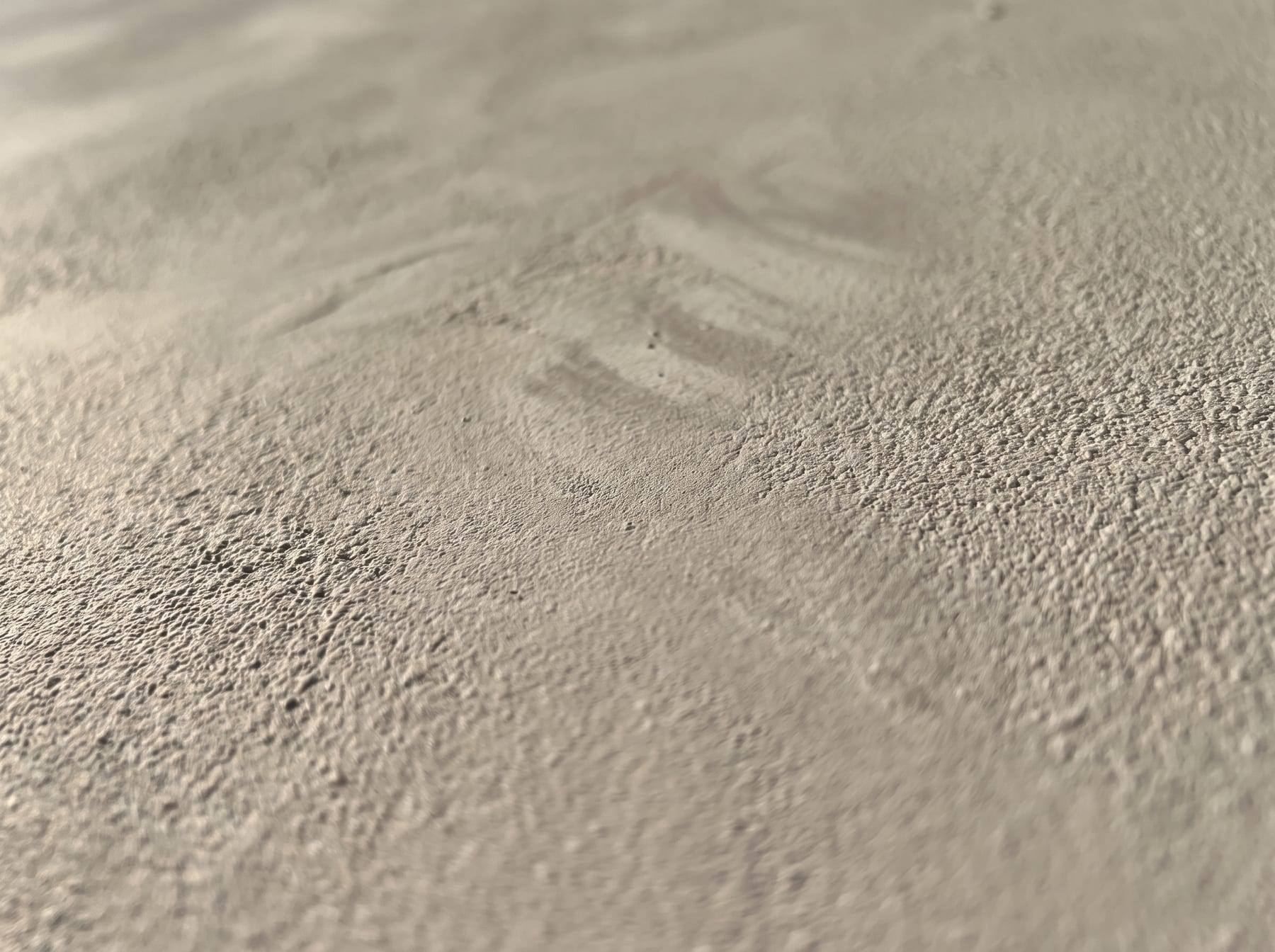
Textured paint is a decorative wall coating with fine sand, chalk or clay in it, so two coats leave real grain on the wall instead of a flat film. We apply it in Dubai, Abu Dhabi and across the UAE as one supply-and-install job that RBS is responsible for from start to finish, and we say plainly when a wall wants a real plaster or plain paint instead.
- 8+ years of decorative surfaces in the UAE
- One company responsible for every job, start to finish
- Wall preparation included in every quote
- We apply it — we do not sell tins
Pricing
Textured paint is priced per project after a site visit, supply and install. On a two-coat finish the wall decides the figure more than the paint does: how much filling, putty and priming it needs, the height and access, the effect you choose, and whether it is one accent wall or a whole home.
Send a photo of the wall and its rough size on WhatsApp; we will tell you whether it suits textured paint, a real plaster or simply a good painter.
Textured paint in Dubai, supplied and applied
Textured paint (shops also call it texture paint or wall texture paint) is a decorative paint with fine sand, chalk or clay mixed through it, so each brush or roller pass leaves grain on the wall rather than a flat film. We apply it in Dubai, Abu Dhabi and across the UAE as one supply-and-install job, priced per project after a site visit, because on a texture finish the wall’s preparation and the applicator’s hand decide more of the result, and the cost, than the paint does. It is the honest budget rung of our wall finishes: right for bedrooms, living-room walls, ceilings, rentals and long corridors in a fine texture; wrong for showers, hob splashbacks, floors and sun-facing outside walls.
This is the “in Dubai, applied by us” page: what we apply, which walls it suits here, how we build it up and how it is priced. If you want the material itself explained, that lives in the encyclopedia entry on texture paints. Every other question people ask about it, from the names and the design ideas to buying a tin for DIY, is answered in the long guide to wall texture paint in the UAE. One thing to know before you read on: RBS applies decorative texture finishes; we do not sell paint products. If you want the material, a paint merchant sells it. If you want the finished wall, that is what we quote.
Textured paint at a glance
| What it is | A decorative paint film, a fraction of a millimetre thick, with sand, chalk or clay in it |
| Time on site | About two days a wall, plus one return visit for any touch-in once the coats have cured |
| Where it goes | Interior walls and ceilings |
| Where it does not | Showers, hob splashbacks, sun-facing outside walls and floors |
| Preparation | Filling, putty, sanding and priming are inside the quote |
| Price | Priced per project after a site visit |
What we check at the site visit
- Cracks, damp and loose paint — a moving crack or a damp patch is fixed at its cause first.
- The light that falls across the wall — side light from big windows shows every dip, and it decides how coarse the texture should be.
- How the room is used — if a wall will be scrubbed, splashed or sun-baked, we say so and suggest the right finish instead.
- How much preparation the wall needs — filling, putty or skim, sanding and priming, which moves the price more than the paint does.
What textured paint is, and what it is not
Two coats are enough to change a plain wall. The grain picks up the light, small shadows settle in its deeper spots, and the colour shifts softly across the surface where flat emulsion would look uniform. That is the appeal, and it arrives fast: it goes on by brush or roller, with no trowel work and no plaster build-up, over almost any sound wall, gypsum board included.
It is worth being precise about what it is not, because that is where most buyers get caught out:
- It is not a plaster. All of its texture sits in a film a fraction of a millimetre thick. A lime or clay plaster goes on several millimetres thick and is worked by hand, which gives it a depth and translucency you notice from across the room. Texture paint copies the look of those minerals; it is not a substitute for them.
- It is not real limewash. Our limewash-effect texture paint copies the cloudy movement of limewash, but it is an acrylic film engineered to look like lime. Real limewash is slaked lime: breathing, mineral, and soft to the touch.
- It is not a velvet or suede effect. Our velvet and suede effects are built to move light, with a fine directional nap that shifts tone as you cross the room. Texture paint is built to hold light: a static, granular tooth that looks the same from every angle.
- It is not a patterned roller or a stencil. A patterned roller or a stencil prints the same motif over and over on a flat wall. Texture paint has no motif: the grain is in the coating itself, random and all-over. We do not do roller or stencil work, which is a decorator’s trade; for a wall with a design carved into it, the finish we apply is sgraffito.
A few more names belong to the same family: textured wall coating, decorative texture coating, sand-texture paint and stone-effect paint. “Wall putty texture” is not the finish at all; it means the skim coat that goes under it.
The textured paint finishes we apply
Five effects cover almost everything sold as texture paint in Dubai, and we apply all five, plus a concrete-effect texture paint for the concrete look on a budget:
| Finish | What it looks like | Where it suits best |
|---|---|---|
| Sand texture | The finest, most even grain | Large walls, living rooms, corridors and ceilings |
| Chalk | Softer and powdery to the eye | Bedrooms and living rooms |
| Clay-effect | Warm, cloudy earth tones | Bedrooms, where the soft movement earns its keep in low light |
| Limewash-effect | The brushed, drifting movement of limewash, in an acrylic film | Bedrooms, ceilings and back walls that want the look for less |
| Stone-effect | A heavier mineral load, rougher and more mineral | A feature wall or a ceiling coffer, not a whole room |
| Concrete-effect | The grey concrete look, as a paint | The budget version of the concrete look on a wall |
Every one of them imitates a material rather than being one, and they come in almost any colour. Two rules of thumb: keep deep colours out of heavy textures, because they flash in raking evening light, and keep the tone warm in a bedroom, because texture reads cold in grey.
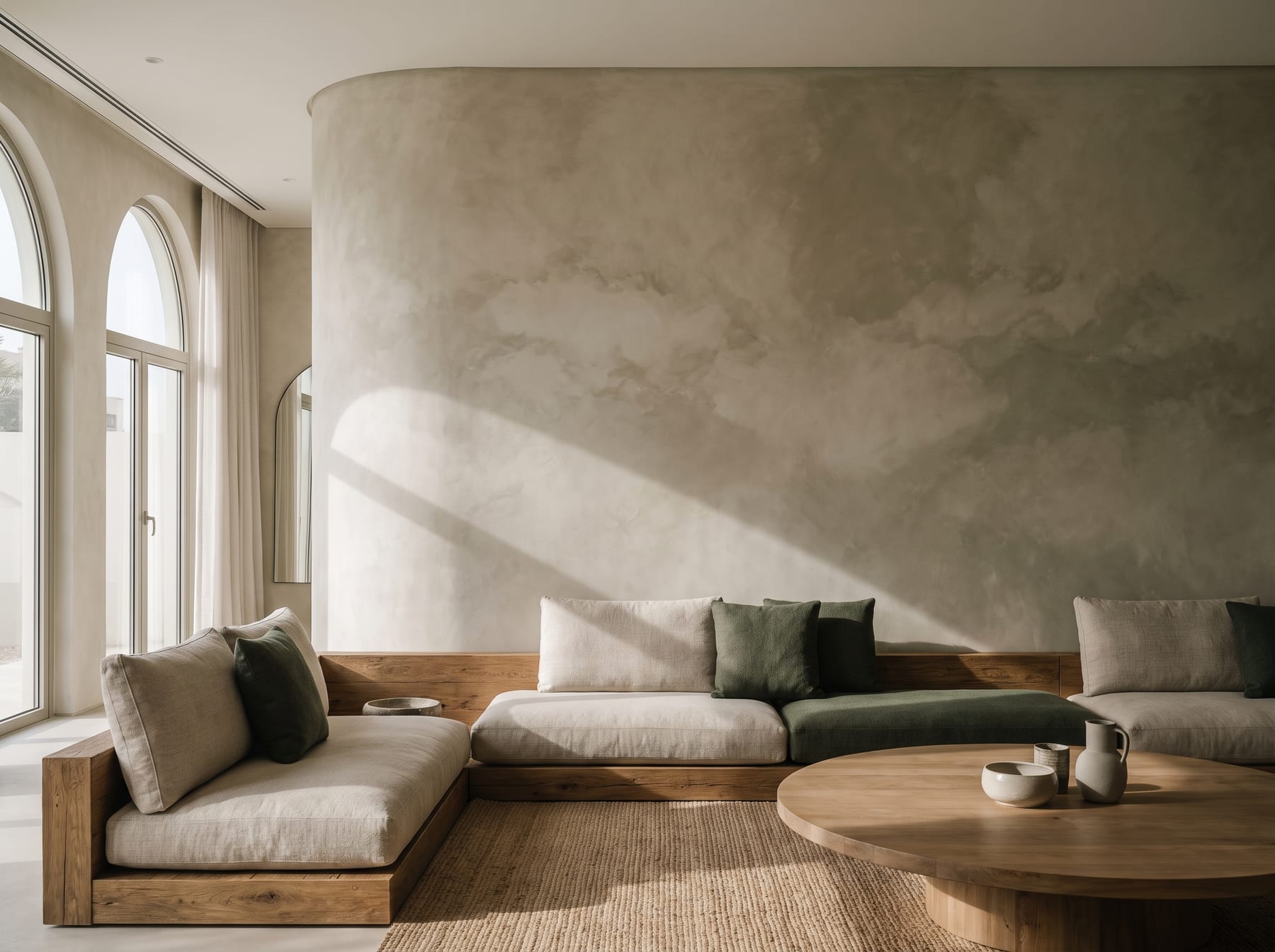
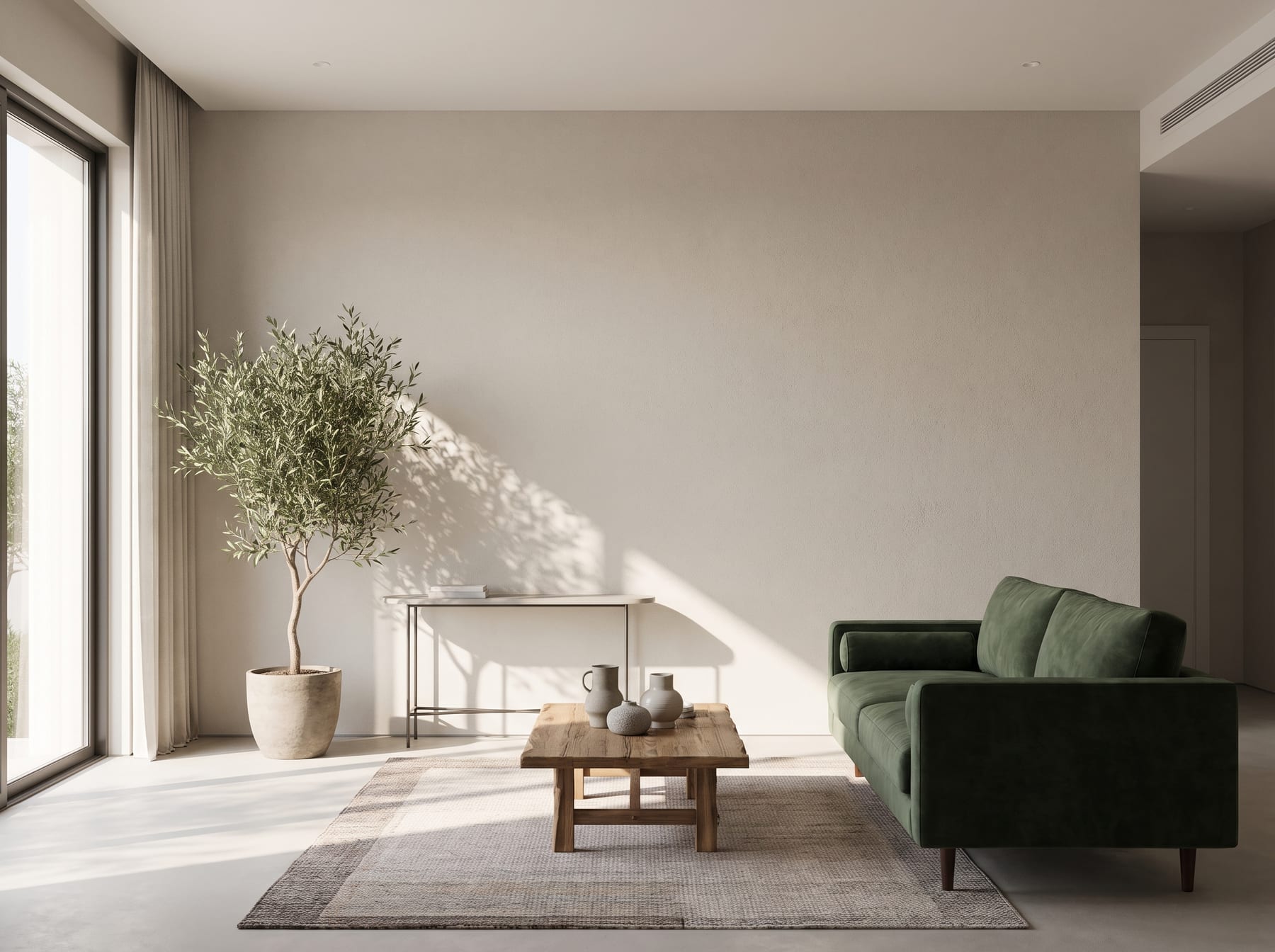
What ages well is restraint. One sand-textured wall behind the sofa, a shade deeper than the walls around it; one limewash-effect wall in a warm neutral; or a fine chalk texture over a whole room, with the doors and skirting kept flat. What dates first is anything that copies a trend instead of a material: combed swirls, stippled “popcorn” relief and stamped repeat patterns.
Wall texture paint in Dubai: what to expect on the wall
The paint is the same anywhere. What changes in Dubai is the setting, and the practical questions are the same ones each time:
- Which walls take it. Almost any sound interior wall or ceiling, plaster or gypsum board, once it has been filled, sanded and primed.
- How long it takes. A textured wall is done in about two days, against about a week for a burnished Venetian plaster wall. We come back for any touch-in once the coats have cured.
- What strong light does. Big windows throw side light across a wall, and side light shows every dip. On those walls a coarser, irregular texture in a matte finish hides the most, and a fine, even texture with a sheen hides the least.
- What humidity does. Texture paint is an acrylic film that largely seals the wall, so it belongs on dry walls. On a wall that is chronically damp, the damp gets fixed at its cause before any paint goes on.
- What it costs. Priced per project after a site visit, with no figure we could honestly print in advance.
Where textured paint works in a UAE home, and where it doesn’t
The rule of thumb we give every client: textured paint where a wall is meant to be good, a real plaster where it is meant to be the room, and a wet-zone finish where it gets wet.
Bedrooms, living rooms and corridors
Bedrooms are the easy case: the headboard wall in a clay or chalk effect, the rest flat, or the whole room in a fine texture. Living-room walls that are not the centrepiece take a sand or chalk texture well. Corridors take a fine texture; a heavy one there holds dust and catches sleeves, and a wall that shoulders and school bags brush past all day is better served by a harder, sealed surface. Keep every version away from the front door’s kick zone.
Ceilings
Ceilings are where texture paint is most useful of all. A fine sand texture in the ceiling colour hides the joins in a boarded ceiling better than flat emulsion, softens the shadows of downlights and costs far less than a plastered ceiling. We apply the finish on a ceiling that is already built; the gypsum false ceiling itself is a gypsum or fit-out contractor’s job. The options overhead are compared in ceiling finishes in the UAE.
Bathrooms, kitchens and wet areas: no
A guest powder room with no shower can take it. A shower cannot: soap and water settle into the grain, steam condensing on the wall lifts the acrylic film into blisters, and within a couple of years the wall turns grey. A hob splashback is no better, because the finish will not stand up to grease and daily wiping. For a wall that gets wet we apply tadelakt, a lime plaster that sheds water, or a sealed microcement wet-zone system.
Exterior textured paint: not in the Gulf sun
The texture paints we apply are for inside walls and ceilings. Put an acrylic texture on an outside wall that faces the sun and Gulf UV leaves it chalky and pale within a few years. For a textured facade that holds its colour we apply a silicate mineral plaster instead, bonded into the render.
Floors: never
Texture paint is a wall and ceiling finish only and has no business on a floor, so we never quote it there. The seamless wall-to-floor answer in a home is microcement.
Colour and samples
Textured paint comes in almost any colour, which is its great advantage over real lime. Two rules keep it looking right: keep deep colours out of heavy textures, because they flash in raking evening light, and keep the tone warm in a bedroom, because texture reads cold in grey. Judge the colour on the wall itself and in its own light — a sample seen in the evening as well as at midday tells you far more than a fan deck under showroom lights.
Names you will see elsewhere, and where they live on our site
Shops and contractors sell many finishes as “texture”. Some are textured paint; others are different materials with their own pages here:
| The name you saw | What it usually is | Where to read about it |
|---|---|---|
| Metallic texture | A metallic plaster or paint effect | Metallic plasters |
| Stucco | A plaster finish, not a paint | What is stucco? |
| Sandstone or travertine look | A lime plaster that copies stone | Travertino |
| Concrete texture | A concrete-effect plaster | Concrete-effect plasters |
Textured paint compared with the finishes it gets confused with
We apply every finish in this table, so none of it is a sales pitch. If you are still choosing between them, the Finish Finder narrows it down in a few questions:
| Textured paint | Limewash | Venetian plaster and marmorino | Microcement wall | |
|---|---|---|---|---|
| What it is | Acrylic coating with sand, chalk or clay tooth | Slaked lime and mineral pigment, brushed thin | Lime and marble dust, trowelled by hand | Sealed cement-polymer coating |
| Thickness | A paint film | A wash, a fraction of a millimetre | A true plaster, several passes | 2–3 mm |
| The look | Even grain; almost any colour | Chalky, cloudy; soft mineral colours only | Soft stone to a polished gleam | Soft clouded mineral colour, no joints |
| Breathes? | Largely seals the wall | Yes, vapour-open | Yes, vapour-open | Sealed |
| Wet zones | No | Only away from the splash zone | Not inside the shower; tadelakt is the lime for that | Yes, as a wet-zone system |
| Budget | Lightest | Middle: the easiest way into real lime | Highest: skilled trowel days | The one wall finish with a published starting rate |
Textured paint vs real limewash
Limewash-effect paint gives you much of the look in far less time, and on a ceiling, a back wall or a fast fit-out that is a sensible trade. It is more scrubbable than limewash and will not chalk. But it largely seals the wall, its movement is more regular close up, and it copies the photograph of limewash, not the physics. On the bedroom wall where depth and breathability are the whole point, real limewash in Dubai wins. The three-way comparison is in textured paint vs limewash vs marmorino.
Textured paint vs Venetian plaster and marmorino
Next to a real lime plaster, texture paint is cheaper and faster, and that is where its advantages end: the plaster has more depth and lasts longer. Up close, a hand-trowelled lime wall and a paint that imitates one are easy to tell apart. If the wall only has to look good, texture paint is enough. If it is the wall the room is built around (the majlis wall, the entrance, the wall facing the sofa), it deserves Venetian plaster or marmorino.
Textured paint vs clay plaster
Our clay-effect texture paint chases the warm, matte look of real clay plaster, which is earth several millimetres thick that genuinely steadies a room’s humidity. Give the feature wall the real clay; give the ceilings, back walls and rooms turning around fast the effect paint. The verdict wall by wall is in clay plaster vs texture paints.
Textured paint vs microcement on a wall
A “cement texture wall” almost always means microcement or a concrete-effect plaster, not a paint. Concrete-effect texture paint is the budget version, but up close it is paint, not cement, and a scuff shows it. For a wall people lean on or wipe daily, or one that gets splashed, a sealed microcement wall is the honest choice. Which of the three a concrete-look wall deserves is in the concrete look on walls.
Textured paint vs wallpaper
Humidity usually settles it in favour of texture paint. On an outside-facing wall, vinyl and paper coverings hold condensation behind them and start to peel at the joins; a textured wall has no seams to lift and takes a fresh coat when it needs one. Wallpaper is still the right pick for a printed pattern, or in a rental where the wall has to be handed back plain. Wallpaper against the real plasters is covered in wallpaper vs plaster finishes.
How we apply textured paint, stage by stage
One accent wall or a whole villa, the job runs in the same five stages:
| Stage | What happens |
|---|---|
| 1. Site visit | We look at the wall for cracks, damp and loose paint, at the light that falls across it, and at how the room is used. If a wall will be scrubbed, splashed or sun-baked, we say so here and suggest the right finish instead. |
| 2. Protection | The room is protected and masked before anything is opened. |
| 3. Preparation | Filling, putty or skim where the wall needs it, sanding and priming. A moving crack or a damp patch is fixed at its cause first; that repair is not part of a texture quote. |
| 4. Two texture coats | Applied wet-to-wet so the grain stays even, never stopping mid-wall. |
| 5. Touch-in | We come back once the wall has cured for any touch-in. |
On a textured wall the labour is most of the cost, and the application is the skilled part. That is why the hand matters more than the tin.
Living with a textured wall
Gently, and without ceremony. The grain holds dust and takes less scrubbing than a polished plaster, so this is a finish for the walls you live beside, not the ones you scrub. When you redecorate, a fresh coat of the same system goes on over the old one and nothing has to be stripped. To paint a textured wall a plain colour later, choose a matte or low-sheen emulsion and a medium- or long-pile roller that gets into the grain. A glossy finish picks out every ridge and makes an old texture look tired.
What decides the cost of textured paint
Textured paint is priced per project after a site visit, supply and install, and we would rather tell you that than print a number we cannot stand behind. These are the things that move it:
- Preparation. A sound wall that is already skimmed needs little work before the texture. One that needs filling and putty first costs more, and that groundwork costs the same whichever finish follows. We include it in the quote rather than adding it later.
- The effect. A fine sand texture and a heavier stone effect are different jobs.
- Height and access. Tall walls, stairwells and ceilings are slower to reach.
- The scope. One accent wall is a very different job from a whole home or a run of ceilings.
- Location. Jobs outside Dubai are planned as a block of days from our Dubai base.
Why there is no texture paint price per square foot
There is no honest texture paint price per square foot or per square metre to publish, because the wall, not the area, sets the figure. If someone quotes you one without seeing the wall, ask two questions: does it include the filling, putty and priming, and who will hold the roller? The answers change the comparison more than the number does. The full ladder of wall-finish costs is in the feature wall cost guide.
Is textured paint expensive?
No. It is the lightest budget of our decorative wall finishes and the cheapest finish we apply. It does cost more than a painter rolling on plain emulsion, because it is skilled work on a prepared wall. If all your home needs is a clean, even repaint in white, a painting contractor is cheaper and just as good, and we will tell you so.
One textured paint company, from the wall to the last coat
Looking for a texture paint company or painter near you? In Dubai, Abu Dhabi and Sharjah, RBS works from its office in Business Bay, Dubai, is responsible for every job from start to finish, and has been finishing walls across the UAE for 8+ years. We are a decorative surfaces company, not a general painting contractor. Call us for the jobs where that matters: a textured feature wall, a boarded ceiling whose joins need hiding, or a room where you cannot decide between texture paint and a real plaster and want the answer from a team that applies both.
Three questions before you book anyone. Can they show you one of their textured walls that is at least two years old, in daylight? Who answers for the wall if it goes wrong? And is the preparation in the price, or added later? A texture priced low and rushed on shows its joins inside a year.
Which brand do you use? We keep brands out of it. What decides a textured wall is not the label on the tin but three other things: a real mineral-filled texture system rather than a thickened emulsion, a wall prepared properly, and two coats laid wet-to-wet. The professional systems we use are bought through trade channels, not from a retail shelf.
Where textured paint goes wrong, and how we build against it
- Joins between sections. A texture rolled in patches and left to dry between them shows every lap. We lay each wall wet-to-wet.
- Flashing in deep colours. Rushed coats patch and flash, worst of all in raking light. We keep deep colours out of heavy textures and never rush the coats.
- Texture over a problem. A moving crack telegraphs through and damp bleeds through any coating. We check at the site visit and fix the cause before the finish.
- The wrong room. A shower, a hob splashback or a sun-facing exterior defeats any acrylic texture, and no application skill changes that. We turn those walls down and recommend tadelakt, microcement or silicate mineral plaster instead.
- Too coarse overhead. A heavy texture on a ceiling collects dust. Ceilings get a fine sand texture.
- A thin retail product. Budget tins skimp on filler, so the grain is thin and uneven. We use professional systems only.
Next step
If the wall is a bedroom, a living-room wall, a corridor or a ceiling and you want warmth and grain without the cost of a hand-laid plaster, textured paint is the honest choice. If it will be splashed, scrubbed or baked by the sun, it is not, and we will tell you so. Send a photo of the wall and the look you are after on WhatsApp, or call +971 4 587 7086. 8+ years in the UAE, and RBS is responsible for every job, start to finish.
Why Dubai chooses RBS for textured paint
Applied, not sold
We are a decorative finishes company, not a paint shop. We supply and apply as one job and do not sell tins, so what you are buying is the finished wall: the preparation, the two texture coats and the touch-in visit once it has cured.
Two coats, wet-to-wet, by a steady hand
Roll a texture in patches and let each one dry, and every join shows; rush the coats and deep colours flash. We lay each wall wet-to-wet, never in patches, and RBS answers for the finish.
The wall prepared first
Filling, putty or skim where the wall needs it, sanding and priming are inside the quote. A texture forgives roller marks and patching; it does not forgive holes, loose paint or a crumbling skim, so we do that groundwork ourselves.
Honest about what the wall deserves
We also apply limewash, Venetian plaster, clay plaster and microcement, so we have no reason to oversell paint. The wall a room is built around may deserve a real plaster; a flat white repaint deserves a painting contractor. We say which.
Your questions, answered straight
Texture paint, textured paint, wall texture paint — is there a difference?
No. They are three names for the same thing, and you will also hear texture wall coating. Each one means a paint loaded with sand, chalk or mineral filler that builds grain on a wall in two coats. What changes from shop to shop is the label, not the product. The real choice is a different one: texture paint or a real plaster.
Is it a paint or a plaster?
A paint. The texture lives in a coating a fraction of a millimetre thick, which is why it is quick and the lightest budget of our decorative finishes, and also why it cannot reach the depth of the lime and clay plasters it often imitates. Close up, its movement is more regular than a trowelled wall.
Can it go in a bathroom or outside?
A powder room without a shower, yes. Inside a shower, no: the tooth holds moisture and soap, the film blisters where steam condenses, and the wall greys within a couple of years; that wall wants tadelakt or a microcement wet-zone system. Outside in Gulf sun an acrylic texture chalks and fades within a few years, so the textured exterior we recommend is silicate mineral plaster.
What is it like to live with?
Easy, on the right wall. It suits walls you live beside rather than walls you scrub: the tooth holds dust and is less scrubbable than a polished plaster. When the room is redecorated, another coat of the same system goes straight over the old one, with no stripping.
Where textured paint belongs
Where we apply it:
- Feature and accent walls
- Bedrooms and headboard walls
- Whole-room wall schemes on a budget
- Ceilings and soffits over gypsum board
- Rentals and fast-turnaround fit-outs
- Retail and hospitality back-of-house walls
The finish
Frequently asked
How much does textured paint cost in Dubai?
Textured paint is priced per project after a site visit, supply and install, and we publish no per-square-metre or per-square-foot rate for it. On a two-coat finish the number is driven by preparation (filling, putty, priming), height and access, and the effect chosen, far more than by the paint. Anyone who prices it without seeing the wall is pricing the paint, not the job. Send a photo and the rough size on WhatsApp and the quote follows the visit.
Do you sell texture paint, or only apply it?
Only apply it. RBS is a decorative finishes company, so there are no tins for sale, online or in a showroom: the material comes with the job and is applied as part of it. If you would rather do a bedroom wall yourself, UAE paint merchants and hardware chains stock retail texture paints, and for a small DIY wall that is a fair route. Go in knowing two things: the cheapest tins carry the least filler, so the grain comes out thin and patchy, and no product rescues a wall that was not prepared.
Which textured paint finishes do you apply?
Sand texture, the finest and most even grain and the safest on a large wall; chalk, softer and powdery to the eye; clay-effect, warm and earthy; limewash-effect, an acrylic that copies the cloudy, brushed movement of real limewash; and stone-effect, with a heavier mineral load for a rougher surface. We also apply concrete-effect texture paint as the budget version of the concrete look. All of them imitate a material rather than being one.
How long does a textured paint job take in Dubai?
About two days for a textured wall, against about a week for a burnished Venetian plaster wall, then one return visit for any touch-in once the coats have cured. The filling, putty and priming are part of the job and of the quote; a moving crack or damp is a separate repair, fixed at its cause before the texture goes on. Jobs outside Dubai are planned as a block of days from our Dubai base.
Will textured paint hide cracks and uneven walls?
Small, stable flaws, yes: patch marks, roller lines and slight undulation, because the grain scatters light across the whole wall. A crack that is still moving, damp, or a wall that is properly out of plane will show through any paint, textured or flat. Those get fixed at the cause first, and then the texture goes on.
Textured paint or limewash: which one for a UAE home?
Textured paint when you want almost any colour, a quick job, a wall that forgives minor unevenness and easy recoating. Real limewash when you want a breathing mineral wall whose soft, earthy colour clouds and moves with the light, and you accept it is not a wall to scrub. If the reason you like texture paint is the limewash look itself, real limewash is the more honest version of that look, and we apply both.
Can textured paint go on a ceiling?
Yes, and ceilings are where it is most useful. A fine sand texture in the ceiling colour hides the joins in a boarded ceiling better than flat emulsion, softens the shadows of downlights and recoats easily. Keep it fine: a coarse texture overhead collects dust you only notice when it drifts down. We apply the finish; the gypsum ceiling itself is built by a gypsum or fit-out contractor.
Is there an exterior textured paint for UAE villas?
Not one we would put on a sun-facing outside wall. The texture paints we apply are for inside walls and ceilings: on an outside wall that faces the sun, Gulf UV leaves an acrylic texture chalky and pale within a few years. For a textured facade that holds its colour we apply a silicate mineral plaster instead, bonded into the render.
Do you apply textured paint outside Dubai?
Yes. Our base is Business Bay, Dubai, and we work in Abu Dhabi, Sharjah and the northern emirates too. Jobs outside Dubai are planned as a block of days from the Dubai base.
Start your project
Tell us about your space.
Send a few photos and rough sizes on WhatsApp — we'll come back with a real number and, if you'd like, a sample of the exact colour and finish.
Updated 16 October 2026. Every project is priced after a site visit.