
Technologies · Specialty
Stucco Lustro
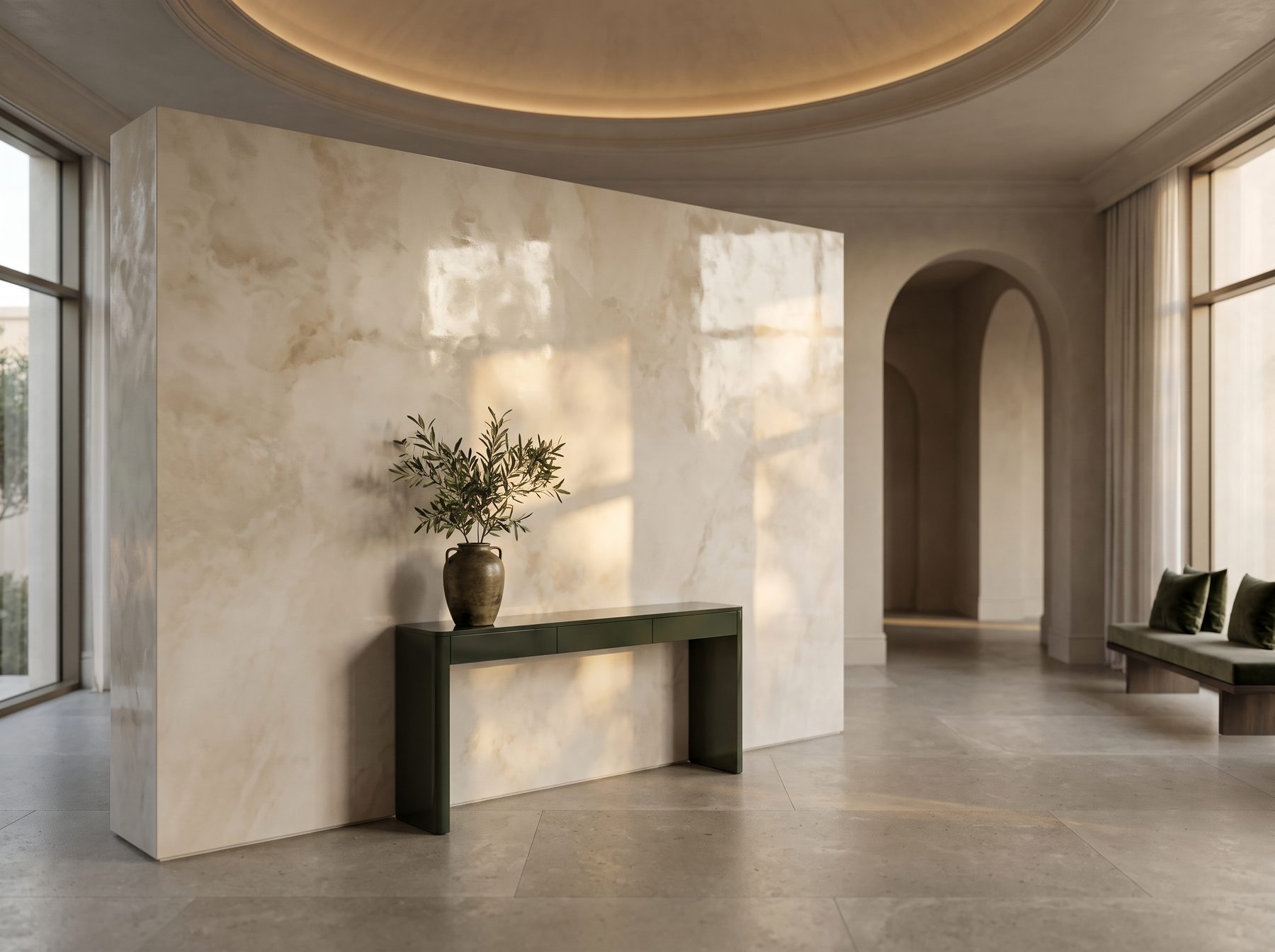
Polished gypsum plaster worked to the cool, deep glow of marble — the wall-scale gypsum marble finish, burnished hot until the surface reads as stone.
What it is
Stucco lustro — also called stucco marmo — is gypsum plaster taken all the way to marble. Fine gypsum, tinted through, is laid in thin tight coats, compressed under the trowel, and then burnished — classically with heated irons pressed over a waxed surface, which is where the lustro, the lustre, is earned. What the wall ends up with is the cool, deep, slightly translucent glow of polished stone: one continuous plane of it, floor to ceiling if the design asks, with no slab joints and no veneer edges.
It lives in a small family of finishes that imitate marble, and the differences decide which one a wall deserves. Its gypsum sibling is Scagliola — and the two divide the craft cleanly. Scagliola draws the stone: pigments are worked into the body and pulled through it so figured veins and even pietra-dura pictures emerge, an artisan panel craft. Stucco lustro becomes the stone’s surface: a calm, cloudy, polished plane — the glow without the drawn figuring, at wall scale. Choose scagliola when you want the vein; choose stucco lustro when you want the light.
The other neighbour is the lime mirror, Stucco Veneziano, which reaches a similar gleam from slaked lime and carbonation, burnished cold under steel. Lime rewards patience — it cures slowly and hardens for months; gypsum sets fast and stable, which is why the gypsum tradition could build its deep, dead-flat polish on large walls, columns and shaped plasterwork on a working programme. And where Marmorino keeps lime matte and cloudy — stone at rest — stucco lustro is stone lit up. To the eye across a room: veneziano reads glassier and cooler, lustro a touch warmer and softer, with the wax remembering the iron.
One honest boundary defines where it belongs: gypsum does not forgive water. This is a finish for dry, conditioned interiors — the formal rooms, the lobby, the columns — and never for a bathroom or splash zone. Where the room gets wet, our answer is Tadelakt or a microcement wet-zone system, and we will say so rather than polish gypsum where it cannot live.
Where it comes from
Polished stucco is old — Roman plasterers were burnishing fine lime to a shine two thousand years ago — but stucco lustro’s particular craft grew up in the Baroque, in the hands of the central-European Stuckateure. Churches and palaces wanted marble on a scale and in shapes no quarry could supply: whole colonnades, curved apses, cornices and altarpieces. Gypsum answered. It set fast, carried colour beautifully, and could be worked over armatures into columns and mouldings — then polished, coat over coat, wax and hot iron, until visitors could not tell the plaster columns from the stone ones. Stucco marmo columns still hold up the look of half the palace halls of Europe, which is its own kind of durability testimony.
The technique survived because the problem it solves never went away: real marble comes in slabs, with joints, weight, and a price that scales with every square metre — and it cannot turn a corner without a cut. A polished gypsum wall is seamless, light, takes any tint the scheme asks for, and flows around curved and classical forms as if the stone had been poured. In the UAE, where formal interiors still speak the classical language — majlis walls, palace-style lobbies, columned entrances — that is exactly the job we bring it out for: the marble effect, at architecture scale, in the rooms where the light deserves it.
Start a project
Considering Stucco Lustro for your space?
Tell us about your project on WhatsApp and we'll take it from there.