
Technologies · Mineral
Limewash
The oldest lime finish there is: slaked lime brushed on thin, drying to a soft chalky matte with cloudy tonal movement. A real breathing mineral colour, not a paint pretending to be one.
What it is
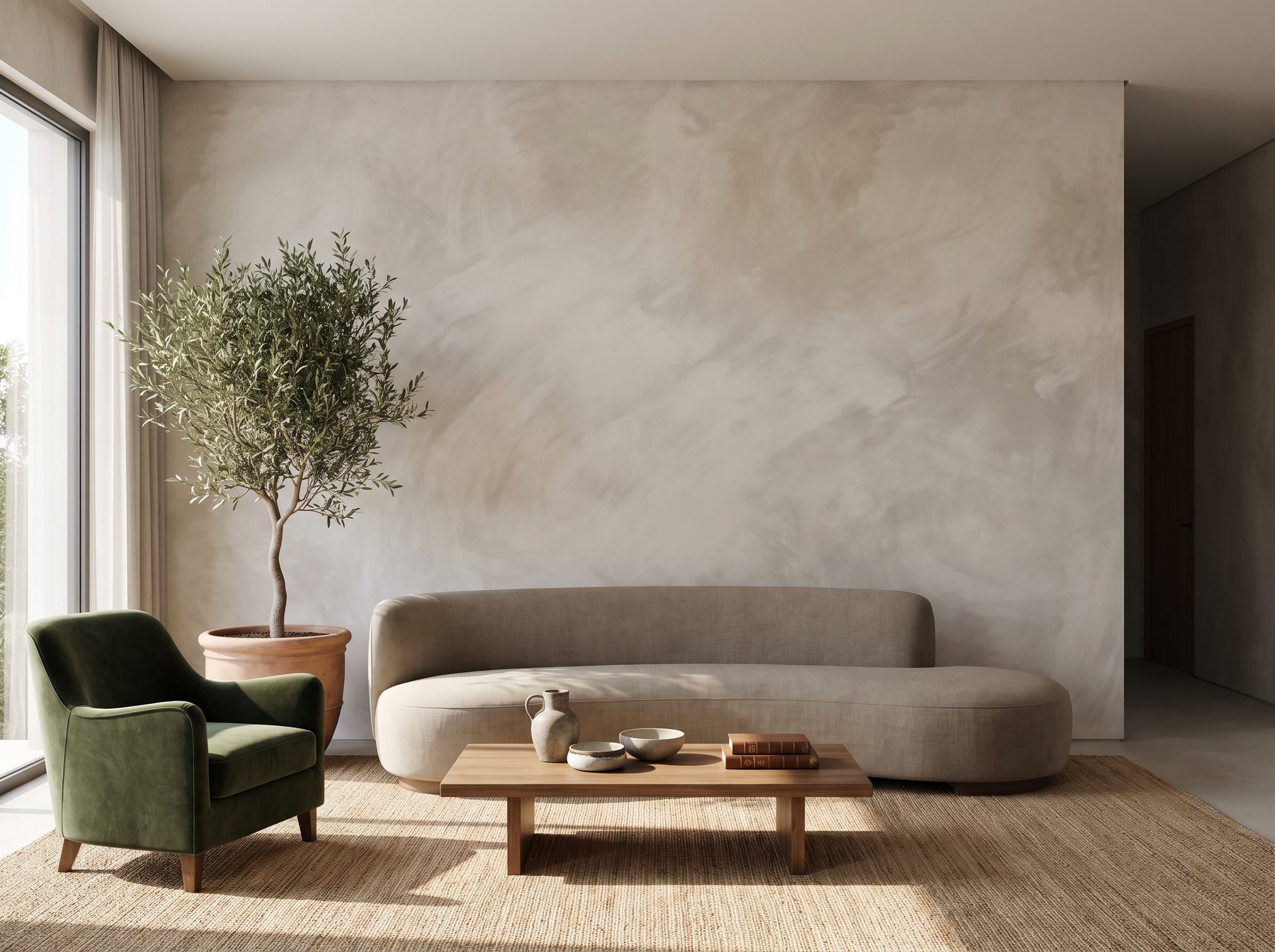
Limewash is the simplest and oldest member of our lime family — slaked lime thinned with water, tinted with mineral pigment, and brushed onto a wall in thin coats. It dries to a soft, chalky matte with a cloudy movement in the colour: pale and deep drifting gently across the same wall, so the surface breathes rather than sitting dead-flat the way ordinary emulsion does. It is a colour you can almost feel is mineral. There is no plastic film on the wall, no sheen, nothing to reflect — just pigment held in lime that is slowly turning back into stone.
That cloudiness is not a defect to be evened out; it is the entire reason to choose limewash. As the lime carbonates it does so a little unevenly, and the brush leaves its own soft record, so light moving across the wall through the day finds depth in what looks, at a glance, like a single quiet colour. It is the same slaked lime that underpins Grassello di Calce and every richer Venetian finish — only brushed on as a wash instead of trowelled on as a plaster. That makes it the most affordable and the most understated way into real lime.
It is worth being precise here, because this is the one finish people most often confuse with an imitation. Our Texture Paints include a limewash-effect option — an acrylic paint engineered to mimic this cloudy movement, and a genuinely good choice on a ceiling, a back wall or a fast fit-out where a mineral finish would be overkill. But it is a plastic film imitating lime. Limewash is the lime: breathable, mineral, alkaline, carbonating. If you want the look for the least money and effort, the effect paint is the honest answer and we will say so. If you want the real thing — a wall that breathes, that ages, that has the faint chalky depth no acrylic quite reaches — that is this page. And where Marmorino and grassello give you lime with body, polish and weight, limewash gives you lime at its most bare and matte. Same material, opposite end of the range.
Where it comes from
Limewash is about as old as painted walls get. For thousands of years, around the Mediterranean and far beyond, the default way to colour a building was to slake lime, thin it, and brush it on — cheap, available everywhere, and quietly practical. The alkalinity kept mould and insects off, the whiteness bounced heat and light, and a fresh coat every so often kept a village looking cared for. The white hill towns of Greece and southern Italy, the courtyards of the Levant and North Africa, the old farm walls of Europe — that particular soft, living white is limewash, not modern paint.
What makes it worth specifying today is exactly what made it ordinary then: it is real. In an age of sealed acrylic walls, a breathing mineral surface with genuine tonal depth has become the quiet luxury, which is why limewash has come back through the wabi-sabi and Mediterranean interiors that value materials honest about what they are. The honest case for it in the UAE is narrow but real. On the right wall — a bedroom, a hallway, a sheltered courtyard, a restaurant that wants atmosphere over polish — it gives a softness and depth that no emulsion reaches, and being breathable it suits older or damp-prone substrates that should never be sealed under plastic. On the wrong wall it is a poor choice, and we would rather tell you: a splash-zone bathroom, a scrubbed kitchen wall, a high-traffic corridor where sleeves brush past all day want a sealed, wipeable surface, not a chalky mineral wash. Choose it for the walls you live beside, not the ones you lean on.
Start a project
Considering Limewash for your space?
Tell us about your project on WhatsApp and we'll take it from there.