
Technologies · Specialty
Metallic Plasters
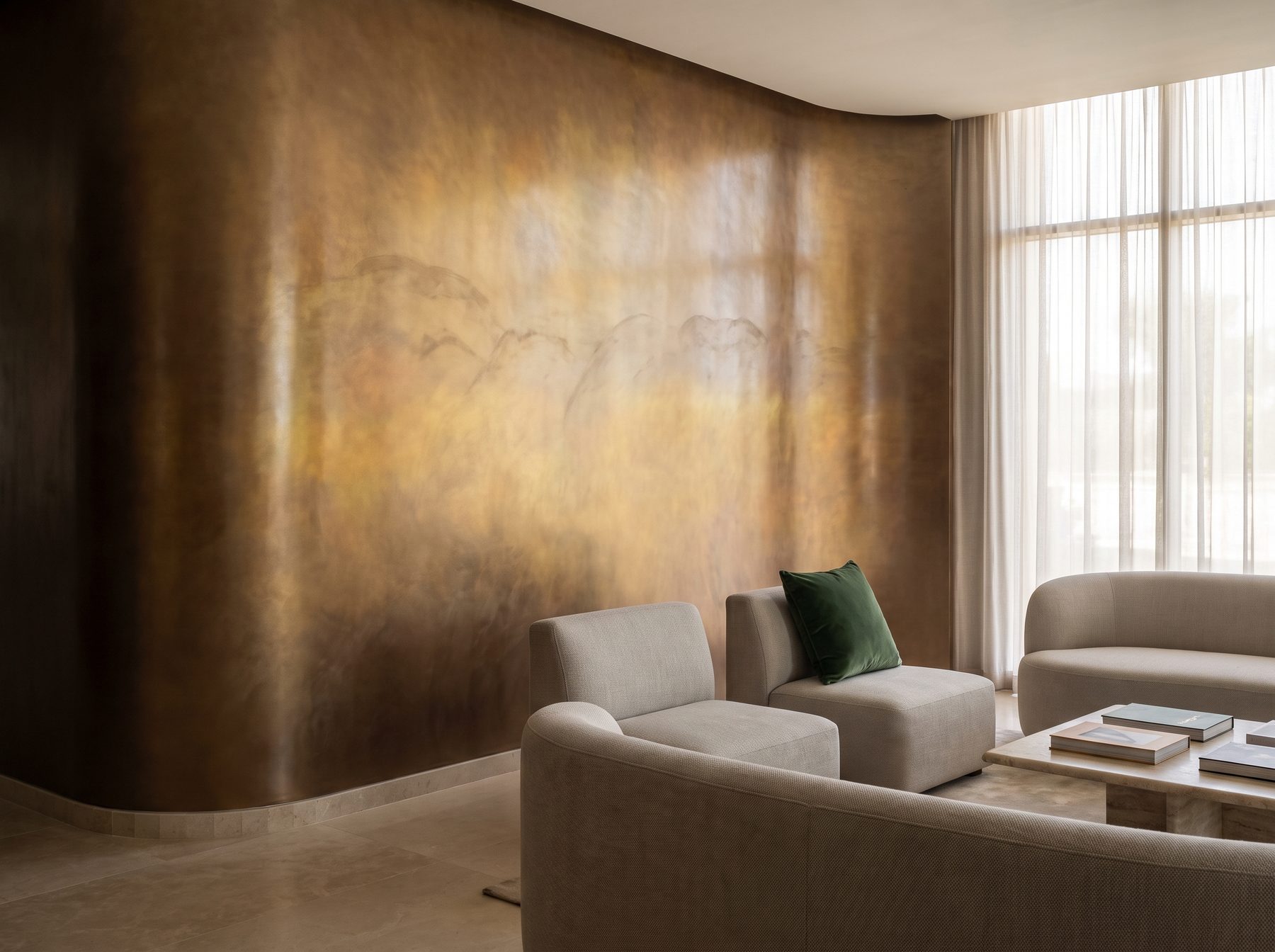
Decorative plasters loaded with mica and metallic pigment, trowelled so the shimmer drifts across the wall — a surface that reads champagne from one side of the room and bronze from the other.
What it is
Metallic plasters are decorative plasters with mica in them. The flakes are microscopically thin, coated in metal oxide, and they lie flat in the plaster as the trowel passes — so instead of a wall that simply is a colour, you get a wall that hands light back. Where the flakes catch a window they flare bright; where they turn away they fall into a deeper tone. Walk past one and the wall follows you, drifting from champagne to pewter, or from a warm glow into bronze shadow.
That drift is the whole reason to choose the family. Every finish is trowelled by hand, so the movement in the shimmer is a record of how the blade travelled — soft cloudy pooling, or a directional sweep, depending on what the wall is meant to do. The tonal range runs from barely-there champagne through pewter and graphite to full warm gold, and the same material can be laid whisper-quiet or frankly theatrical.
It is worth being precise about what this is not, because three of our other surfaces get confused with it. It is not Liquid Metal: that is genuine bronze, copper or iron spread over the surface and burnished or patinated, and it has a density and a gravity that pigment cannot imitate — if you want real metal, take the real metal. It is not Metallic Epoxy, which uses a related pigment but is a poured resin floor; this is a trowelled plaster for walls, and the two are not interchangeable. And it is not Velvet & Suede Effects, which also change with the light but do it through a soft fabric-like nap — those go matte and textile; these go bright and mineral. Against Stucco Veneziano, the difference is where the depth comes from: Venetian earns its glow from burnished lime and translucency, while a metallic plaster earns its glow from the flake. One looks like polished stone. The other looks like light.
Where it comes from
Putting metal on a wall is an old ambition and, for most of history, an expensive one. Gilding meant beating real gold thin enough to lay leaf by leaf, which is why it stayed in palaces and places of worship and why, done properly, it is still priced like the craft it is. The decorative plaster tradition spent centuries reaching for the same effect by other means: marble dust burnished until it gleamed, waxes and glazes worked over lime to fake a sheen the material didn’t naturally have.
What changed things was pearlescent pigment. Once mica could be reliably coated with metal oxide, mid-twentieth century, the shimmer stopped depending on precious metal or on the patience of a gilder — it could simply be stirred into a binder and trowelled on. Italian decorative houses took it up quickly, and the metallic plasters became a fixture of hotel lobbies and boutique interiors worldwide.
We use them the same way we’d use any effect finish: sparingly, and where the light will do the work. A metallic plaster needs something to react to — a window, a wash of concealed lighting, a lamp grazing down the wall. Put it in a flat, evenly-lit box of a room and you have spent a premium on what will read as beige. Put it where light rakes across it, and it earns every dirham. Knowing which wall in a villa is which is the part of this we actually get paid for.
Start a project
Considering Metallic Plasters for your space?
Tell us about your project on WhatsApp and we'll take it from there.