
The best gym flooring in Dubai is rubber — but which rubber depends on the gym. A commercial gym usually takes rubber rolls across the training floor and thick interlocking rubber tiles under the free weights and lifting platforms. A home gym in a villa, a roof-terrace training corner or an outdoor gym in a compound is where a seamless poured rubber floor makes sense: no joints, no curling tile edges, and it takes the sun. Hard floors — porcelain, marble, epoxy, microcement, wood or laminate — are the wrong choice anywhere weights get dropped.
A word on who is writing this. RBS pours seamless rubber floors — the same wet-pour surface we lay for play areas and pool edges — along with microcement, lime plasters and resin bound stone. We do not sell or lay rubber rolls, interlocking gym tiles, mats or vinyl sports flooring. For those, a specialist gym-flooring supplier is the right call, and we will say so if that is what your gym needs.
What is the best flooring for a gym?
Rubber, in one of three forms: rolls, tiles or poured. All three absorb impact, protect the slab and the equipment, grip under sweaty feet and soften the noise. They differ in how they are made and fitted, and that decides where each one belongs.
| Gym | The usual right floor | Why |
|---|---|---|
| Commercial gym, hotel or building gym | Rubber rolls across the floor, thick rubber tiles in the free-weight zone | Fast to fit over large areas; worn tiles can be swapped one by one |
| Heavy lifting area (deadlifts, Olympic lifts) | A lifting platform with thick rubber tiles or a platform build-up | Barbells dropped from overhead need more cushion than any general floor gives |
| Villa home gym | Poured rubber, or thick rubber tiles if the room may change use | Seamless, quiet, kind to knees; tiles can be lifted and moved |
| Apartment home gym | Thick rubber tiles or mats over the existing floor | Easy to remove when you move out; check your building’s renovation rules first |
| Outdoor gym corner, roof terrace, compound fitness area | Poured rubber | Seamless, drains through the base, no tile edges to lift in the heat |
| Yoga, Pilates or dance studio | A PU comfort floor, sports vinyl or a sprung timber floor | Smooth and slightly giving for bare feet; heavy weights stay elsewhere |
Rubber gym tiles, rolls and mats: what is the difference?
Rolls are long sheets for big areas, tiles are thick squares for heavy zones, and mats are loose pieces you put down yourself.
- Rubber rolls come off a reel and are glued or laid loose across a training floor — the economical way to cover a large gym with few seams. They suit cardio, functional training and machine zones, but are usually too thin on their own under heavy free weights.
- Interlocking rubber tiles are thicker squares that lock together. They go under racks, benches and free weights, and a damaged or stained tile can be lifted and replaced.
- Rubber mats are loose pieces — under a treadmill or a squat rack. They protect a floor without changing it: the answer in a rented flat.
The weak point of all three is the joint: seams can open in a room left to heat up in summer, edges can lift, and sweat and dust collect in the gaps. In an air-conditioned commercial gym that is manageable, and swapping one tile outweighs it.
Poured rubber gym flooring: when a seamless floor makes sense
Poured rubber is laid wet on site and trowelled into one continuous, cushioned floor with no joints at all. It is built in two layers: a cushioning layer of coarse rubber granules, then a coloured wear layer of finer EPDM granules bound in polyurethane. How it goes down, stage by stage, is set out on our rubber flooring in Dubai page.
Where it wins in a gym:
- Home gyms in villas. One seamless, quiet floor wall to wall, with no edges to curl, and kinder to knees than any hard floor.
- Outdoor training areas. A compound fitness corner, a roof terrace with a rack and kettlebells, a garden with a pull-up station. Loose tiles outdoors lift, shift and trap sand; a poured floor stays put. Choose calm, darker colours — bright reds, greens and blues fade in the UAE sun, while greys, blacks and earth tones age far better.
- Odd shapes. A curved terrace or a room with columns: a poured floor follows the shape; tiles have to be cut.
Where it does not win, and we will tell you so:
- Very heavy point loads. A floor that is soft enough to cushion a fall is also soft enough to dent under very heavy racks and machines standing on small feet. Spreader plates under the feet help; for a full commercial machine floor, rolls and tiles are the better product.
- Heavy barbell drops. Deadlifts and Olympic lifts dropped from overhead need a dedicated lifting platform. Do not ask any general floor, poured or not, to take that job alone.
- A room you may convert later. Poured rubber is a permanent floor. If the gym may become a bedroom in two years, tiles that lift out are the honest choice.
A denser build-up takes a dropped dumbbell without cratering. The right thickness is set by what will be dropped and how heavy the equipment is, so tell whoever quotes you exactly what is going in.
Home gym flooring in a Dubai villa or apartment
In a villa, poured rubber or thick rubber tiles; in an apartment, tiles or mats that leave the existing floor untouched.
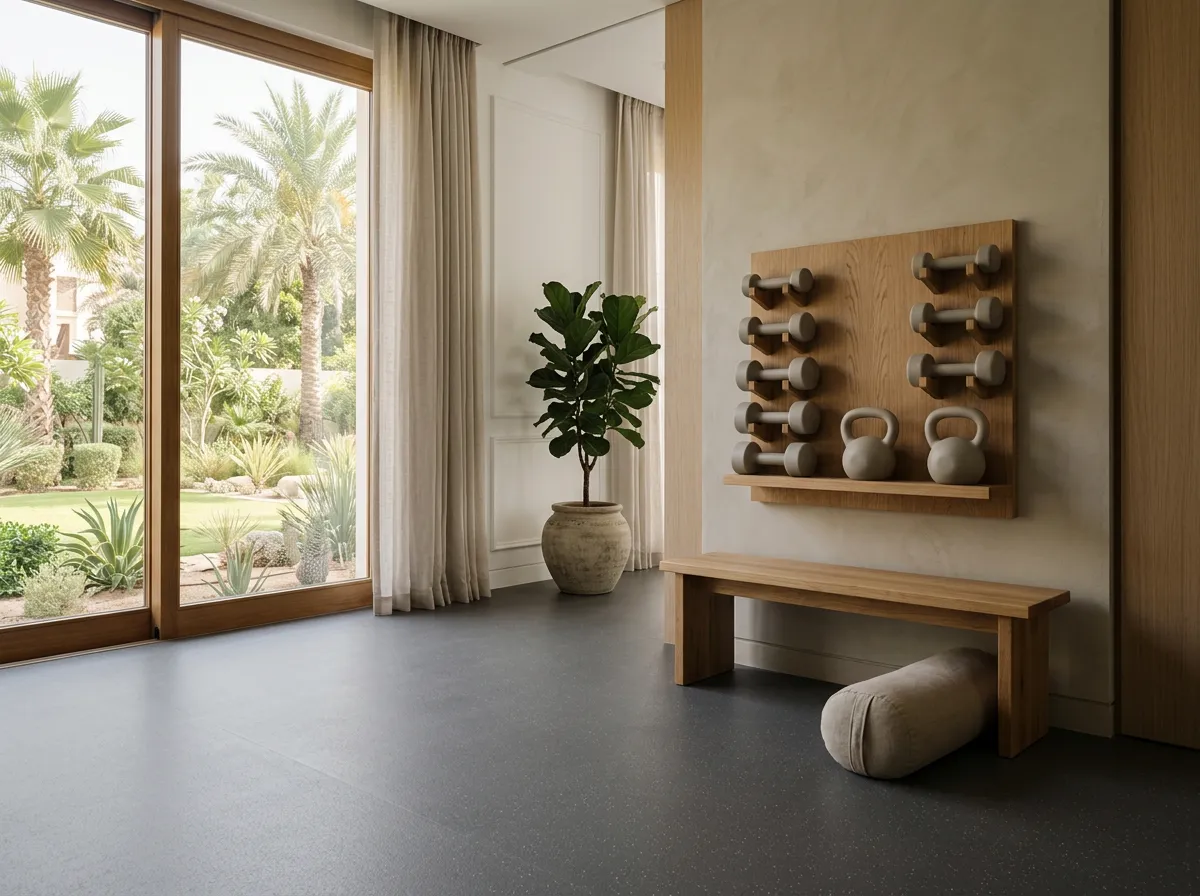
A villa home gym is usually a converted room, a basement, a garage or a roof terrace. Before any floor goes down, check that the slab is sound and dry, the room is properly air-conditioned, and the door thresholds still work with the new floor height.
An apartment home gym has two extra questions. The first is your neighbours: dropped weights and treadmills carry through a concrete slab, and rubber is the only floor that genuinely softens that — see quiet floors for how the other seamless floors compare. The second is the building: many towers have rules for renovation works and heavy equipment, so ask your building management before you start. Loose rubber tiles or mats over the existing tiles are often the simplest answer, because they leave with you. If you are changing more of the flat, our apartment renovation guide covers what to keep and what to replace.
Outdoor gym flooring in the UAE heat
Outdoors, the floor has to survive sun, sand, heat and the odd winter downpour as well as the training. Poured rubber is the usual seamless choice: it drains through to a base that falls away from the building, has no joints to open in the heat, and stays soft for push-ups and stretching. Two honest trade-offs: dark rubber in full summer sun gets hot to touch — shade or a lighter tone helps — and colours soften over the years.
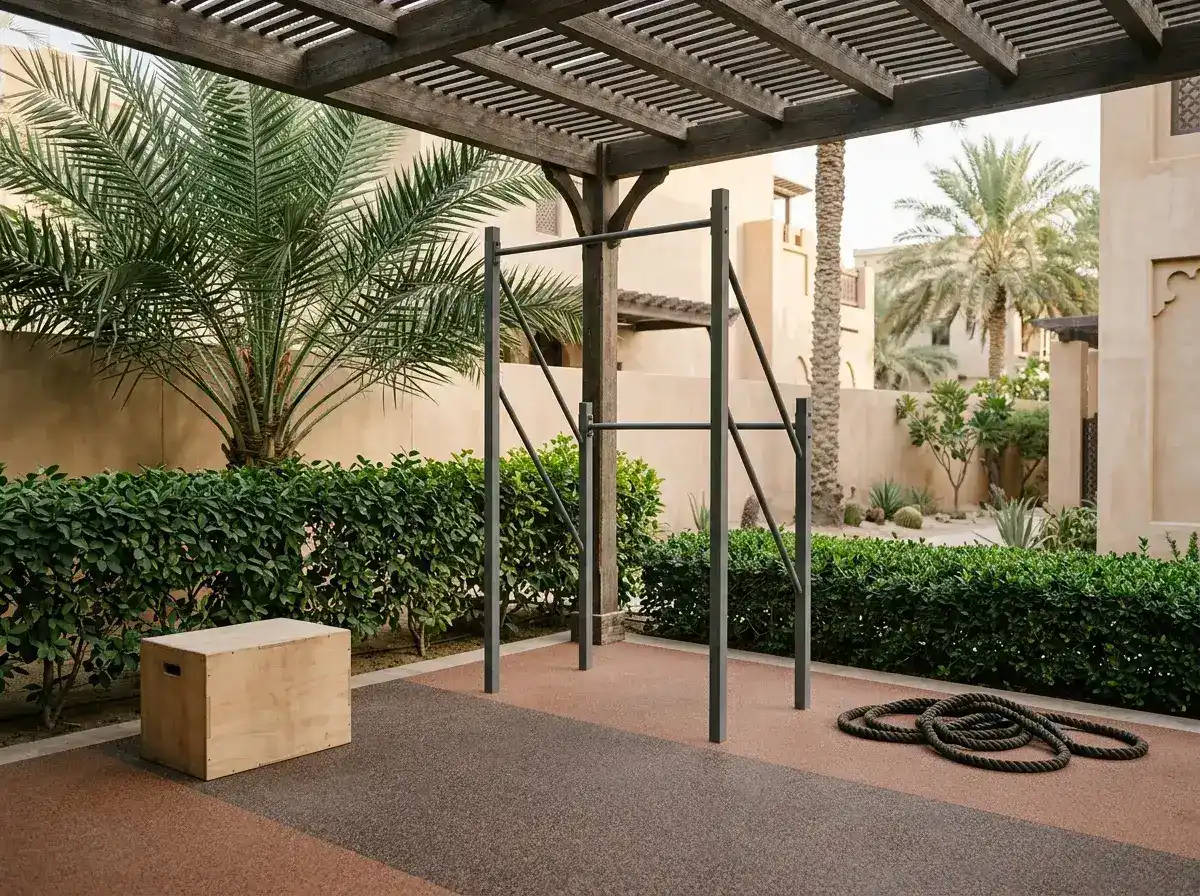
Artificial grass is the other common outdoor gym floor, and it suits sled pushes and agility drills; how grass, poured rubber and resin bound compare in a garden is in our artificial grass vs rubber vs resin guide. For the paths and terraces around the gym, our outdoor flooring guide compares tiles, pavers and seamless floors.
Which floors fail in a gym?
Every hard floor fails the same test: a dropped weight. That includes the beautiful ones.
- Porcelain and ceramic tiles crack or chip under a dropped dumbbell, and a cracked tile is a sharp edge under bare feet. Our ceramic vs porcelain tiles guide covers where tiles do belong.
- Marble and natural stone chip, crack and stain with sweat and chalk.
- Microcement is not a gym floor. It is a thin decorative finish for homes and normal-use rooms, not for heavy use, dropped weights or equipment dragged across it. We say the same in our microcement pros and cons.
- Epoxy is tough against wear but hard, loud and slippery when sweaty, and a dropped plate can chip it. Its softer cousin, PU, is used in studios — see PU vs epoxy.
- Wood, laminate and SPC dent under weights, and laminate and SPC are not built for impact. They suit a yoga corner, not a rack — see our wooden flooring and vinyl, SPC and LVT guides.
- Carpet traps sweat, gives no stable footing and is crushed by equipment (carpet in Dubai covers where it does belong).
None of these are bad floors — just the wrong floors for a gym.
The honest comparison
| Rubber rolls | Interlocking rubber tiles | Poured rubber | PU comfort floor | Hard floors (tile, stone, epoxy, microcement) | |
|---|---|---|---|---|---|
| Joints | Few seams | Many joints | None | None | Grout lines or none |
| Dropped dumbbells | Light weights | Yes, in thicker tiles | Yes, in a denser build-up | No | No — they crack or chip |
| Heavy barbell drops | No | Only on a lifting platform | Only on a lifting platform | No | No |
| Very heavy machines | Yes | Yes | Use spreader plates | Light equipment only | Yes, but loud and hard |
| Outdoors in UAE sun | Edges lift | Edges lift, traps sand | Yes, choose calm colours | No | Tiles and stone yes, others no |
| Repairs | Cut out and patch | Swap one tile | Patch the area (reads newer at first) | Specialist repair | Replace tiles or re-coat |
| Removable later | Yes | Yes | No | No | No |
| Who fits it | Gym-flooring supplier | Gym-flooring supplier | A poured-rubber contractor (RBS does this) | A resin-floor contractor | Tile or flooring contractor |
Which one should you choose?
- Running a commercial or building gym? Rubber rolls across the floor, thick tiles under the free weights, a proper lifting platform for barbells. Talk to a gym-flooring supplier; that is not our product.
- Building a home gym in a villa? Poured rubber for one seamless, quiet floor, or thick tiles if the room may change use. Plan spreader plates under the heaviest rack.
- Training in an apartment? Thick rubber tiles or mats over the existing floor, after checking the building’s rules.
- Training outdoors? Poured rubber, in a calm colour, on a base that drains — with shade if you can.
- Yoga, Pilates or dance only? A smoother, slightly softer floor: a PU comfort floor, sports vinyl or timber. Rubber can feel too grippy for barefoot turns.
What does gym flooring cost in Dubai?
Poured rubber is priced per project after a site visit, because the cushioning thickness — set by what will be dropped and how heavy the equipment is — drives the cost more than the area does. Rolls, tiles and mats are priced by gym-flooring suppliers by product and thickness.
To get a quote for a poured rubber home gym or outdoor training area, send a few photos, the rough size and a list of the equipment going in on WhatsApp, or call +971 4 587 7086. We will tell you honestly whether poured rubber is right, or whether tiles from a supplier would serve you better.
Related guides
- Rubber Safety Flooring: Where It Belongs in the UAE
- Quiet Floors: Which Seamless Surfaces Are Kind to Your Ears?
- Cork Resin vs Rubber Safety Surfacing: What’s the Real Difference?
- PU vs Epoxy Flooring: What’s the Real Difference?
- Artificial Grass vs Poured Rubber vs Resin Bound in UAE Gardens
FAQ
What is the best flooring for a home gym?
Rubber. In a villa, a seamless poured rubber floor or thick interlocking rubber tiles; in an apartment, tiles or mats over the existing floor so they leave with you. Rubber cushions dropped weights, protects the slab, grips under sweaty feet and cuts the noise that reaches the neighbours.
Can poured rubber take dropped weights?
Dropped dumbbells, yes, when the build-up is made denser for a gym — that is decided at the site visit from the equipment list. Barbells dropped from overhead need a dedicated lifting platform, and very heavy racks and machines need spreader plates under their feet so they do not dent the floor.
Can you use microcement or epoxy for a gym floor?
Microcement, no — it is a thin decorative finish for homes and normal-use rooms, and dropped weights and dragged equipment will damage it. Epoxy is tough against wear but hard, loud and slippery when sweaty, and a dropped plate can chip it. For a training floor, rubber is the honest answer.
Is rubber gym flooring good outdoors in the UAE?
Poured rubber is, because it has no joints to lift in the heat and drains through to its base. Loose tiles outdoors tend to shift and trap sand. Expect dark colours to get hot in full summer sun and bright colours to fade over the years; calm greys, blacks and earth tones age best.
How thick should gym flooring be?
It depends on what will be dropped. Cardio and machine areas need far less than a free-weight zone, and Olympic lifting needs a platform. Give whoever quotes you the heaviest weight that will be dropped and from what height, and ask what that thickness is rated for.
Does RBS supply rubber gym tiles or mats?
No. We pour seamless rubber floors on site; we do not sell or lay rolls, interlocking tiles, mats or sports vinyl. For a commercial gym fit-out, a gym-flooring supplier is the right call. For a seamless home or outdoor gym floor, message us on WhatsApp.
Get an exact price
Tell us about your space.
Send a few photos and rough sizes on WhatsApp — we'll come back with a real number.