
Technologies · Composite
Acid-Stained Concrete
Translucent colour that reacts into the slab itself — acid stains, water-based stains and dyes turning grey concrete into variegated, organic tones that are never the same twice.
What it is
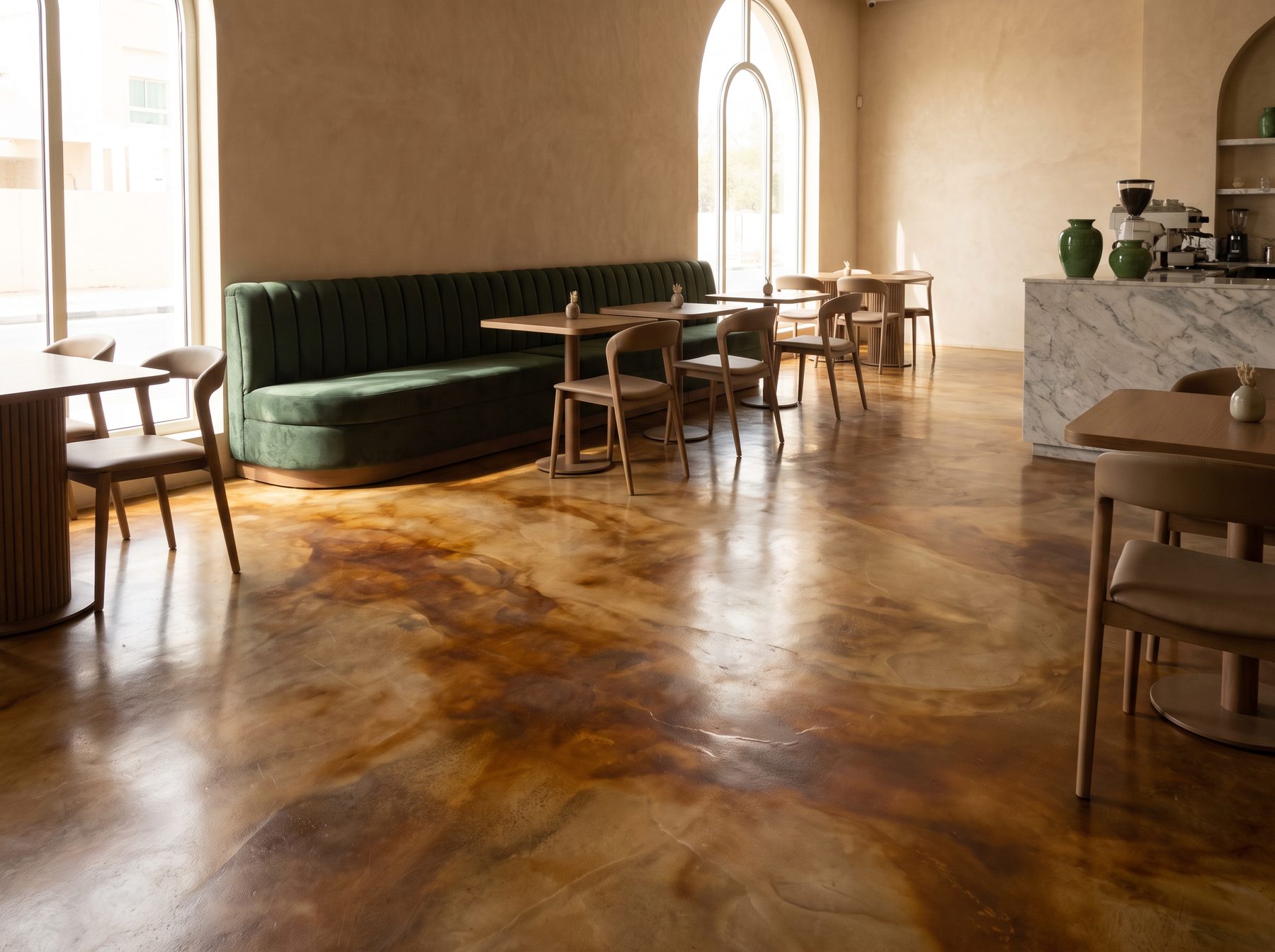
Acid staining is colour as a chemical event. A solution of metallic salts in a mild acid is worked over cured concrete; the acid opens the surface and the salts react with the lime in the slab, growing translucent mineral colour inside the concrete itself — ambers, tans, umbers, soft blue-greens. Because the colour is a reaction rather than a coating, it pools, drifts and mottles with the slab’s own character. The result reads like polished stone or old leather: organic, variegated, and never the same twice. Alongside the true acid stains sit their modern companions — water-based stains and penetrating dyes — which trade the reaction’s drama for a wider palette and more even, controllable colour.
The honesty this finish demands is simple: the slab is the author, we are the editors. An acid stain reacts with whatever the concrete contains, so every patch, glue residue, old sealer and trowel pass leaves its signature in the final colour. On a characterful old slab that is the whole magic; on a badly patched one it is a documentary you may not want. We sample on the actual floor before anyone commits, and if the slab cannot carry it we will say so — a damaged floor is better served by an overlay or Microcement than by a stain that will faithfully exhibit every scar. The finished floor also needs sealing to hold its colour, and re-sealing as the years and the Gulf sun demand.
Two neighbours frame it. Dyes are the natural partner of Polished Concrete, carrying colour into a floor that is then ground and burnished. And Integral-Coloured Concrete is the opposite philosophy: pigment mixed through the pour, giving even, predictable colour to the whole depth of new concrete — colour through the mix, versus colour reacted into the surface of a slab that already exists. New pour, choose integral; existing slab wanting soul, stain it.
Where it comes from
The craft is an American accident turned trade. Early in the twentieth century, chemists noticed that certain metallic salt solutions left permanent, marbled colour on concrete floors; by mid-century, stained concrete had become the signature of patios and courtyards across the American Southwest — a hot, bright, dusty climate not unlike ours. The technique spread wherever plain slabs outnumbered beautiful floors, which is to say everywhere.
In the UAE that is exactly the opportunity: a country full of sound, grey, characterless concrete — villa terraces, courtyards, warehouses turning into showrooms. Staining is how a slab you already own becomes a floor with a past, applied by our own in-house crews, sampled honestly before a drop of acid touches the wider floor.
Start a project
Considering Acid-Stained Concrete for your space?
Tell us about your project on WhatsApp and we'll take it from there.